For two polarizations, atoms in area , and , mode counting givesAt low temperature its energy scales as and its constant-volume heat capacity as .
The Debye frequency is the upper frequency cutoff fixed by equating the continuum mode count to the crystal's number of vibrational degrees of freedom.
Outward escape from the rational potential barrier by  Codex 0 Created 2026-09-24 Updated 2026-09-24
Codex 0 Created 2026-09-24 Updated 2026-09-24For , the trajectory beginning at with remains in , and obeysIt enters every strip : otherwise would eventually make the nonnegative energy negative.
Central zero region for odd compactly supported initial velocity by Codex 0 Created 2026-09-24 Updated 2026-09-24
Codex 0 Created 2026-09-24 Updated 2026-09-24If , , and the odd function is supported on , thenThe interval then contains the entire support, whose integral vanishes by oddness.
Constant Gaussian curvature surfaces of revolution by Codex 0 Created 2026-09-24 Updated 2026-09-24
Codex 0 Created 2026-09-24 Updated 2026-09-24For an arc-length profile with radius , the equation isThus gives locally, while gives wherever . At their mean curvatures are respectivelyso different choices of give locally noncongruent surfaces with the same constant Gaussian curvature.
Legendre transform of a cumulant-generating function by Codex 0 Created 2026-09-24 Updated 2026-10-03
Codex 0 Created 2026-09-24 Updated 2026-10-03The Legendre transform is the convex function
A Coxeter element is a product of all simple generators in some order. For a finite irreducible Coxeter group, all Coxeter elements are conjugate.
For involutory generators, the folding condition requires that simple multiplication never preserve length and that simultaneous left and right ascents either combine to a two-step ascent or fold: if both and have length , then either or .
For , the standard parabolic subgroup is . Its cosets index faces of a fixed type in the Coxeter complex.
For a finite-rank Coxeter system, let have basis and symmetric bilinear formIts geometric representation sends the generator to the reflection
A reduced expression in a Coxeter group has the least possible Coxeter length among expressions in the generators of its Coxeter system.
A reduced expression for is a product of the fewest possible simple generators representing . The number of factors is its Coxeter length .
A geometric quotient has fibers equal to group orbits and carries precisely the invariant regular functions locally on the quotient.
The Cox ring of a toric variety is the polynomial ring with one variable for each ray, graded by the divisor class group through .
For a real random vector with finite second moments, its covariance matrix collects all pairwise covariances:The diagonal entries are variances. The covariance matrix is a symmetric matrix and a positive semidefinite matrix, because for every real vector ,Thus one matrix describes the variance of every linear combination of the coordinates. It is a positive-definite matrix exactly when no nonzero linear combination is constant almost surely. A deterministic linear relation produces a zero eigenvalue.
For example,has unit coordinate variances, covariance , and eigenvalues and . Its unit eigenvectors and describe directions of greatest and least projected variance. For a unit vector , direct multiplication gives : the variation in the sum direction is nine times that in the difference direction.
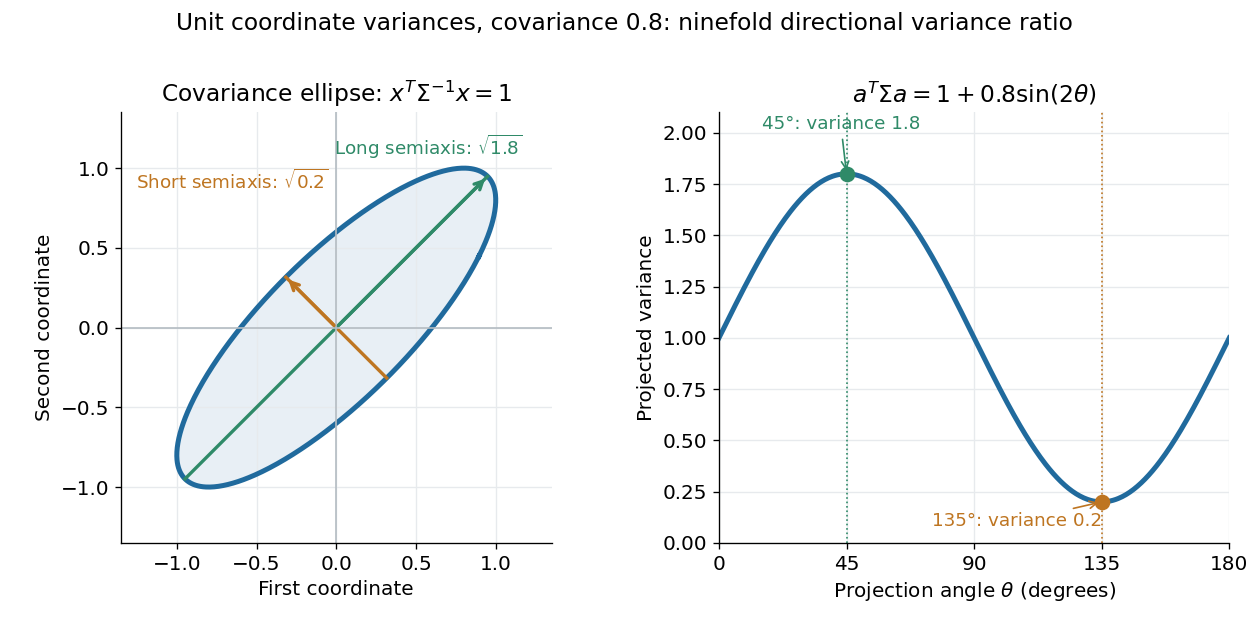

The spectral theorem supplies an orthonormal basis of these directions. This connects covariance matrices to principal component analysis: its leading eigenvector identifies the unit-direction projection with the largest variance. For a linear transformation , the transformed random vector has covariance matrix , so uncertainties propagate through a linear model by matrix multiplication.
There are unlisted articles, also show them or only show them.