If every transition transfers individuals between compartments without births, deaths, immigration, or emigration, the sum of all compartment sizes is constant.
For an ideal of a commutative ring , reducing coefficients modulo is a surjection with kernel . Hence
Module theory studies abelian groups with scalar multiplication by a ring. It extends linear algebra: a module over a field is a vector space, while ring scalars let the same language describe integer arithmetic and linear operators. The new phenomena are visible before any abstract classification: some nonzero scalars cannot be divided out, some modules have torsion elements of a module, and some have no basis of a module.
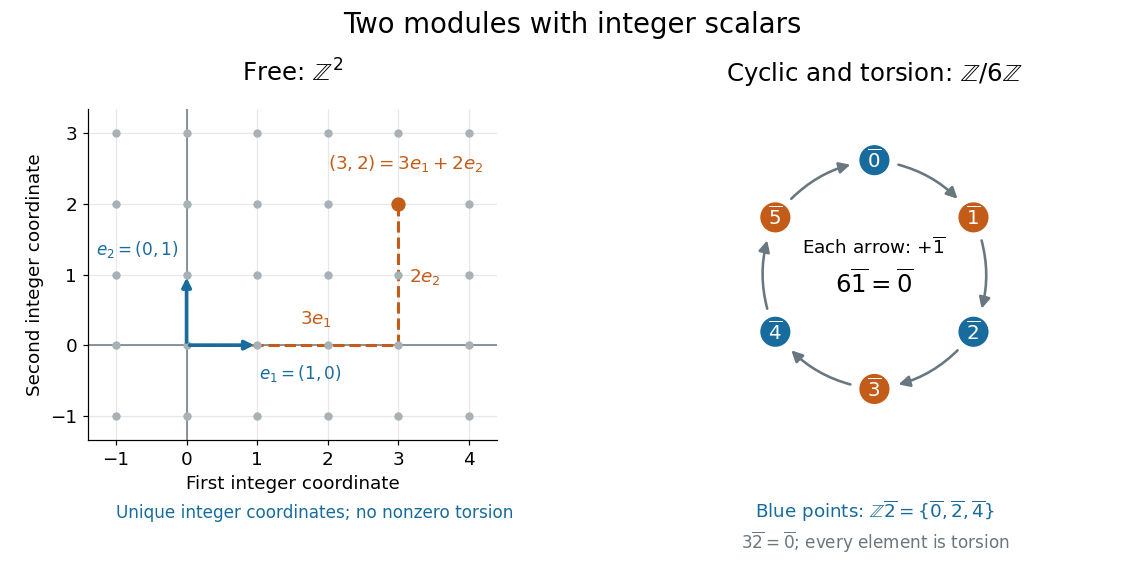

The distinction is useful because an integer relation such as carries information which disappears if one assumes all nonzero scalars have multiplicative inverses. A finitely generated module over a principal ideal domain can be separated into a finite free module and a torsion module; the structure theorem for finitely generated modules over a principal ideal domain unifies the classification of finitely generated abelian groups with the study of linear operators through polynomial rings. See Keith Conrad's Modules over a PID, Theorem 4.1 and the operator applications.
A historical anchor is Emmy Noether's 1921 paper [ref]
https://gdz.sub.uni-goettingen.de/id/PPN235181684_0083. Idealtheorie in Ringbereichen, Mathematische Annalen 83, pages 24–66
. Its first section studies rings and ideals under the condition that every ideal is a finitely generated module over its ring, and connects this to the ascending chain condition; later sections develop primary decomposition. This is an early source for the structural viewpoint underlying Noetherian rings. [ref] makes those statements accessible in English. Odd-valuation obstruction to a rational-function square by  Codex 0 Created 2026-09-24 Updated 2026-09-24
Codex 0 Created 2026-09-24 Updated 2026-09-24For a primitive polynomialif a prime does not divide , divides every for , and has , then is irreducible. If , reduction modulo forces both and to be positive-degree monomials. Their constant terms are consequently divisible by , making , a contradiction. Gauss lemma for polynomials transfers the result between and .
Reduction between quotient rings sends units to units and is surjective when every target unit avoids the same prime factors.
A commutative ring has a nontrivial idempotent exactly when it decomposes as a product of two nontrivial rings. The isomorphism determined by iswith inverse .
An integral domain is a nonzero commutative ring without zero divisors. Equivalently, a product of two nonzero elements is always nonzero. The zero ring is excluded, and fails because . Every field is an integral domain, but the integers show that the converse fails: has no multiplicative inverse in . See MIT's Basic Properties of Rings, definitions 15.9–15.10 and example 15.11.
The practical benefit is multiplicative cancellation. In the integers, has at most one solution and indeed works. Yet has no integer solution. Thus multiplicative cancellation guarantees uniqueness when a solution exists; it does not guarantee division by every nonzero element. Passing to the fraction field supplies the missing solution .
The polynomial ring is also an integral domain. For example, the product of and has leading coefficient and cannot vanish. Generally the leading coefficient of a product is the product of the two leading coefficients; an integral domain prevents that coefficient from vanishing. This connects integer arithmetic to polynomial arithmetic through one reusable principle.
Historically, this connection grew far beyond elementary examples. Keith Conrad identifies the ring of integers of a number field and a ring of polynomial functions on a smooth plane curve as early important examples of Dedekind domains. This shared structure connects number theory with algebraic geometry; see Conrad's Ideal Factorization, section 6.
A ring is a set with two binary operations, addition and multiplication, satisfying three requirements. Under addition, is an abelian group: there is a zero, every element has an inverse element, and grouping or exchanging summands does not change the result. Multiplication is associative and has an identity element , so and . Finally, both versions of the distributive property hold:Here every ring is unital, but the zero ring, with , is allowed. Commutativity of multiplication is an additional condition defining a commutative ring. These conventions agree with [ref].
The integers form a ring with their usual operations. The polynomial ring is another: addition combines coefficients, while multiplication uses the distributive property. For example,The same rules justify symbolic calculations in both rings; this is why one definition can organize apparently different kinds of arithmetic. In every ring, , and . The first identity follows by distributing and subtracting ; the second follows by distributing . Thus familiar sign rules are consequences of the structure.
Order still matters in some rings. In the matrix ring , takeThen matrix multiplication givesNevertheless, matrix multiplication is associative, distributes over addition, and has the identity matrix as its identity element. This is a valid ring. On a column vector, applies first and second: swapping coordinates before discarding the second coordinate differs from doing those actions in reverse. The failure of commutativity records a meaningful difference in function composition.
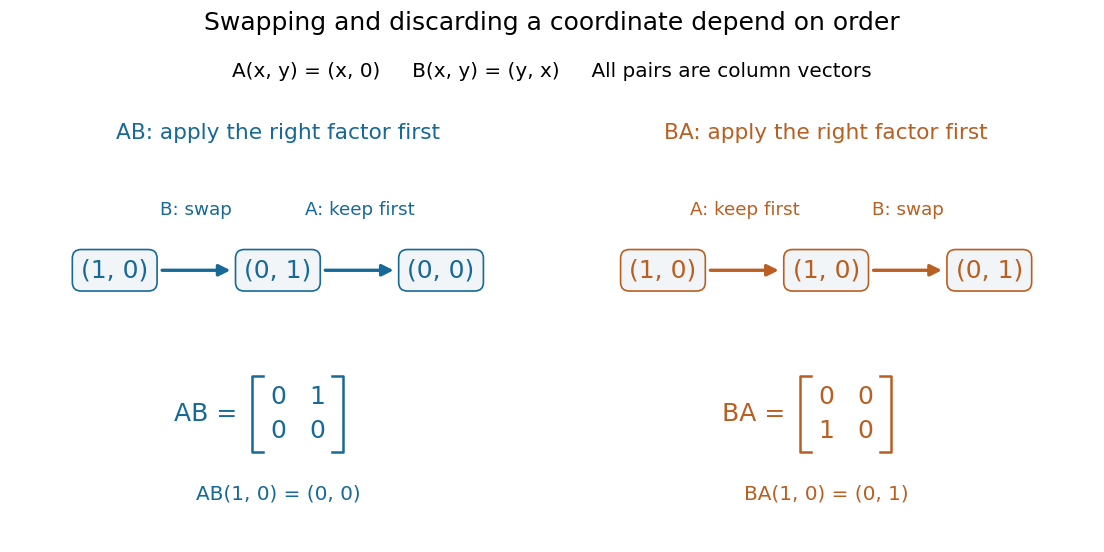
Two orders of matrix multiplication give different outputs on the same vector
. Details. 
A Dedekind domain is a Noetherian integrally closed domain of Krull dimension one. Equivalently, every localization at a nonzero prime ideal is a discrete valuation ring.
There are unlisted articles, also show them or only show them.