The direct method takes a minimizing sequence, extracts a subsequence using compactness, and uses lower semicontinuity to show that its limit attains the infimum.
If a cut joins two poles with opposite residues, every loop avoiding the cut has equal winding number about the endpoints, so the two residue contributions cancel.
Analytic continuation of an integral of a meromorphic function around a closed loop changes its value by times the winding-number-weighted sum of enclosed residues.
For steady incompressible flow with imposed outer pressure gradient,The normal momentum equation makes pressure approximately uniform across the layer.
Balancing with gives .
Magnetization is magnetic dipole moment per unit volume, described by a vector field . Average the microscopic magnetic dipole moments in a small region of volume around the point :The averaging region should contain many microscopic constituents while being small compared with the distance over which the macroscopic magnetization varies. With number density of identical constituents, this becomes . Magnetic dipole moment has SI units , so magnetization has units : amperes per metre. The average is a vector sum, not a sum of magnitudes.[ref]
Magnetization. Classical Electromagnetism: An intermediate level course by Richard Fitzpatrick; Magnetization, equations (856)–(857) and the surrounding averaging definition
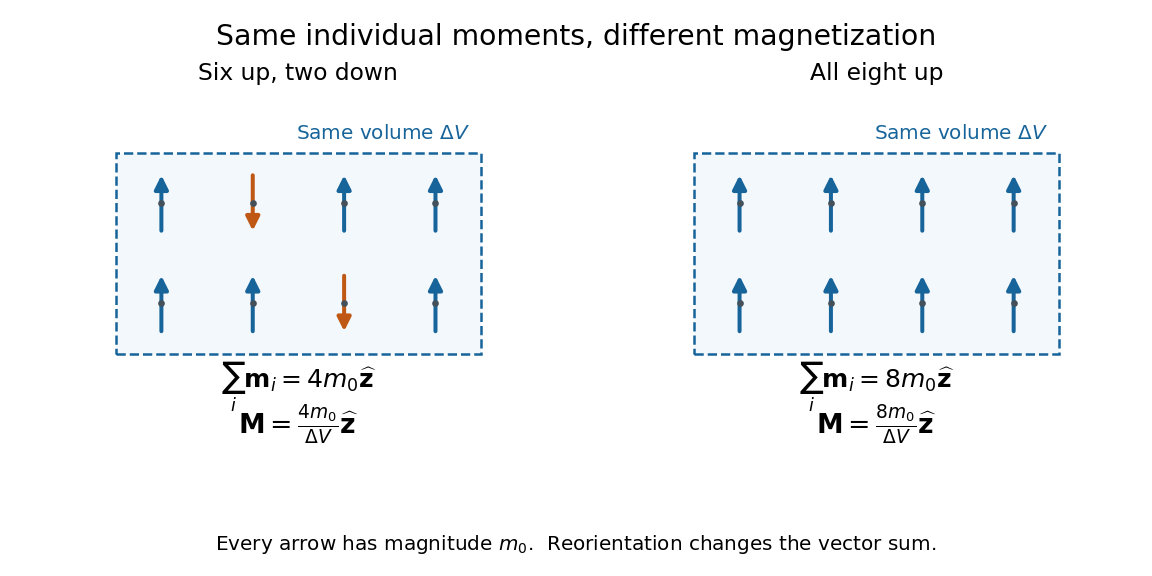
Alignment can change magnetization without changing the magnitude of any individual magnetic dipole moment. In a constructed counting example, eight equal magnetic dipole moments of magnitude occupy the same volume . Six along and two along give ; turning the two opposing magnetic dipole moments to doubles magnetization to . Both arrangements have the same sum of magnitudes, . Changing the individual magnetic dipole moments provides another possible response; their alignment and their magnitudes are distinct ingredients. Microscopic spin contributes magnetic dipole moment without being a literal rotating charged ball.

Distinguish magnetization , magnetic field , and magnetic field intensity . In SI,Here is the vacuum permeability, and denotes the tesla. Magnetization describes matter's magnetic dipole moment density; magnetic field enters the Lorentz force; magnetic field intensity separates the free electric current contribution in the macroscopic equations. In particular, zero applied magnetic field does not generally imply inside a finite magnet: its demagnetizing field depends on shape.[ref]
Magnetization. Classical Electromagnetism: An intermediate level course by Richard Fitzpatrick; Magnetization, equations (860)–(864): current decomposition and definition of H
For stationary electric polarization, magnetization produces bound current in the volume and on its bounding surface:The curl gives a current density in ; is a surface current density in . The unit normal points outward from the magnetized material into a region with zero magnetization. Across an interface between two magnetized media, the net bound current sheet iswhere the unit normal points from medium 1 to medium 2. Both faces contribute: medium 2 has the opposite outward normal vector. This fixes the cross product sign. If electric polarization changes with time, add its contribution to the bound current.[ref]
Permanent Ferromagnets. Classical Electromagnetism by Richard Fitzpatrick; Permanent Ferromagnets, equation (716): volume and outward-surface magnetization currents
A short proof outline explains why both contributions are needed. Write , where is the indicator function of the material's volume. In the sense of distributions, its gradient is , with the surface delta distribution. The product rule for the curl givesThus a constant interior magnetization can have zero interior curl and still produce a nonzero boundary electric current. Equivalently, neighboring ideal microscopic current loops cancel along shared edges while uncompensated edges remain on the outside. This bound current representation predicts the same macroscopic magnetic field as the magnetization distribution; it does not require a wire or free charge transport around the magnet. Its usefulness is that the familiar Biot-Savart law can now calculate the magnetic field from a specified magnetization.
A time-dependent average magnetization need not vary smoothly under a smooth drive. The Barkhausen effect resolves collective jumps through their induced electromotive force; Barkhausen pulse area explains how that derivative readout relates to the underlying change.
The critical dimension is the target-spacetime dimension in which quantum anomalies obstructing Lorentz or Weyl symmetry cancel. It is 26 for the bosonic string.
Here critical means cancellation of the string’s quantum anomalies; it does not mean the upper or lower critical dimension of a phase transition.
The Fourier modes and of the transverse closed-string coordinates obey harmonic-oscillator commutation relations. Modes with negative index create string excitations.
The Polyakov action introduces an independent worldsheet metric :Its metric equation makes conformal to the induced worldsheet metric, reducing it classically to the Nambu–Goto action.
Product-state factorization of measurement probabilities by  Codex 0 Created 2026-09-24 Updated 2026-09-24
For two labelled orthonormal bases, the event of equal labels is represented by .
The Bondi news is the retarded-time derivative of the leading asymptotic shear and measures outgoing gravitational radiation at null infinity.
Expanding an angular distribution in multipoles converts the Boltzmann equation into a hierarchy in which free streaming couples neighboring multipoles and collisions damp or source selected moments.
The delta-comb Kronig-Penney potential is
Floquet matrix for a one-dimensional periodic potential by Codex 0 Created 2026-09-24 Updated 2026-10-13
Codex 0 Created 2026-09-24 Updated 2026-10-13For a potential of period , the Floquet matrix maps Cauchy data through one cell:For a real Schrodinger equation, .
The nearly-free electron model treats a weak periodic potential by degenerate perturbation theory. At a Bragg crossing, a Fourier coefficient couples the two degenerate plane waves and opens an energy gap of width .
There are unlisted articles, also show them or only show them.