An abstract simplicial complex is a pair , where is a set of vertices of a simplicial complex and is a collection of finite nonempty subsets, called simplexes. Every singleton belongs to , and every nonempty subset of a simplex is a simplex. Its dimension is the supremum of over . Some conventions also include an empty simplex; it contributes no points to the geometric realization.
For a simplex in a simplicial complex , its link consists of the simplexes disjoint from whose union with is a simplex of :This is a simplicial subcomplex, because taking a nonempty face preserves both conditions. At a vertex of a closed combinatorial surface its link is a cycle graph; at a boundary vertex in a triangulated surface with boundary it is a graph path. Geometrically, the incident triangles form a cyclic fan or a fan with two ends. Deleting one incident triangular face from a cyclic fan changes the vertex link into a path.
An edge path in a simplicial complex is a finite sequence of vertices of a simplicial complex such that is a simplex for each consecutive pair. Repeated consecutive vertices are allowed. Its geometric realization is a continuous path formed by traversing the corresponding line segments, with constant pieces for repetitions.
A connected geometric realization has an edge path between any two vertices. For a fixed vertex, the reachable vertices form a union of whole simplexes: all vertices of a simplex are pairwise joined by edges. The reachable and unreachable geometric parts therefore intersect each simplex in either the whole simplex or the empty set. Both parts are closed in the realization topology and are complements, so both are open. Connectedness forces the unreachable part to be empty. Conversely, edge paths between vertices and straight segments inside simplexes join arbitrary points, so the realization is path-connected.
An edge loop in a simplicial complex is an edge path whose first and last vertices are the same chosen base vertex. Consecutive repeated vertices are allowed as stationary steps. Its geometric realization is a piecewise linear based loop in the realization of the complex.
A simplicial subdivision replaces the simplexes of a simplicial complex by finitely many smaller simplexes with the same underlying space, compatibly on common faces. A piecewise linear ball can be parametrized by a map linear on the simplexes after appropriate subdivisions of its domain and target.
A triangulation of is regular in this antipodal-combinatorics convention when the antipodal map preserves its simplices and its nested coordinate equators are subcomplexes. The two closed hemispheres at each stage are then triangulated balls. Barycentric subdivision preserves these conditions while making the mesh of a simplicial complex arbitrarily small. This convention is distinct from other meanings of regular triangulation in polyhedral geometry. Cambridge extremal-combinatorics notes use this convention.
The boundary simplicial complex of the cross-polytope has vertices , and its faces choose at most one vertex from each opposite pair. Radial projection identifies its geometric realization with the round sphere . It is a regular antipodal triangulation of a sphere and is useful as a target for signed vertex labels: a vertex map is a simplicial map precisely when no edge receives opposite labels.
A triangulation of a topological space is a homeomorphism from the realization of a simplicial complex to that space. In three-manifold topology, thickening its one-skeleton and the dual one-skeleton constructs a Heegaard splitting.
An element of the underlying vertex set of an abstract simplicial complex; a simplex is a finite subset of these vertices. In a barycentric subdivision, the vertices are nonempty simplices of the original complex.
A simplicial subcomplex is a subfamily that is itself a simplicial complex. In particular, every face of a simplex in also lies in .
Take one copy of the standard geometric simplex for every face of an abstract simplicial complex , label its vertices by , and identify equally labelled common faces. Give the result the quotient topology from the disjoint union of all these simplexes. Equivalently, a point is a finitely supported family of barycentric coordinates with and .
The weak topology of a simplicial realization makes open precisely when is open in every closed simplex. This definition determines the topology even for infinite complexes, when a metric realization of a simplicial complex may give a different topology.[ref]
Topology and Groups by Marc Lackenby. Definitions I.17–I.18, printed pp. 8–9: labelled simplexes and gluing of their faces
Represent a point by finitely supported barycentric coordinates with and support a simplex. Restricting the displayed Euclidean metric on these coordinates gives a metric realization. The coordinate-sum is finite because both points have finite support. For a finite simplicial complex, this agrees with the weak topology of a simplicial realization: the coordinate map from the finite quotient realization is a continuous bijection from a compact space to a Hausdorff space, hence a homeomorphism. For an infinite complex the two topologies can differ, as the countable-star examples demonstrate.
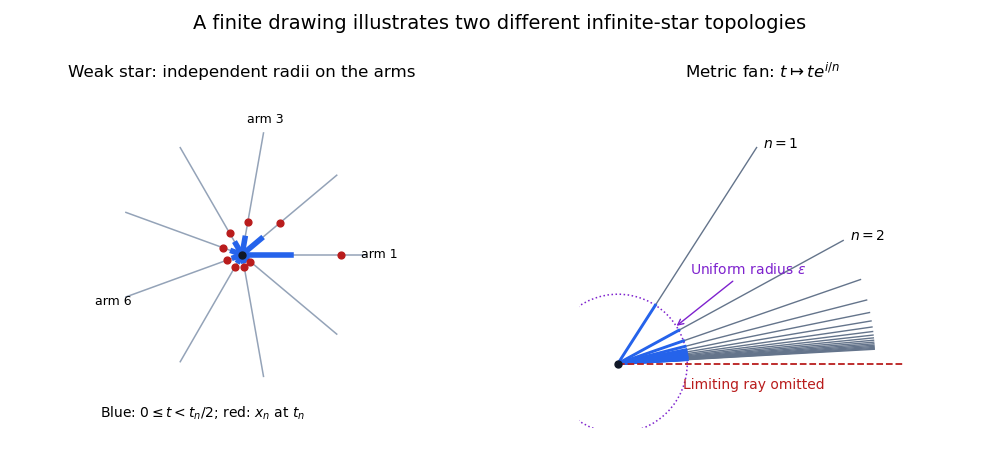
In the metric realization of a simplicial complex, the point on arm at parameter is . Its distance from the common vertex is . Consequently the vertex has a neighbourhood basis consisting of one uniformly short initial interval on every arm. Away from that vertex, each arm is locally isolated from the other arms.
The map , with all identified, is a homeomorphism ontoIt is a bijection, preserves the one-dimensional topology on each arm away from zero, and matches the uniform-radius neighbourhood bases at zero. The positive real limiting ray is omitted. The outer endpoints form an infinite closed discrete subset in the original metric realization, so the image is not compact. This planar fan and the weak realization of a countable star have different topologies at their common vertex.
Give the geometric realization of an abstract simplicial complex the quotient topology obtained by gluing the disjoint union of its standard simplexes along their labelled faces. A subset is open exactly when is open in every closed geometric simplex . This is the weak realization topology. It is the topology of its CW complex structure; the word weak here refers to the simplexwise test, rather than to the weak topology of a topological vector space. A map out of the realization is continuous exactly when its restriction to every simplex is continuous.
Identify the initial endpoints of countably many closed intervals to a vertex , using the quotient topology. This is the geometric realization of the complex whose only edges are . A neighbourhood of may contain a separately chosen initial interval on each arm, with no positive lower bound on the .
The space is not first countable. Given any proposed countable neighbourhood basis at , choose a point at coordinate on arm with . This is possible by the interval topology on that arm. The set whose intersection with arm is is an open neighbourhood of , by the simplexwise definition. But for every , so no lies inside . Consequently this weak star cannot embed in the plane, or in any metric space.
The terminal vertices form an infinite closed discrete subset: on each closed arm they meet only its terminal endpoint. Hence the star is not compact, by closed discrete subsets of compact spaces are finite.
The open star of a vertex is the union of the relative interiors of the simplices containing . The open stars of the vertices cover the geometric realization.
The topological realization of a simplicial complex with infinitely many vertices is not compact. Its vertex open star in a simplicial complex form an open cover, but a vertex belongs only to its own star. Thus every finite collection of vertex stars omits all the other vertices. The argument uses the weak topology of a simplicial realization, in which a vertex star is open because its complement is the realization of the subcomplex of simplices missing that vertex. No local finiteness assumption is required.
A simplicial map sends vertices to vertices and sends the vertex set of every simplex to the vertex set of a simplex. It induces a continuous map between geometric realizations and a chain map between simplicial chain complexes.
A simplicial homeomorphism is the homeomorphism of geometric realizations induced by an isomorphism of simplicial complexes: a bijection of their vertex sets such that a finite vertex set is a simplex exactly when its image is a simplex. The map acts linearly in each barycentric coordinate system. It and its inverse are continuous by the realization topology. Between the boundaries of two triangles, any bijection of the three vertices extends linearly on edges to a simplicial homeomorphism. This ensures that the edge identifications agree at common endpoints.
For a simplicial map to the standard simplicial decomposition of a sphere, a -simplex is positive alternating when its image has the displayed distinct labels. Reversing all signs makes it negative alternating. A collapsed or nonalternating simplex is neutral. Counting positive facets modulo two is the local ingredient in the antipodal alternating-simplex parity lemma.
An antipodal simplicial map from a regular antipodal triangulation of a sphere to has an odd number of positive alternating -simplices. For each -simplex, the number of positive alternating facets is odd exactly when the simplex is positive or negative alternating; otherwise it is even, including collapsed images. Count these incidences in one hemisphere: interior facets contribute twice, boundary facets once. Antipodal pairing then gives , starting with one positive vertex on . In particular, no such map exists when .
A map satisfying this condition is the object whose existence after subdivision is guaranteed by the Simplicial approximation theorem.
If simplicially approximates , then and lie in a common simplex for every . The affine formulatherefore remains in the realization and gives a homotopy from to .
For a finite simplicial complex , a simplicial complex , and a continuous map , some iterated barycentric subdivision admits a simplicial approximation to . The proof applies the Lebesgue number lemma to the inverse images of target open stars and uses that the mesh of a simplicial complex tends to zero under repeated barycentric subdivision.
If , every continuous map is null-homotopic. After simplicial approximation, its image lies in the -skeleton of a triangulation of , hence omits a point. The punctured sphere is homeomorphic to and is therefore contractible.
Simplicial maps are contiguous when lies in one simplex of for every simplex of . Contiguous maps have homotopic geometric realizations.
Conversely, every flag complex is the clique complex of its one-skeleton, so these two descriptions specify the same class of complexes.
A barycentric coordinate system assigns to a point in the affine span of the vertices of a nondegenerate simplex its unique vertex weights , constrained to sum to one. Uniqueness follows because form a basis of the translation space: expand in that basis and set . A point lies in the closed simplex exactly when every weight is nonnegative. An affine function satisfies , which makes these coordinates useful for interpolation and the integral of an affine function over a simplex.
The probability simplex consists of vectors of nonnegative weights summing to one. It is the convex hull of the coordinate vectors. A linear function has maximum on this simplex; equality holds exactly when the weights are supported on maximizing indices.
On the probability simplex, . The Cauchy-Schwarz inequality gives , with equality only when all coordinates are equal. Thus the displayed centroid is the unique closest point to the origin. It is also equidistant from all coordinate vertices, since .
The boundary subcomplex consists of all proper faces of the -simplex. Its geometric realization of a simplicial complex is homeomorphic to the sphere , while is homeomorphic to the closed disk .
A regular simplex has pairwise equidistant vertices. Conversely, every finite equidistant subset of Euclidean space is the vertex set of a regular simplex.
This simplicial notion is induced by an orientation of a vector space on the affine span of the simplex.
The geometric realization is a pseudomanifold without boundary in the convention used here.
A pure -dimensional simplicial complex is a pseudomanifold when every codimension-one simplex belongs to exactly two top-dimensional simplices and the top simplices are connected through shared codimension-one faces.
Compatible orientations of all top-dimensional simplices make their signed sum a cycle. For a connected pseudomanifold this cycle generates top homology over the integers; if no compatible orientation exists, top integral homology is zero.
Articles by others on the same topic


A simplicial complex is a mathematical structure used in algebraic topology and combinatorial mathematics to study spaces and their properties. It is a way of building up a geometric object from simpler building blocks called simplices. ### Definition of a Simplicial Complex A simplicial complex \( K \) is a set of simplices that satisfies two conditions: 1. **Non-emptiness**: The empty set is in \( K \).