Simplicial homology computes homology from the boundary maps between free abelian groups generated by oriented simplices.
A simplicial cycle is a simplicial chain with zero boundary. Its homology class is unchanged on addition of a boundary; in the Mayer–Vietoris sequence, splitting a cycle between two subcomplexes constructs the connecting map.
The simplicial chain group is freely generated by oriented -simplices, subject to reversal of orientation changing sign. Its boundary is
In an augmented chain complex of a simplex with vertices , put and when is absent, and zero when it is present. Direct expansion of the boundary operator gives . This proves that every positive-degree chain cycle is a chain boundary, without invoking cellular homology.
The Euler characteristic compresses a finite CW complex's homology into one integer: count its topological cells with alternating signs, or count its Betti numbers with the same signs. A filled triangle has Euler characteristic one; its cycle graph boundary has Euler characteristic zero. The missing face changes the answer even though the vertices and edges are identical.
For a finite CW complex , including the geometric realization of a finite simplicial complex,Here is the rational Betti number. More generally this ordinary homology definition makes sense whenever every rational homology group is finite-dimensional and only finitely many are nonzero. An arbitrary infinite CW complex need not satisfy these assumptions; its formal infinite alternating cell count is not a definition of this invariant.
The usefulness is that a finite description can reveal something about a space without computing every homology group. By the cell-count formula for Euler characteristic, count pieces rather than solve all the boundary operators. If two spaces give different answers, topological invariance of Euler characteristic rules out a homeomorphism, and even a homotopy equivalence. Equal answers are less decisive: the Euler characteristic of an annulus and the Euler characteristic of a torus are both zero, while their homology groups differ. This is a compact diagnostic, with a clearly defined limit on what it can tell us.
The boundary of a cube has eight vertices, twelve edges and six square faces. Treating each open face as a two-dimensional topological cell givesThis agrees with its being a two-sphere: stretching the hollow polyhedral surface changes its geometry but not its topology. The interior is excluded from this space.
Now include the solid interior. The cube has the same lower-dimensional topological cells, together with one open three-dimensional topological cell. The cell-count formula for Euler characteristic becomesThe filled cube is contractible, so its homology agrees with that of a point. The term is essential: by itself is the full count only for a two-dimensional CW complex.
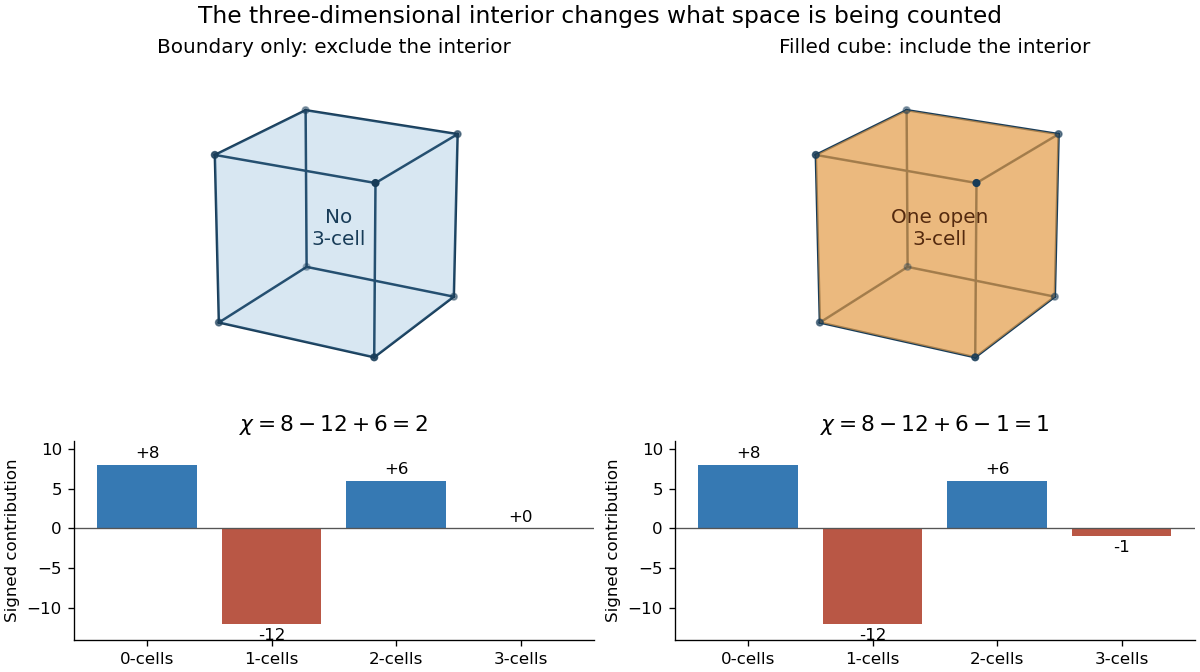
The boundary of a cube has Euler characteristic 2; including its three-dimensional interior adds one negative contribution and gives 1
. Details. Adding a diagonal within one square face replaces that face by two triangular faces and introduces one edge. Thus the Euler characteristic changes by , as in subdivision invariance of Euler characteristic. Including an interior is a different operation: it adds points to the space, rather than giving the same space a finer description. This distinction matters whenever a geometric model could mean either a surface or the solid it encloses.
For a concrete example of cellular homology of real projective space, the real projective plane has one topological cell in each of dimensions zero, one and two. Its one-dimensional topological cell is a loop, and the face attaches around that loop twice. Choose orientations so that the cellular chain complex over the integers iswith nonzero chain groups in degrees two, one and zero. The twice-around attachment is why the first boundary operator shown is multiplication by two.[ref]
Algebraic Topology by Allen Hatcher. Algebraic Topology by Allen Hatcher, §2.2, Example 2.42, printed p. 144: real projective cellular boundary maps
Over the rational numbers, multiplication by two is invertible, so and vanish, while . Over the finite field , two equals zero. Both boundary operators then vanish, giving one-dimensional homology groups in all three degrees. Their respective Betti numbers areNevertheless,The direct cell count is also .
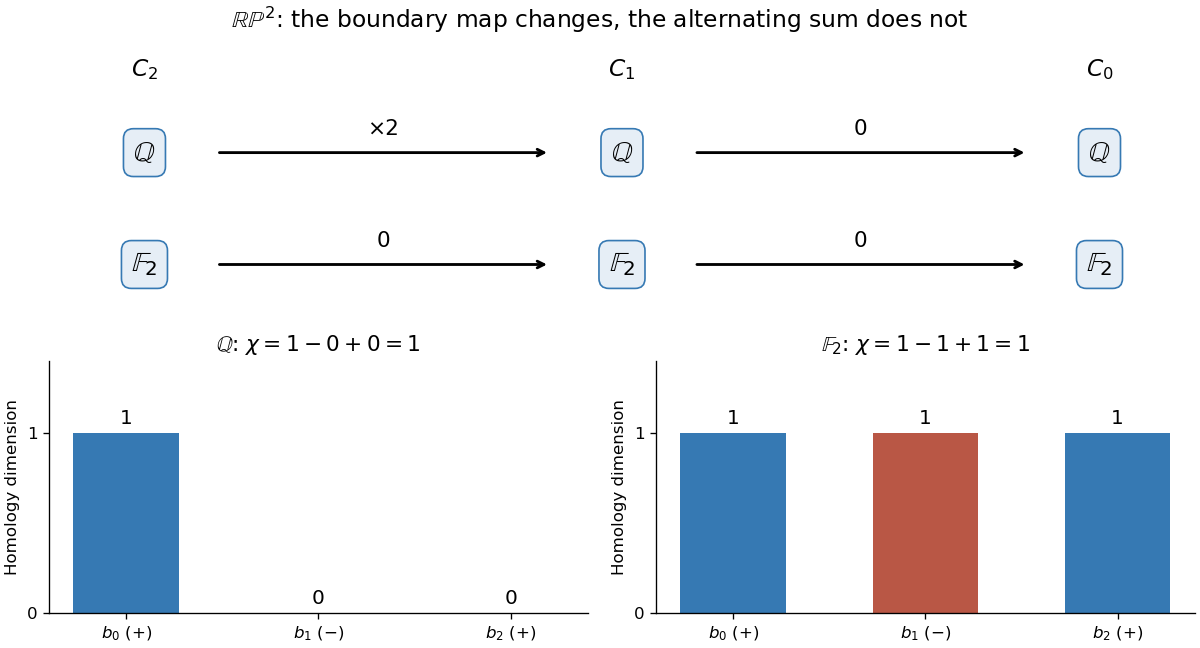
Changing coefficients changes the projective plane's homology groups, but their alternating dimension sum remains 1
. Details. This calculation makes the strength and loss of information visible. The Euler characteristic survives a change of the field used for coefficients, while individual homology groups can change. Over the integers, the same chain complex has and : a torsion subgroup that rational Betti numbers do not record. The rank cancellation in the Euler-Poincare formula explains why the alternating total still agrees with the cell count.
Leonhard Euler's Elementa doctrinae solidorum, or Elements of the doctrine of solids, appeared in 1758 in volume 4 of Novi Commentarii academiae scientiarum Petropolitanae, pp. 109–140. The repository record dates its composition to 1750. Composition and publication are distinct dates here.[ref]
The modern cell-count formula for Euler characteristic puts polyhedral counting into an arbitrary-dimensional CW complex. It also identifies what is being counted: the Euler characteristic of a cube boundary and its interior distinguishes a polyhedral surface from the filled solid using the missing three-dimensional term. The modern homology formulation explains why this alternating arithmetic persists across different decompositions.[ref]
Algebraic Topology by Allen Hatcher. Algebraic Topology by Allen Hatcher, §2.2, printed pp. 146–147, Theorem 2.44: alternating cell counts, homology ranks and independence from the CW structure
Let be a finite CW complex, with topological cells of dimension and none above . Its Euler characteristic is the displayed alternating sum. For a finite simplicial complex, counts its -dimensional simplexes, each counted once rather than once for each containing simplex. In dimension two this becomes . A topological cell's interior is counted; identified parts of its boundary are counted in their own lower-dimensional topological cells.[ref]
Algebraic Topology by Allen Hatcher. Algebraic Topology, §2.2, p. 146, definition of Euler characteristic and Theorem 2.44
The cellular homology theorem identifies cellular homology with singular homology, so the count equals the alternating rational Betti numbers. These are the free ranks of integral homology; torsion subgroups do not contribute to them. Over any field, the alternating homology dimensions still give the same Euler characteristic, although individual Betti numbers can depend on the field.
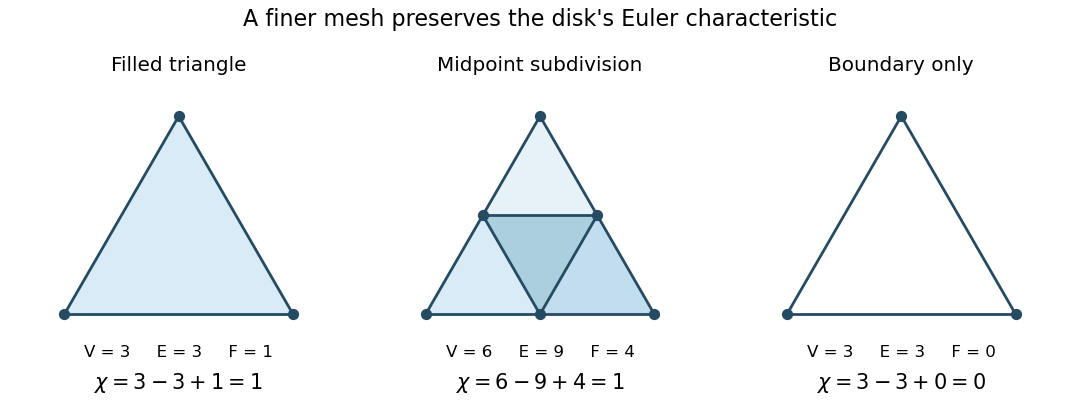
A filled triangle is a disk with three vertices, three edges and one two-dimensional topological cell, so . Its simplicial homology has : the filled triangle is contractible, and the three-edge chain cycle is the chain boundary of its face. Keeping only the cycle graph on those three vertices gives and , since that chain cycle no longer bounds a face. The surrounding plane's exterior is not part of either simplicial complex; do not add it to .
Build a closed annulus from two nested -sided polygons, , with radial edges joining corresponding vertices. There are vertices, edges and quadrilateral topological cells, giving . The central missing region and the exterior are not faces of the annulus. A deformation retraction onto a circle gives , agreeing with the cell count. This is a useful reduction: the annulus is two-dimensional, yet its homology is that of a one-dimensional cycle graph.
Identify opposite sides of a square by translations to obtain a torus. All four corners become one vertex; the horizontal sides give one topological cell and the vertical sides one topological cell . The open square supplies one two-dimensional topological cell. Thus and . The cellular boundary of each one-dimensional topological cell is zero because its endpoints agree. Traversing the face boundary gives the group commutator , whose signed counts of both and vanish. Hence its cellular boundary is also zero, and .[ref]
A Concise Course in Algebraic Topology by J. P. May. A Concise Course in Algebraic Topology, Chapter 13, §5, p. 103, Example (i), the torus cellular chains and integral homology
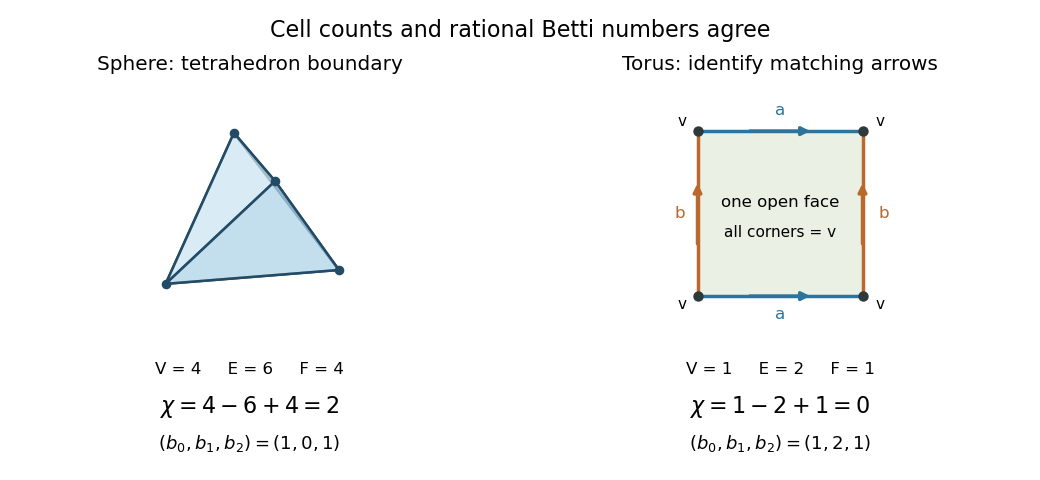
The tetrahedral sphere and the square presentation of a torus have different alternating cell counts
. Details. The boundary of a tetrahedron is a two-sphere, with four vertices, six edges and four triangular topological cells: . Its rational Betti numbers are by homology of a sphere. The torus's two independent one-dimensional homology classes cancel its degree-zero and degree-two contributions. The torus and annulus both have Euler characteristic zero, yet different homology groups; one integer cannot recover all of homology.
In the illustrated simplicial subdivision, inserting the three edge midpoints turns one filled triangle into four. The counts change from to , but . Splitting a single edge adds one vertex and one edge, so its net contribution is . Adding a diagonal inside a polygonal face adds one edge and one face, giving .
These local accounts explain common refinements. For arbitrary finite simplicial subdivisions, including barycentric subdivision in any dimension, the underlying geometric realization is unchanged. The topological invariance of Euler characteristic therefore guarantees the same alternating count, even when the individual counts change substantially.
A homeomorphism preserves every homology group, hence the Euler characteristic wherever the finite rational Betti number sum is defined. In fact, homotopy invariance of homology makes Euler characteristic invariant under homotopy equivalence. Thus different finite CW complex structures on the same space have equal alternating cell counts.[ref]
Algebraic Topology by Allen Hatcher. Algebraic Topology, §2.2, p. 146, homotopy-type independence immediately before Theorem 2.44
For a finite CW complex, counts connected components: its connected components are its path components, as recorded by the zeroth homology group. For a finite graph regarded as a one-dimensional CW complex, no higher homology groups occur, so counts independent graph cycles, and . For a connected planar surface obtained by removing disjoint open disks from the interior of a closed disk, and ; the annulus is .
The word "hole" needs its dimension. A two-sphere encloses a cavity but has and . A closed orientable surface of genus instead has and : increasing the genus by one adds two independent one-dimensional homology classes. In higher dimensions, further homology groups enter with alternating signs; there is no universal "components minus handles" rule.
Use Poincare duality with coefficients in , valid also without orientability. The ranks in complementary degrees agree, and their signs in the alternating sum are opposite. They therefore cancel in pairs. Euler characteristic is independent of the coefficient field, giving the stated integer equality.
Poincare duality gives the displayed formula for connected closed oriented four-manifolds. Every integer occurs. A connected sum of copies of the Complex projective plane and copies of has Euler characteristic , because the summand characteristics are three and zero. Given any integer , choose large enough that ; when both counts are zero use . If simple connectivity is additionally required, the possible values instead begin at two, since ; connected sums of projective planes realize every such value.
A finite set of distinct great circles not all passing through a common antipodal pair has a vertex lying on exactly two circles. Its cells are spherical polygons with at least three edges: a digon would have antipodal endpoints, and every circle's defining hemisphere would then have to contain both endpoints, forcing a common axis. With and , the graph has a vertex of valence less than six. Valences are even and at least four, so one is exactly four. Central projection identifies this with an ordinary intersection in a real projective line arrangement. If affine line intersections are counted only at finite points, parallel-line configurations require a separate qualification.
For a finite cell decomposition of the sphere into polygonal faces, the numbers of vertices, edges and faces satisfy the displayed formula. Triangulating faces preserves because each added diagonal adds one edge and one face. This is the spherical form of Euler formula for a connected planar graph, where the plane's exterior face is included.
For finite CW complexes, the product cell structure has one -cell for every pair consisting of a -cell and a -cell. Taking the alternating cell count gives
If is a finite covering of degree between spaces having finite CW type, thenA lifted CW structure has exactly cells above each cell of the base.
Every closed odd-dimensional manifold has Euler characteristic zero. For an orientable manifold this follows by pairing complementary Betti numbers using Poincare duality; the general case follows from the orientable double cover and Euler characteristic under a finite covering.
If a finite simplicial complex has simplices of dimension , thenWriting a lift of and makes the boundary dimensions cancel in the alternating sum.
Use the cellular chain complex or simplicial chain complex over , rather than the infinite singular chain complex. Put , with . The rank-nullity theorem gives ; quotienting the chain cycles by the chain boundaries then gives . Each boundary operator's rank occurs in adjacent degrees with opposite signs, soFiniteness makes this cancellation an ordinary finite sum. This is the algebra behind the cell-count formula for Euler characteristic.
The vertices of the barycentric subdivision of a simplicial complex are its nonempty faces, and its simplices are strict chains of faces.
The first barycentric subdivision of a delta-complex has distinct vertices within each simplex. Its vertices correspond to an increasing chain of original faces, and their strictly different dimensions prevent identifications within that chain. Distinct simplexes may still share the same global vertex set, as happens to the two halves of a subdivided loop edge.
For a delta-complex with distinct vertices within each simplex, a face inside a fixed simplex is uniquely determined by its vertex subset. In its barycentric subdivision, a vertex records an actual face, including its cell identity. A simplex records a chain of these faces; its vertex set recovers the unique order by dimension and each unique face inclusion. Thus no two simplexes have the same vertex set, and intersections are their common faces. Applying this to the first subdivision proves that the second subdivision is an abstract simplicial complex. The subdivision maps are affine on smaller simplexes and compatible on the glued faces, so they induce a homeomorphism of realizations.[ref]
Algebraic Topology by Allen Hatcher. §2.1, exercise 23, p. 133: the two successive subdivision steps
For a geometrically realized simplicial complex, its mesh isIf has dimension , barycentric subdivision satisfiesso .
The barycentric subdivision of a tetrahedron has f-vectorIts two-skeleton therefore has Euler characteristic and homology , , and .
Articles by others on the same topic



Simplicial homology is a fundamental concept in algebraic topology, a branch of mathematics that studies topological spaces through algebraic invariants. It provides a way to associate a sequence of abelian groups or vector spaces (called homology groups) to a simplicial complex, which is a type of combinatorial structure used to approximate topological spaces.