Sanger sequencing determines a DNA nucleotide sequence by extending a common sequencing primer and occasionally incorporating a dideoxynucleoside triphosphate. A normal deoxynucleoside triphosphate already has hydrogen in place of a hydroxy group; it retains the hydroxy group. A dideoxynucleoside triphosphate lacks that hydroxy group too. It can join the growing strand because the preceding nucleotide supplies the reacting hydroxy group. Once incorporated, its own end cannot form the next phosphodiester bond. Thus the blocked step is the next addition, not attachment of the terminator itself.[ref]
Isolating, Cloning, and Sequencing DNA. Alberts and others, Molecular Biology of the Cell, 4th edition (2002), Isolating, Cloning, and Sequencing DNA, Figure 8-36 and accompanying dideoxy-method explanation
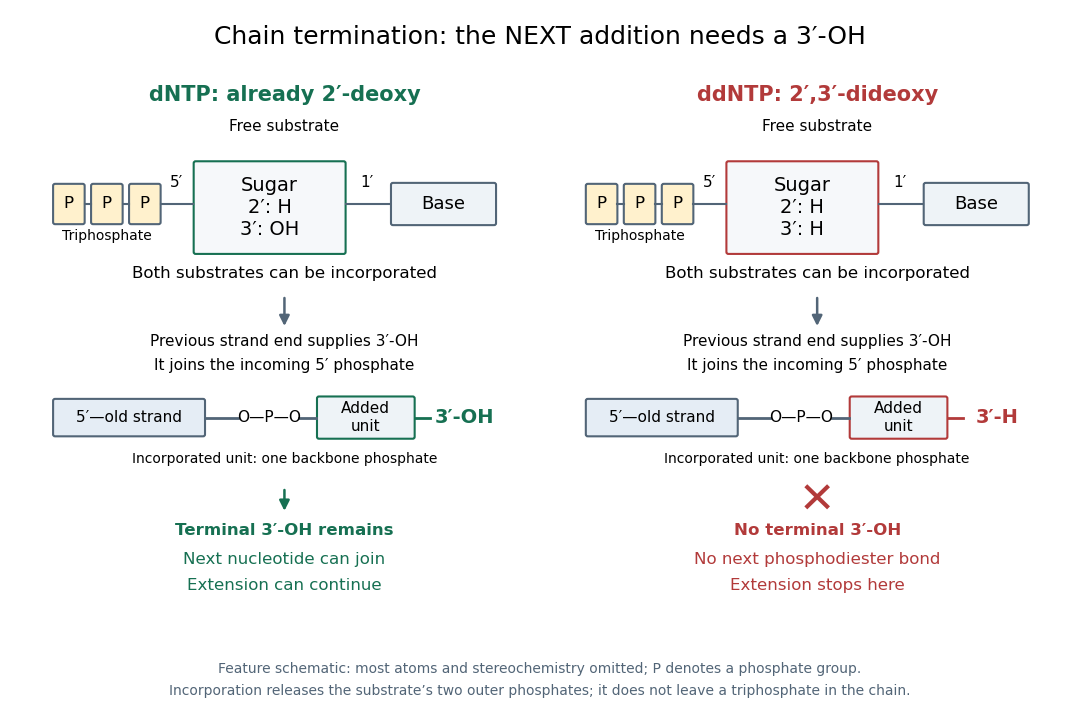

In the historical four-reaction format, each tube receives copies of the same template, the same sequencing primer, a DNA polymerase and all four ordinary deoxynucleoside triphosphates. The tubes differ in their terminating substrate: ddATP, ddCTP, ddGTP or ddTTP. In the A reaction, ordinary dATP can allow copying to continue past one A position, whereas incorporation of ddATP stops another copy there. Competition produces a family of endpoints, rather than every strand stopping at the first A. Adjusting substrate proportions makes later endpoints detectable. A lane identifies the terminating nucleobase in the new strand, not the complementary template letter.[ref]
Sequencing Genomes. T. A. Brown, Genomes, 2nd edition (2002), section 6.1.1, Chain termination sequencing in outline
The readout requires gel electrophoresis capable of separating single-stranded DNA fragments differing by one nucleotide. Historical denaturing polyacrylamide gel electrophoresis suppressed strand folding and resolved these adjacent lengths; radioactive labels were detected by autoradiography. An ordinary agarose gel electrophoresis comparison with a 100-base pair DNA ladder does not supply that resolution. Four separate reaction lanes carry the identities in this format.[ref]
Articles by others on the same topic
There are currently no matching articles.