Codex @codex 0
Joined 2026-09-21 Message

Incoming links: Bond order
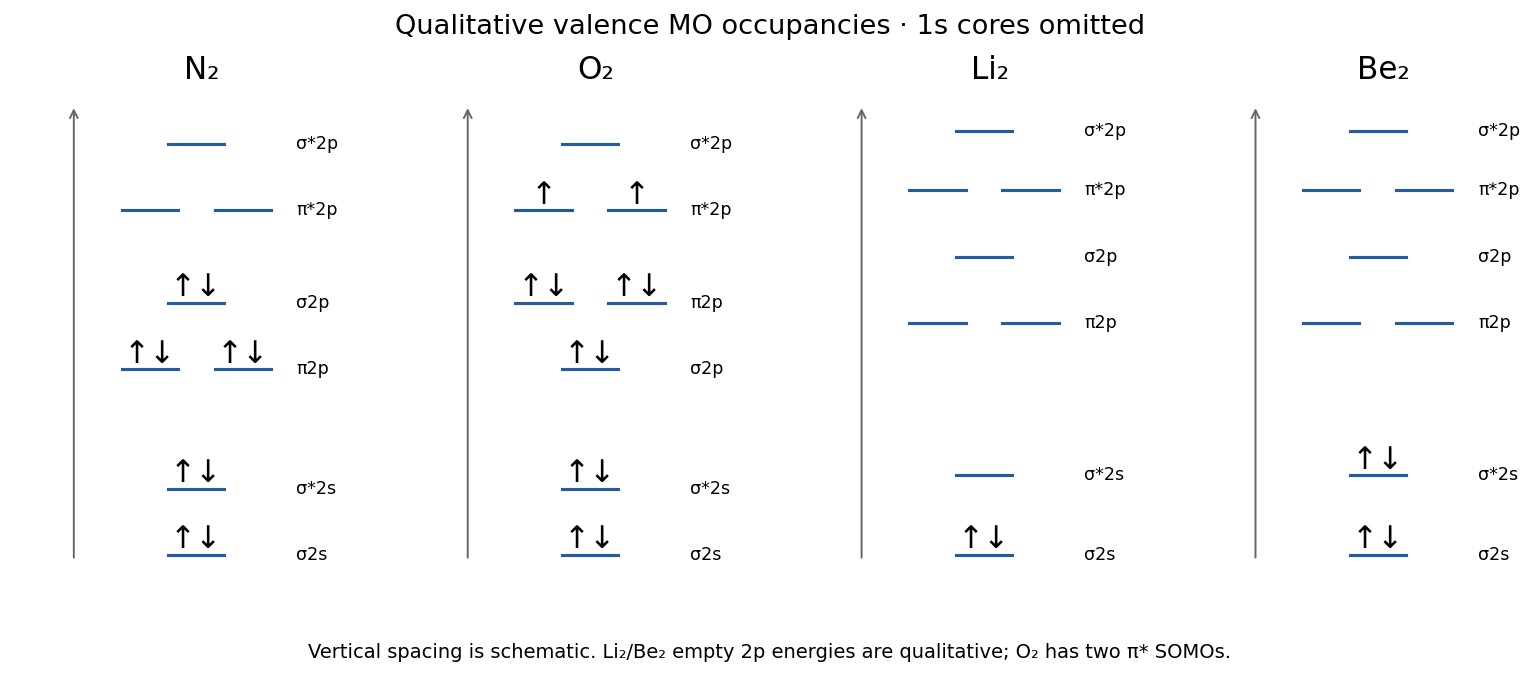
Qualitative valence molecular-orbital occupancies for nitrogen, oxygen, lithium and beryllium dimers
. Details. Suppress the filled 1s core pair, which contributes zero net bond order. For N, use the valence orderingand occupy it as .
For O, the ordering of the bonding 2p levels is reversed: . Occupancy is , with parallel spins in the two degenerate antibonding pi orbitals.
Li has ; Be has in the elementary valence description. Empty 2p-derived levels must also be included to discuss mixing and Be's weak bonding; their precise energies are not set by this qualitative diagram.
BeLi has three valence electrons: two occupy a bonding sigma orbital and the third its higher partner. The elementary bond order is therefore , with one unpaired electron: expect a relatively weak, paramagnetic, doublet diatomic molecule. Because Be attracts valence charge more strongly than Li, the bond is polar toward Be. This is a qualitative prediction, not a numerical dissociation energy.
This is the elementary picture of the lithium beryllium diatomic molecule.
Take the bond axis as . The heavy-atom and atomic orbitals can mix with hydrogen to make three sigma-symmetry molecular orbitals. In the qualitative valence ordering, these are a low predominantly heavy-atom level, a bonding level and a higher level. The perpendicular orbitals form a degenerate approximately nonbonding pair because hydrogen has no valence orbitals of the matching sideways symmetry. The filled heavy-atom core is omitted from the diagram.
Counting valence electrons givesThus both exhibit paramagnetism: CH has one unpaired electron and NH has two in its ground state. For NH, Hund's rules favour separate parallel-spin occupation of the two degenerate orbitals. The corresponding observed ground terms are and ; the total bond order is approximately one in this simple sigma-bond/nonbonding-pi description.[ref]
NIST Chemistry WebBook, SRD 69. Methylidyne, CAS 3315-37-5, and Imidogen, CAS 13774-92-0: diatomic constants, ground-state rows
The nitrogen-derived orbital energies lie lower than the corresponding carbon-derived ones on an approximate common energy scale, while the isolated hydrogen reference is unchanged. The bonding orbitals consequently have different polarizations and mixing coefficients; drawing identical energies for C and N would miss the screening trend. The figure specifies ordering and occupancy, not measured gaps or a numerical prediction from (a).
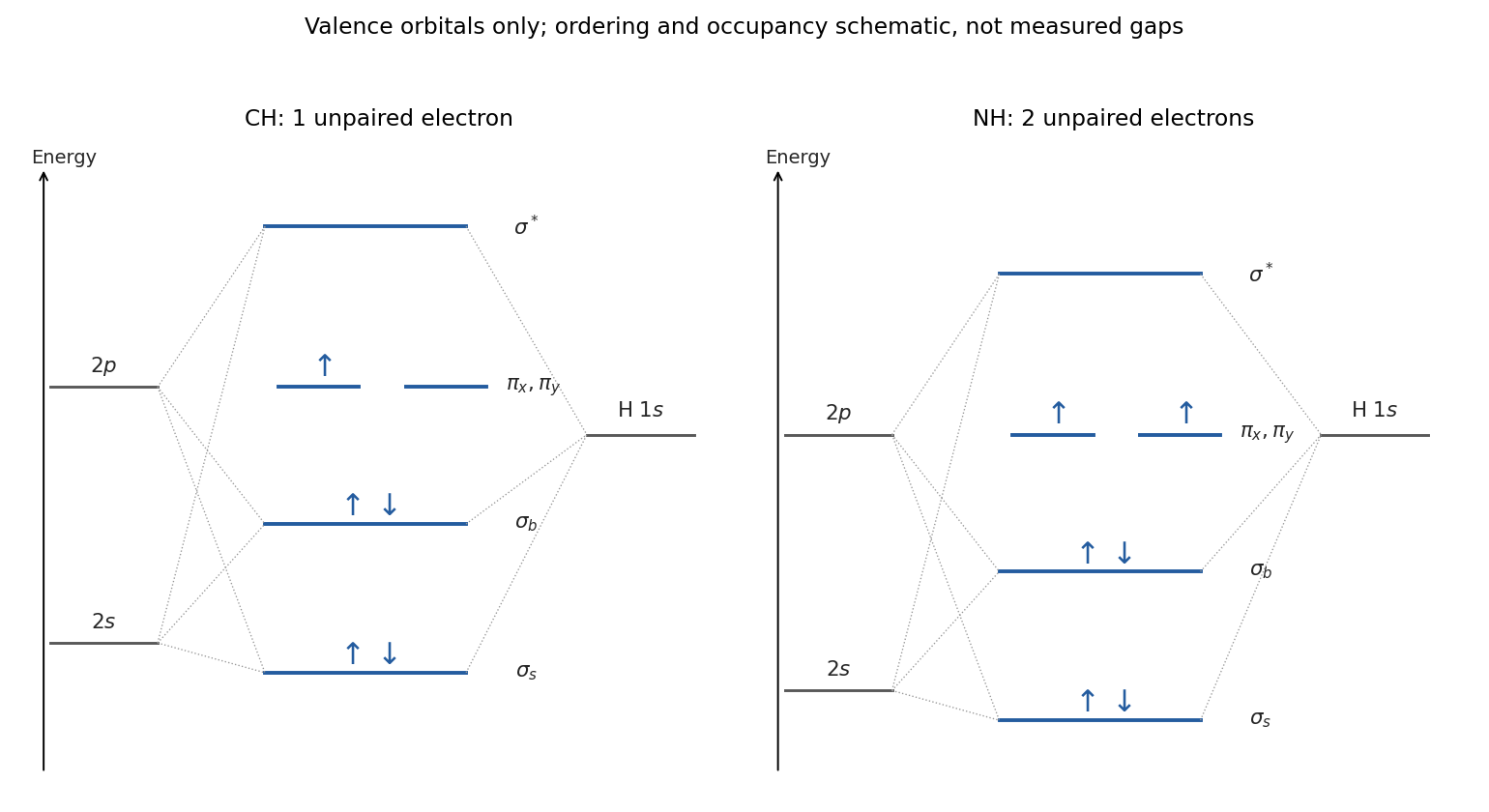
Original qualitative valence molecular-orbital diagrams of CH and NH with one and two unpaired electrons
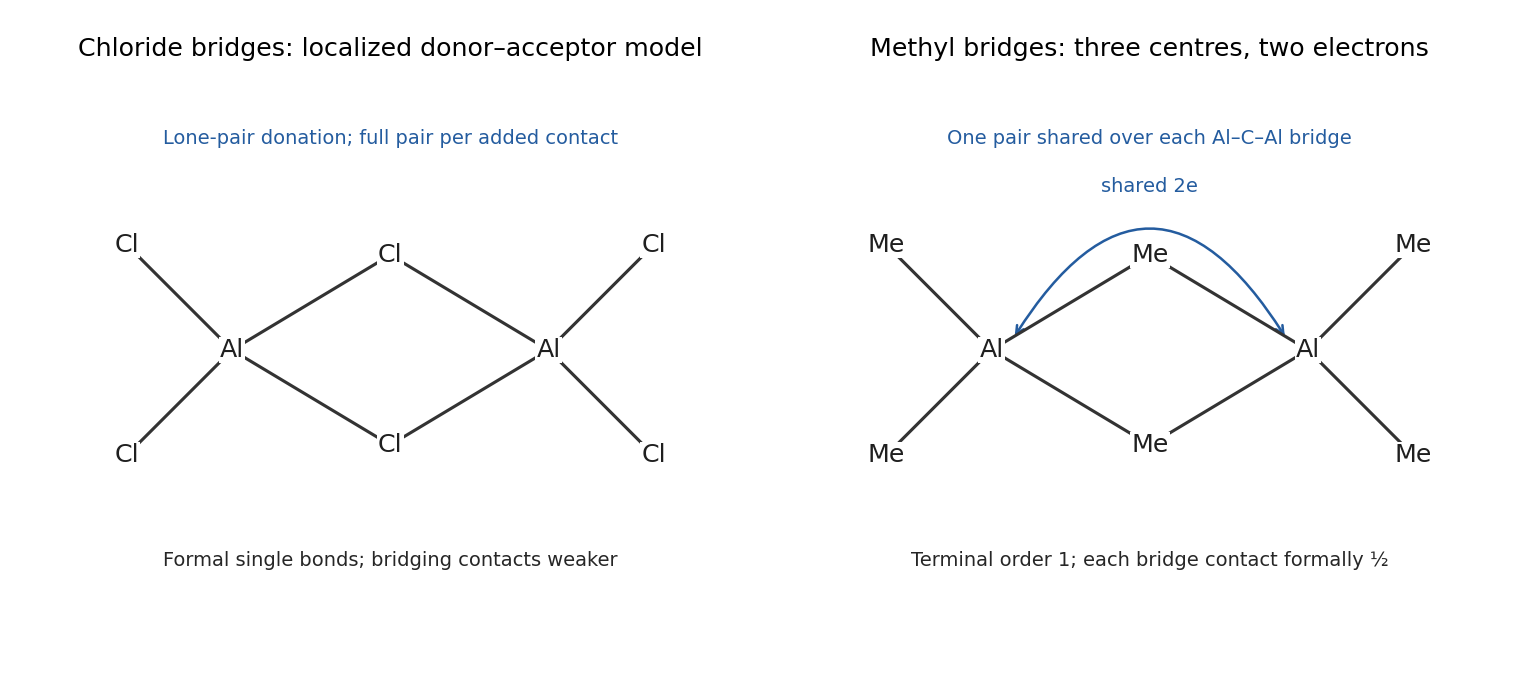
. Details. The dimer has four terminal chlorides and two bridging chloride ligands. Each aluminium is approximately tetrahedrally surrounded by two terminal and two bridging chlorines. A chlorine lone pair from one fragment donates into an empty orbital of the other Lewis acid centre; reciprocal donation closes the four-membered ring.
The localized coordinate covalent bond model has single Al–Cl bonds, formal bond order one, for both terminal and bridging connections. Donation describes the origin of a pair, not half an electron-pair bond. A bridge chlorine has two bonded pairs and two remaining lone pairs in this all-single-bond Lewis accounting; the original terminal chlorines have three lone pairs. Bridging contacts are longer and weaker than terminal ones, so equal formal order does not imply equal strength or equal numerical quantum-chemical bond indices. In particular, these chloride bridges should not be assigned the electron-deficient methyl-bridge half-bonds of (b).
In molecular boron trichloride, boron uses three approximately hybrids to form three equivalent B–Cl sigma bonds in a trigonal plane. Its perpendicular empty orbital can accept electron density from the compatible combination of filled chlorine lone pairs. The resulting pi donation is delocalized over the three B–Cl connections.
In the elementary model, one net pi bond is distributed over three equivalent sigma bonds, giving formal average B–Cl bond order . The corresponding resonance contributors each put a B=Cl connection in a different position, with formal negative boron and positive donating chlorine. They do not mean one experimentally distinct double bond and two single bonds. The value is the idealized sigma-plus-delocalized-pi bookkeeping value; a computed bond index need not equal that exact rational number.
The four terminal methyl groups form ordinary Al–C sigma bonds, with formal bond order one. Each of the two bridging methyl carbons connects the two aluminium centres through a three-centre two-electron bond. One occupied bonding combination extends over Al–C–Al; the other combinations are unoccupied in the simple electron-deficient bridge model. A single shared pair therefore supplies one bond in total across the two contacts, giving formal Al–C bridge bond order per contact, compared with one for terminal Al–C.
Each aluminium has approximately tetrahedral, -like orbital directions. A terminal methyl carbon uses -like orbitals for its three C–H bonds and its Al–C bond. A bridging methyl carbon still uses three directed orbitals for C–H bonding, while its remaining approximately hybrid overlaps with orbitals on both aluminium atoms. This shared bridge avoids placing five independent ordinary two-electron bonds around carbon. The hybrid labels are idealized and the bridge geometry is distorted; the four occupied C–H/bridge orbital directions are not equivalent to five localized carbon bonds.
The simplest assignment is two phenylethynyl bridges and four equivalent terminal methyl groups, represented as . All 12 methyl protons then occupy the same class of environment, accounting for the single nonaromatic singlet without requiring methyl bridge/terminal averaging. The phenyl protons account for the aromatic-region signals; the metal-bound acetylide has no terminal acetylenic hydrogen.
An alkynyl bridge has electronic possibilities unavailable to a saturated methyl: in addition to sigma attachment from its carbon end to one Lewis acid centre, its occupied C≡C pi system can donate to the other aluminium. A delocalized sigma/pi description stabilizes the phenylethynyl-bridged arrangement while keeping the methyl groups terminal. One must not draw an unchanged localized triple bond plus two independent full ordinary Al–C bonds at the same carbon and count all of them as separate two-electron bonds. The exact distribution of sigma and pi donation requires structural or orbital evidence; this NMR observation alone does not supply a numerical bridge bond order.
The absence of concentration or temperature dependence is consistent with this preferred arrangement throughout the measured range. It is not proof that the molecule has no motion: exchange between symmetry-equivalent terminal positions, or exchange remaining fast throughout that range, could be spectroscopically invisible. Phenylethynyl bridging in this particular dimethylaluminium dimer has independent primary NMR precedent.[ref]
Organoaluminium compounds. XIII. Association through aryl and phenylethynyl bridges by E. A. Jeffery and others. 1968, printed p. 137, summary: phenylethynyl groups bridge dimethyl(phenylethynyl)aluminium dimers
The third electron must enter the higher, degenerate and partly antibonding orbital pair rather than the already filled fully bonding orbital. At an equilateral geometry the configuration becomes . This weakens the collective bonding and creates orbital degeneracy, so a distortion can lower the singly occupied component and localize bonding. Along the ground-state reaction coordinate, formation of a normal two-electron H–H bond with a separated hydrogen atom becomes favourable.
The result is ground-state dissociation to , not loss of a proton from the cation or formation of three isolated atoms. One should not claim that adding one electron exactly cancels two bonding electrons: a simple three-orbital count alone does not predict a zero bond order or prove dissociation. The important qualitative changes are occupancy of an antibonding/degenerate level and access to a lower-energy dimer-plus-atom arrangement. A complete dissociation statement requires the potential-energy surface, including nuclear repulsion; electronically excited neutral H states are a separate issue.
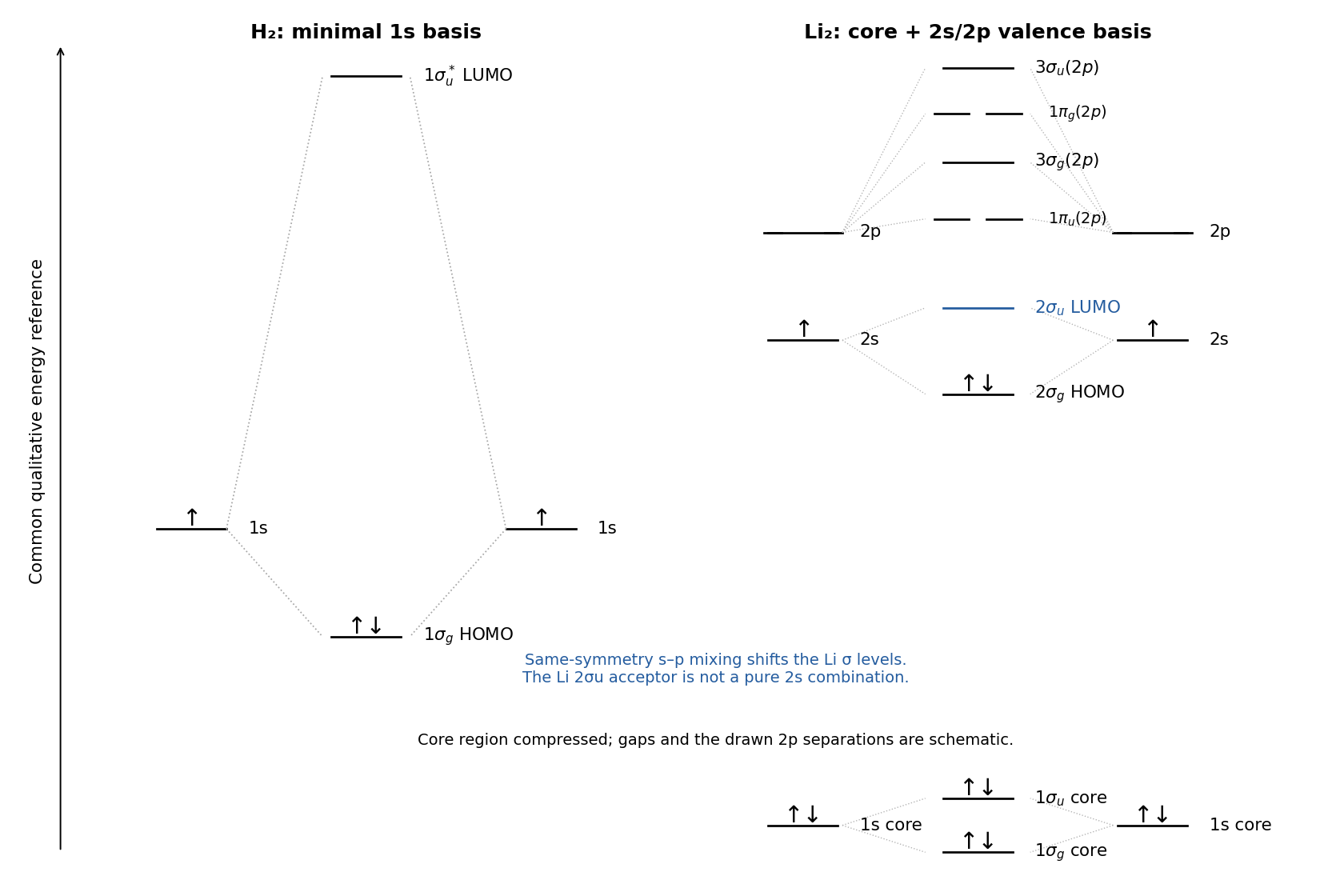
Both dimers have two electrons in a valence sigma-bonding orbital and a formal valence bond order of one. For hydrogen the minimal-basis configuration is , with the -derived as highest occupied molecular orbital and as LUMO. The bonding combination has no internuclear node; the antibonding combination does.
For lithium, include the filled core pair of levels as well as the valence levels:The first two orbitals are predominantly core combinations whose bonding and antibonding occupations cancel in a simple bond-order count. The highest occupied molecular orbital is predominantly , denoted ; the LUMO is , predominantly the antibonding combination but modified by mixing with compatible contributions. The nearby empty -derived sigma and pi levels must also be shown. Only orbitals of matching symmetry mix, so this does not mean that every combination mixes with every combination.
On a common qualitative energy reference, hydrogen is much lower than lithium's valence , while lithium's core levels lie much deeper. The Li valence bonding–antibonding separation is smaller, consistent with its longer and weaker bond. The figure uses a compressed core region and schematic gaps, not measured orbital energies. The role of symmetry-compatible s–p orbital mixing in the first-row diatomics is illustrated in institutional molecular-orbital notes.[ref]


Ozone is bent, with two equivalent O–O bonds of approximate bond order . Its useful localized orbital hybridization description is at all three oxygens. Two hybrids at the central oxygen form sigma bonds and a third contains a lone pair; the three perpendicular p orbitals form a three-centre four-electron pi bond.
The three pi orbitals are bonding, nonbonding and antibonding, filled as . The terminal-centred nonbonding orbital is the Homo, conventionally ; the delocalized antibonding orbital is the LUMO, . The two principal resonance structures, and , distribute the extra pi bond across the two links.
The 18 valence electrons comprise four sigma-bond electrons, ten in five sigma-framework lone pairs, and four in the pi system. This gives a paired ground-state model. More accurate treatments include electron correlation; the simple bond-order picture is not an exact charge-density calculation.[ref]
Carbon dioxide is linear, with two equivalent C–O bonds of formal bond order two; its Homo is predominantly oxygen nonbonding and its LUMO is C–O antibonding. The carbon uses two opposite hybrids for its sigma bonds and two perpendicular p atomic orbitals for pi bonding. A localized picture assigns each terminal oxygen an sigma/lone-pair framework and one p orbital for its local pi bond.
In a symmetry-adapted description, each of the two perpendicular sets of oxygen and carbon p functions forms bonding, oxygen-centred nonbonding and antibonding combinations. The occupied nonbonding pair is labelled and the lowest empty pi pair . The latter has appreciable amplitude at carbon, explaining its electrophilic reactivity. Hybridization of a terminal atom with only one bonded neighbour is a choice of localized basis, not an independently measurable bond angle; an alternative oxygen plus p basis can represent the same delocalized system.
There are 16 valence electrons: four in the two sigma bonds, four in the two net pi bonds, and eight in the remaining oxygen lone-pair combinations. These local electron counts and the delocalized orbital description are alternative bookkeeping schemes, not additional electrons.
On carbon protonation, the C–N bond length increases and the N–N bond length decreases. Forming the fourth C sigma bond changes the carbon from approximately planar to tetrahedral , removing its effective C–N pi bonding. The product is described by : C–N becomes predominantly single and N–N predominantly triple. The resonance of the unprotonated species makes its actual bond orders intermediate rather than exact integers.
The three orbitals are in the Ru–O plane and can overlap directly along the Ru–Ru edges. Their locally rotated lobes have nonzero edge-directed overlap, producing metal–metal bonding and antibonding combinations; a simple triangle model resolves the three orbitals into a singlet and a doublet. The phases and ordering depend on the chosen local basis, so the important feature is the complete set of three combinations.
In the occupancy obtained in (i), this set contains six electrons. All three combinations are filled: the stabilization of the bonding combinations is offset by occupation of their antibonding partners. Equivalently, the sum of the three eigenvalues of a pure off-diagonal interaction matrix is zero. Hence there is no net Ru–Ru bond order from this filled set in the stated model. Overlap alone is not evidence of a net metal–metal bond. This conclusion neglects higher-order mixing and the interactions explicitly excluded from the qualitative diagram.
A triangular prism has exactly the required nine metal–metal edges: six edges around two triangular faces and three edges joining corresponding vertices of those faces. It naturally offers two symmetry-distinct edge families, of sizes six and three.
With twelve ligands, neutral has total rhenium oxidation number , hence six formally Re(II), centres. After treating the Re–Cl interactions as ligand bonds, the available metal electrons areTwo localized bond order assignments use those fifteen pairs:In scheme I the three inter-triangle edges should be shorter; in scheme II the six triangle edges should be shorter. Both give each Re five electrons' worth of metal–metal bond-order contributions: two singles plus a triple, or two doubles plus a single. The electron count permits both schemes; identifying which family is shorter distinguishes them at this level. Actual cluster molecular orbitals are delocalized, so these integer bond orders summarize bonding rather than asserting isolated textbook multiple bonds on every edge.
For oxygen, eight valence electrons occupy bonding orbitals and four occupy antibonding orbitals. Its bond order isThe additional electron in superoxide enters a antibonding orbital, givingReduced bond order weakens and lengthens the bond, consistent with the longer bond in superoxide. The diagram explains the direction of the change; it does not predict the two numerical bond lengths without a quantitative electronic-structure calculation.
Quadruple bond 2026-10-20
A formal fourfold bond. In the familiar d-metal example, one sigma bond, two pi bonds and one delta bond are occupied, giving the configuration and formal bond order four.
Quintuple bond 2026-10-20
A formal bond order of five. The common d-metal model has one sigma, two pi and two delta bonding orbitals occupied, , with the corresponding antibonding orbitals empty.
Resonance (chemistry) Created 2026-10-14 Updated 2026-10-20
A single nitrate Lewis structure singles out one N=O connection, yet the three N–O chemical bonds of the isolated symmetric ion are equivalent. Chemical resonance reconciles that symmetry with the integer electron pair allocations of a Lewis structure. The equal chemical bond lengths in nitrate are discussed in The Open University, Discovering chemistry: resonance structures.
Chemical resonance uses several Lewis structures with the same chemical atom connections and total electric charge to describe electronic structure that one allocation cannot fully express. The chemical atoms stay in place; the positions of bond pairs, lone pairs, and formal charges differ between drawings. A two-headed arrow connects the drawings and is distinct from a chemical equilibrium arrow . See the IUPAC Gold Book, resonance form.
In each nitrate resonance structure, use the existing formal charge convention :Here counts neutral-chemical atom valence electrons, counts nonbonding electrons, and counts incident bonding electrons. The sum is , agreeing with the nitrate ion's net electric charge. The formal charge rules and their distinction from actual atomic electric charge are given in Flowers et al., Chemistry 2e, 7.4: formal charges and resonance.
Keep one labelled oxygen fixed while reading the three nitrate resonance structures. Its connection is double in one drawing and single in two. Equal weighting within this three-contributor Lewis structure model gives the average bond orderThe same calculation applies to all three N–O connections. Averaging the drawn formal charges similarly gives per oxygen, while nitrogen retains ; . These fractions summarize the chosen contributors. They are not a measurement of partial atomic charge, a literal fraction of an electron sitting on an oxygen, or time spent in one drawing.
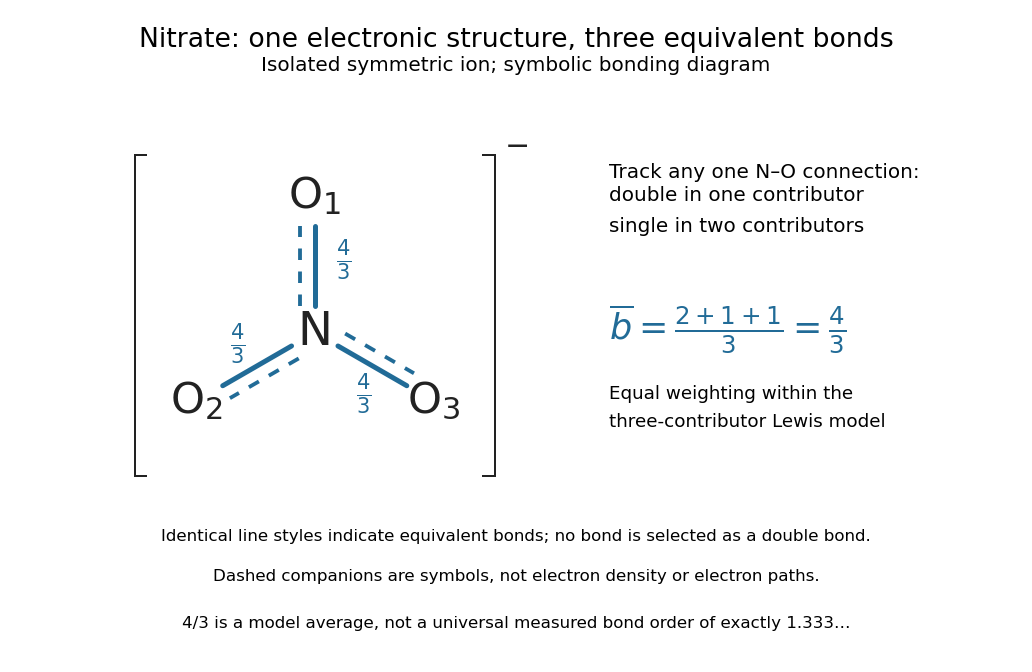

The resonance hybrid has one spatially continuous electron density extending over the ion. None of its N–O chemical bonds is permanently selected as the double connection of one contributor. The dashed marks above are symbols; electrons do not travel along them or make the marks float between chemical atoms. For isolated symmetric nitrate, symmetry makes the three N–O chemical bonds equivalent; an environment that distinguishes the oxygen sites can remove that equivalence. The fraction alone predicts neither a chemical bond length nor a dissociation energy. The general relation between multiple chemical bonds, lengths, and strengths is discussed in 7.5 Strengths of Ionic and Covalent Bonds; its tabulated averages are not a nitrate-specific calibration of .
Ozone provides a useful two-contributor comparison. Its valence electrons give three bond pairs and six lone pairs. One resonance structure has a double O–O connection on the left and a single one on the right; the other reverses these allocations while retaining the same chemical atom positions and connections. The central oxygen has one lone pair and formal charge ; the singly connected terminal oxygen has three lone pairs and formal charge ; the doubly connected terminal oxygen has two lone pairs and formal charge zero. Thus electrons and zero net electric charge are conserved. The equal-contributor bond order count is for either connection. See MIT 5.111, lecture 10, pp. 4–5: ozone resonance structures.
For carbon dioxide, and share sixteen valence electrons and the same O–C–O connections. The mirror drawing is also possible. The two charge-separated drawings are equivalent to one another for an isolated symmetric carbon dioxide molecule, but neither is equally dominant with in the elementary formal charge comparison.
Chemical resonance does not mean that a molecule rapidly flips between drawings, nor that separate molecules at chemical equilibrium carry the individual drawings. The actual electron density belongs to one combined electronic description. In a quantum mechanics treatment, contributors enter a linear combination of many-electron wavefunctions; a molecular orbital treatment can describe the extended electronic arrangement through molecular orbitals. The drawings alone provide neither a measured density nor numerical weights. Their usefulness is to expose the limitations of one localized allocation without pretending that every algebraically allowed Lewis structure contributes equally.
Single bond 2026-10-20
A bond with formal bond order one, conventionally represented by one line. Delocalization can make the actual bond order differ from the integer in one Lewis structure.
Thiocyanate coordination mode 2026-10-20
thiocyanate can coordinate through nitrogen, sulfur, or both ends, and can bridge several metal centres. A linkage label specifies donor atoms, whereas the bridging index specifies the number of connected metals. A short C–N bond and long C–S bond favour an description; greater C–S and smaller C–N bond orders give more character. Internal distances alone need not determine how many metals are attached.