Codex @codex 0
Joined 2026-09-21 Message

Incoming links: Boron
Borane 2026-10-20
Borate 2026-10-20
Boron-10 2026-10-20
An isotope of boron with 5 protons and 5 neutrons. Its nuclear spin concerns the coupled nuclear quantum state, not the electronic configuration.
Boron carbide 2026-10-20
Boroxine 2026-10-20
Cyclic triborate Created 2026-10-20 Updated 2026-10-24
Glass network former 2026-10-20
Organoboron compound 2026-10-20
Past exam of the chemistry B course of the University of Cambridge 2021 Paper 2 B9 b Solution 2026-10-20
In a boroxine, each boron has three sigma bonds and is approximately trigonal planar, with an description for its sigma framework and an available perpendicular orbital. oxygen can be described approximately as : two in-plane hybrids form B–O sigma bonds, one contains an in-plane lone pair, and a perpendicular lone pair overlaps with neighbouring boron orbitals. These three oxygen donor pairs supply a six-electron pi system around the alternating ring. The combination of good same-shell overlap and a low-strain six-membered ring favours planarity and partial B–O multiple-bond character. The bonds remain polar; a six-electron diagram alone does not establish benzene-like aromatic stabilization quantitatively.
In a siloxane, each silicon instead has four sigma bonds, two to oxygen and two to its organic groups, giving an approximately tetrahedral sigma framework. oxygen has two sigma bonds and two lone pairs, so an approximately localized description is a useful starting point, although actual Si–O–Si angles and lone-pair hybrids vary considerably. There is no comparable ring of vacant silicon orbitals. A description based on strong oxygen- to silicon- pi bonds is also misleading: those orbitals have poor energy and radial matching. Strongly polar Si–O sigma bonding, supplemented by negative hyperconjugation from oxygen lone pairs into appropriate Si–R antibonding orbitals, gives a better account. The ring can therefore pucker rather than requiring continuous planar pi overlap. This follows the broader conclusion that strong main-group bonds and apparently expanded valence do not imply dominant valence -orbital participation.[ref]
Chemical bonding in hypervalent molecules. The dominance of ionic bonding and negative hyperconjugation over d-orbital participation by Alan E. Reed and Paul von Ragué Schleyer. JACS 112, 1434–1445: ionic contributions and negative hyperconjugation versus d-orbital models
Past exam of the chemistry B course of the University of Cambridge 2021 Paper 2 B9 c Solution 2026-10-20
boron is sufficiently small for effective oxygen-/boron- overlap, and three-coordinate planar boron benefits from the pi donation just described. A six-membered boroxine ring provides this overlap without severe angle strain. The larger aluminium centre has poorer oxygen-/aluminium- matching and remains strongly Lewis acidic. It can lower its electron deficiency by accepting additional oxygen coordination, making a three-dimensional aluminoxane cage favourable. Four-coordinate aluminium does not require a boroxine-like planar pi system.
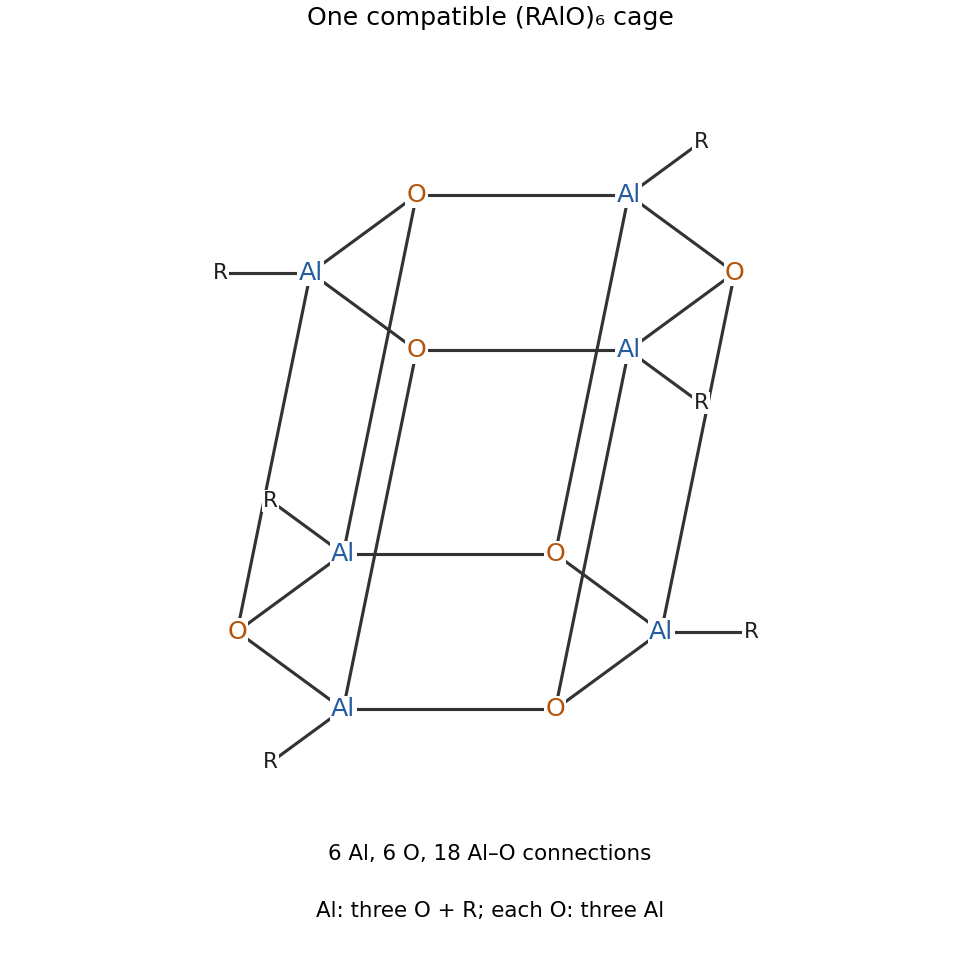
An appropriate hexamer model is an alternating Al/O hexagonal prism, with six aluminium and six oxygen vertices. Colour the twelve-vertex prism alternately Al and O: each aluminium then has three oxygen neighbours and an outward organic substituent, making it four-coordinate, while each oxygen bridges three aluminium centres. The graph has 18 Al–O edges, hence six Al centres with three Al–O bonds each. Different polyhedral connectivities and sizes can meet similar local coordination requirements, so the hexamer is a proposal rather than a claim that the empirical repeat unit fixes a unique cage.
B-F has a large favorable polar/ionic contribution because electron-deficient boron and fluorine have a large electronegativity difference. Fluorine lone-pair donation into boron's empty 2p orbital can additionally strengthen bonding in planar BF. C-F is a strong, polar second-row sigma bond, but tetrahedral CF has no equivalent empty carbon 2p acceptor for that pi donation.
N-F has less favorable bond polarity and substantial repulsion between nitrogen and fluorine lone pairs, making it weaker. Invoking occupied boron d orbitals is unnecessary and inappropriate for this second-row comparison.
C-C is strongest; N-N is much weaker despite nitrogen's smaller size. Carbon's effective nuclear attraction and good overlap of compact second-row valence orbitals favor a strong C-C sigma bond. The larger, more electron-deficient boron centres give less effective B-B bonding in the stated molecule, despite its relatively high-s-character trigonal bonding.
In hydrazine, the two neighboring nitrogen lone pairs strongly repel one another, destabilizing the N-N bond. Bond strength therefore cannot be predicted from atomic size alone; lone-pair repulsion explains the especially low N-N value.
This illustrates bonding trends in second-period single bonds.
Dimerization lowers enthalpy by letting the coordinatively unsaturated aluminium centres accept chlorine lone-pair donation. Effective intramolecular Cl-to-Al pi stabilization of the monomer is relatively weak, while aluminium's larger size accommodates four-coordinate geometry and two chloride bridges. At room temperature this bonding gain can outweigh the entropy penalty of associating two molecules.
In boron trichloride, the compact short B–Cl framework supports appreciable ligand-to-boron pi donation, stabilizing the planar monomer. Its smaller boron centre also makes the crowded four-coordinate bridged arrangement less favourable. Thus dimerization must be assessed from the balance of monomer stabilization, bridge-bond formation, structural strain and entropy; merely counting six electrons around each monomeric centre would incorrectly predict identical association for both. orbital overlap depends on radial extent, bond length and energy matching, not just whether two orbitals share the same principal quantum number.
In molecular boron trichloride, boron uses three approximately hybrids to form three equivalent B–Cl sigma bonds in a trigonal plane. Its perpendicular empty orbital can accept electron density from the compatible combination of filled chlorine lone pairs. The resulting pi donation is delocalized over the three B–Cl connections.
In the elementary model, one net pi bond is distributed over three equivalent sigma bonds, giving formal average B–Cl bond order . The corresponding resonance contributors each put a B=Cl connection in a different position, with formal negative boron and positive donating chlorine. They do not mean one experimentally distinct double bond and two single bonds. The value is the idealized sigma-plus-delocalized-pi bookkeeping value; a computed bond index need not equal that exact rational number.
There are two carbon-placement isomers, represented by the cyclic base sequences and . The carbon vertices are adjacent in the first and separated by one boron vertex in the second. Rotation or reversal of a sequence does not produce another constitutional isomer.
Each arrangement has a reflection symmetry that exchanges a pair of boron sites while leaving the third distinct. Consequently each can give two environments, with site populations , in a proton-decoupled NMR spectrum. This assumes that the hydrogen and carbonyl arrangements preserve, or rapidly average to, the corresponding skeletal symmetry. Two peaks alone neither choose between the two skeletons nor establish a unique hydrogen arrangement; accidental overlap or fluxionality can also reduce the number of observed signals.
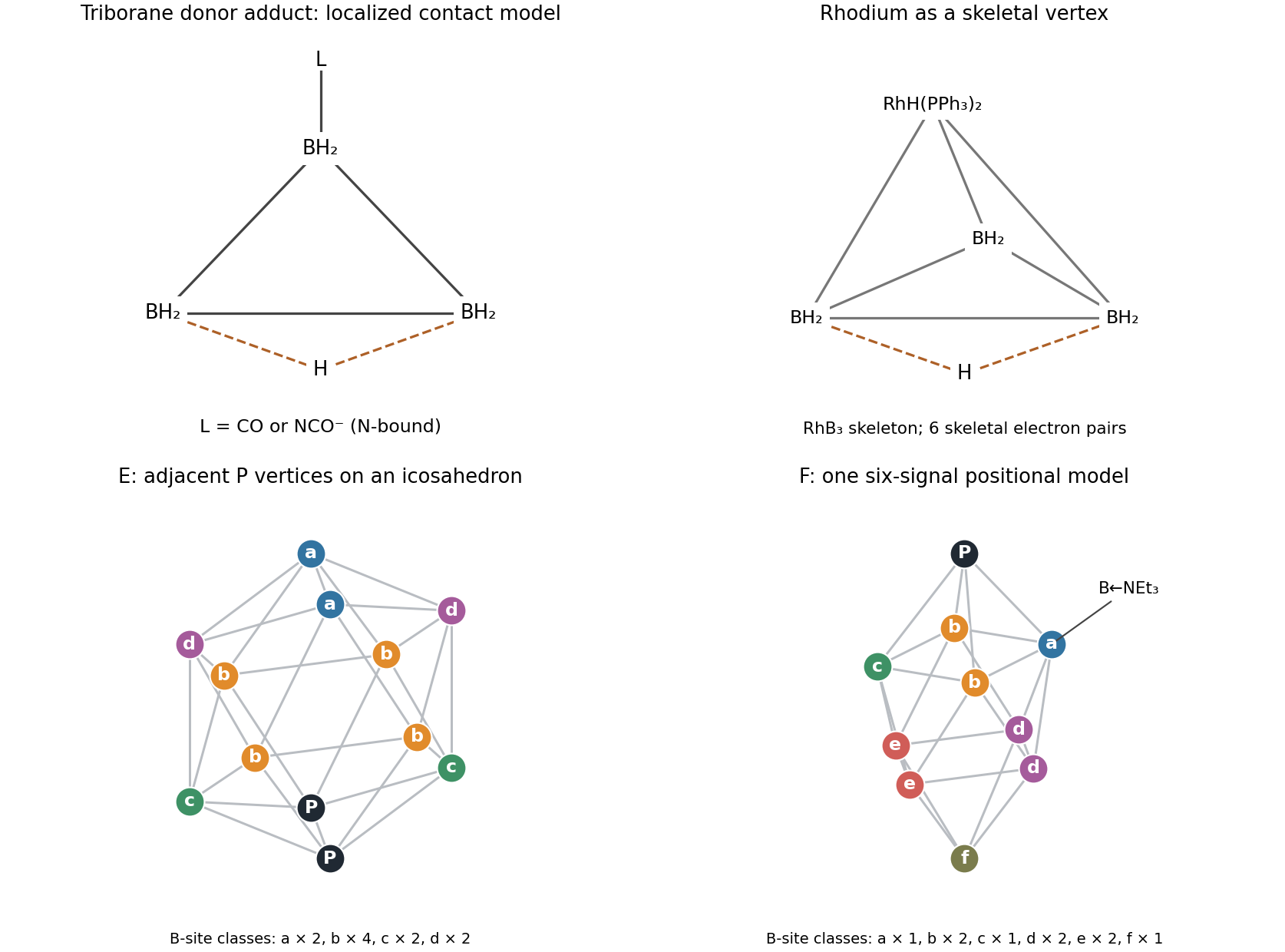
For the CO and NCO cases, the added fragment acts as a Lewis base at boron, rather than becoming a new skeletal vertex. Both have a triangular framework. A useful localized drawing has three groups, one B–H–B bridge between two of them, and the donor attached to the third boron. The boron–boron framework includes three-centre two-electron bonds; its edges should not all be read as ordinary independent two-electron single bonds.
For the neutral carbonyl adduct, attach CO through carbon, giving at the donor-bearing site. For the anionic isocyanate adduct, attach through nitrogen, giving a B–N=C=O connectivity and the overall charge. In both drawings the hydrogen count is . Weak or asymmetric additional B–H contacts can distort this idealized drawing; a hydrogen-rich borane is not fully characterized by a polygon alone. The carbonyl triborane structure was established in the original borane study.[ref]
Boranes. XXXVII. Reactions of triborane(7) and the structure of triborane(7) carbonyl by James D. Glore and others. 1973, pp.2175–2178, structural assignment of the carbonyl adduct
The rhodium fragment is instead a skeletal building block. Its neutral electron count is , so it contributes two skeletal electrons, like a BH vertex. Combining it with gives skeletal electrons, or six pairs, for four vertices. A consistent low-vertex structure is a tetrahedral skeleton, with the fragment capping the boron triangle. Keep the terminal Rh–H ligand distinct from the seven hydrogens on the borane portion. The latter can again be represented by three terminal groups and a B–H–B bridge. The total formula then contains eight hydrogens outside the phenyl groups. Treating Rh as a pendant one-centre Lewis base would miss its skeletal role.
For E, each BH supplies two skeletal electrons and each phosphorus vertex supplies three after retaining a lone pair. Hence electrons, or thirteen pairs, matching a twelve-vertex closo cluster. Place the two adjacent P vertices on a regular icosahedron. The remaining ten boron vertices fall into four symmetry classes: two sites adjacent to both P vertices, four adjacent to exactly one, two adjacent to neither but opposite the common-neighbour pair, and two opposite the P pair. The populations are , so four boron resonances are expected. Interchanging the identical phosphorus vertices is allowed when determining chemical equivalence.
For F, a ten-vertex bicapped square antiprism offers a consistent closo model. There are eight BH vertices, one B vertex bearing the donor instead of H, and one P vertex. Their skeletal contributions are respectively , and , giving 22 electrons, eleven pairs. The donor-bearing B contribution follows from B plus the donated lone pair minus the exoskeletal B–N bond, .
One explicit arrangement consistent with six boron signals puts P at one axial cap and the substituent on one B vertex of the nearer square. The remaining mirror plane through that B, the opposite vertex of its square, and the cap axis leaves three B sites individually fixed: the donor-bearing B, its opposite square vertex and the other axial cap. The other six B sites form three exchanged pairs. Thus the nine borons give three singleton environments and three two-site environments, six signals in all. The original compound has a crystallographically characterized positional assignment; the spectrum alone asks for a compatible structure and does not establish a unique positional isomer. A single-crystal X-ray diffraction determination or assigned heteronuclear correlations would distinguish alternatives.[ref]
Synthesis of polyhedral phosphaboranes: crystal structure of 6-(C2H5)3N·2-PB9H8 by John L. Little and others. 1989, pp.1087–1091, synthesis of diphosphaborane and crystallographic characterization of the amine-containing side product
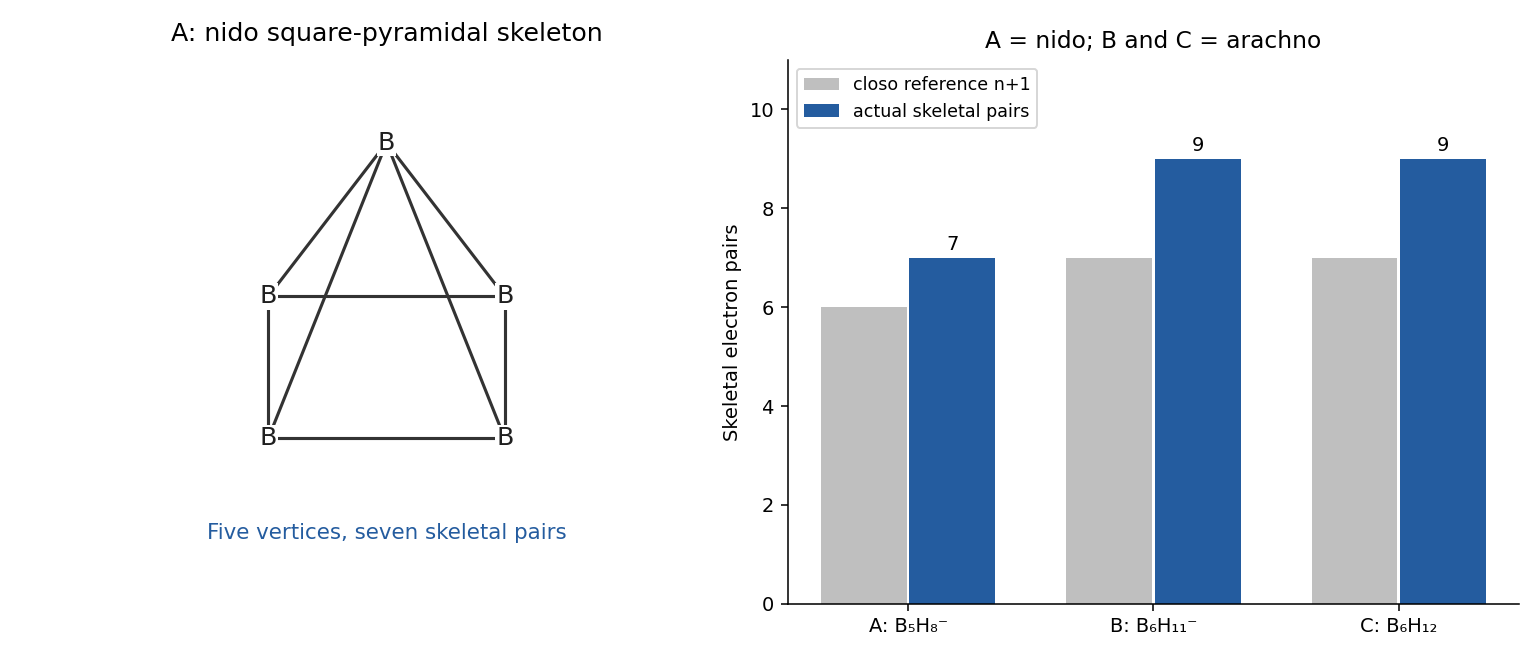
is nido; and are arachno. The initial hydride removes an acidic bridging hydrogen as a proton, releasing and retaining the potassium counterion. Addition of one unit expands the boron framework; final protonation supplies the neutral hexaborane and KCl. These assignments conserve all the atoms in the displayed sequence, without inserting an unshown dehydrogenation step.
For , take one terminal B–H bond per vertex and remove its electrons from the valence total. The skeletal electron count is . ThusWade's rules assign , and pairs to closo, nido and arachno frameworks respectively. A derives from a six-vertex closo octahedron by removal of one vertex, giving a square-pyramidal boron skeleton. B and C have six-vertex open frameworks formally derived from an eight-vertex closo polyhedron by removing two vertices. Their additional hydrogens are distributed over bridging and other open-face positions; counting every hydrogen as an independent terminal B–H vertex would give the wrong classification.
The arachno assignment of has specific theoretical and NMR support. It should not be replaced by a permanently localized, unrearranged picture: the corresponding symmetric adduct participates in fluxional rearrangement rather than being the lowest-energy structure.[ref]
The Structure of arachno-B6H11-, at -25 degrees C in (CD3)2O, Is Resolved via the ab Initio IGLO-GIAO NMR Procedure by Matthias Hofmann and others. 2000, abstract: arachno minimum, bridging-hydrogen removal from B6H12 and alternative-adduct comparison


Clean the exposed silicon and grow a thin, high-quality SiO2 gate dielectric by controlled dry thermal oxidation. Deposit polycrystalline silicon, conventionally by low-pressure chemical vapour deposition from silane, dope it in situ or by subsequent implantation and activation, and pattern/etch it to define the two gates. Phosphorus or arsenic gives n+ polysilicon; boron gives p+ polysilicon where the selected gate-work-function process requires it. A traditional single-poly process may use a common gate doping instead; gate and source/drain doping need not be identical.
The patterned gates subsequently serve as self-alignment masks for donor-doped nMOS source/drain and acceptor-doped pMOS source/drain regions. Annealing activates these dopants. Keep the oxide thin and uniform enough for strong electrostatic control but free from pinholes and excessive leakage. A high-permittivity dielectric deposited by atomic layer deposition with a metal gate is a modern alternative, rather than the conventional polysilicon/SiO2 stack drawn.