The Cabibbo-Kobayashi-Maskawa matrix compares the left-handed unitary matrices that diagonalize the up-type and down-type Yukawa matrices. Its rows label up quarks, charm quarks and top quarks; its columns label down quarks, strange quarks and bottom quarks. In the weak charged current, the coefficient of is . A single CKM matrix therefore connects quark masses, flavour-changing decay amplitudes, and CP violation.
Write and . An exactly unitary matrix with three mixing angles and one CP-violating phase isThis convention agrees with Makoto Kobayashi's account of three-generation quark mixing.[ref]
Nobel Lecture: CP violation and flavor mixing by Makoto Kobayashi. p. 1022, Section III, exact mixing matrix
The Christenson-Cronin-Fitch-Turlay kaon CP violation experiment established the phenomenon that required an explanation. Makoto Kobayashi and Toshihide Maskawa showed that two-generation quark mixing cannot supply it, whereas adding a third quark generation permits an irreducible weak phase. Their 1973 paper also considered additional fields as alternative mechanisms; the three-generation conclusion concerns CP violation from the minimal unitary quark mixing mechanism.[ref]
CP-Violation in the Renormalizable Theory of Weak Interaction by Makoto Kobayashi and Toshihide Maskawa. pp. 654 and 657, Eq. (6) and six-plet model, Eq. (13)
A common weak phase makes CP violation across mesons testable through the BABAR time-dependent CP violation experiment. It does not explain the cosmic baryon asymmetry.[ref]
Nobel Lecture: CP violation and flavor mixing by Makoto Kobayashi. p. 1024, Section IV, concluding limitations
Column orthogonality of the CKM matrix gives three complex numbersDrawing these as successive vectors in the complex plane produces a closed triangle. Its area is , because unitarity identifies this imaginary quartet with a signed Jarlskog invariant. A nonzero area therefore detects physical CP violation for nondegenerate quark masses.
For a worked example, choose the exact parametrization of the CKM matrix with , , and . These are illustrative choices, not fitted quark mixing parameters. They give . The unscaled triangle has area approximately .
Divide the closure relation by , assuming , and define the complex numberThe normalized triangle has vertices , with for these choices. Dividing each side by divides area by : its area is , approximately . The familiar normalized picture therefore does not itself have area .
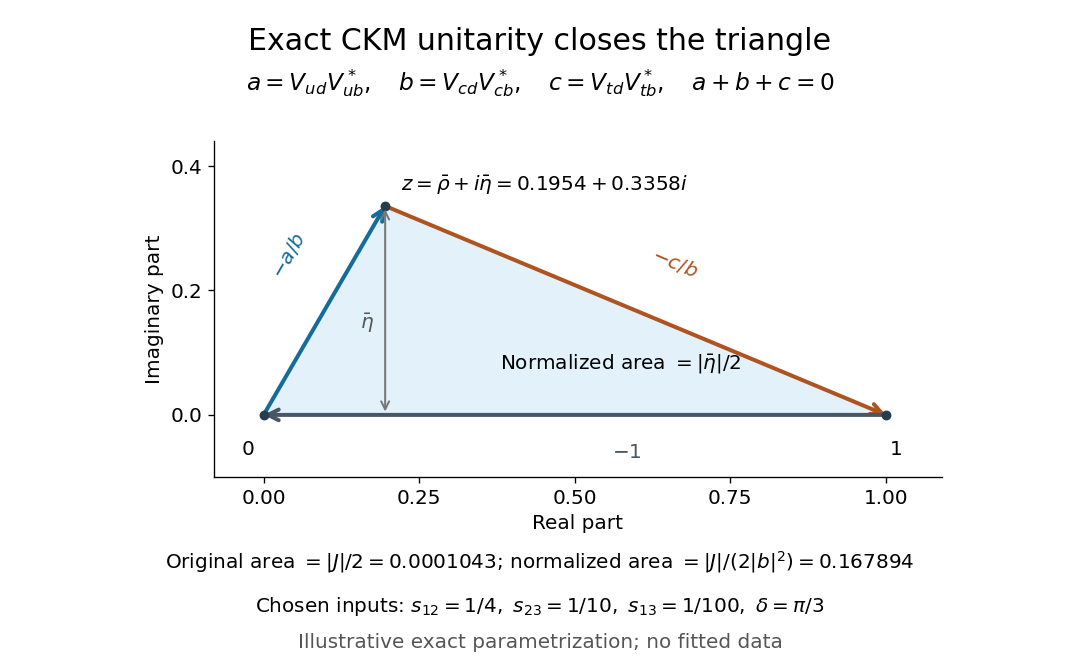
Under quantum field rephasings, all acquire the same phase, so the original triangle merely rotates and stays fixed. Ratios and angles can thus compare quark mixing measurements without dependence on field conventions. If the Jarlskog invariant vanishes, the triangle collapses; additional quark mass degeneracies require extra care in interpreting the converse.
The Wolfenstein parametrization organizes the CKM matrix in powers of a small parameter , defining and . Substitution into the exact unitary matrix gives the cubic truncationThis is a useful truncation, with entrywise corrections starting at order , rather than an exactly unitary matrix. For example, its first-row squared norm is , already different from one. The exact definitions of the sines can instead be inserted into the exact CKM matrix, retaining every cosine, to obtain exact unitarity.
For the illustrative parameters of the CKM unitarity triangle, the exact definitions give , , and . The first-row norm error in is , whereas the exact CKM matrix has unit row norms. To leading order the Jarlskog invariant is , but the exact expression includes cosine factors. The barred parameters are defined by the exact ratio in the CKM unitarity triangle; they differ from beyond leading order. This distinction matters when a geometrical closure test is used to test unitarity.
For nondegenerate quark masses, changing the constant quantum phases of quark fields preserves their diagonal mass terms. Adopt the conventionSuch quantum field rephasings alter individual entries of the CKM matrix without altering physics. Physical CP symmetry in this mixing sector means that some allowed convention makes the CKM matrix real. Toshihide Maskawa emphasized the distinction between complex entries and an irremovable CP-violating phase.[ref]
Nobel Lecture: What does CP violation tell us? by Toshihide Maskawa. pp. 1029–1030, Eqs. (1)–(2) and phase counting
Here is a constructive two-generation argument. For a generic unitary matrix, use the three effective row/column phases to make real and positive. Column orthogonality then forces to be real and negative. Row normalization leaves just the real rotation specified by the Cabibbo angle. Zero entries are limiting cases and introduce no weak phase. Thus two-generation quark mixing cannot violate CP symmetry through this mechanism, even when its entries initially look complex.
For three quark generations, the Jarlskog invariant provides an obstruction to repeating that construction: all four phase factors cancel from its defining quartet. If its imaginary part is nonzero, no choice of quantum field rephasings can make every entry real. With nondegenerate quark masses, this proves physical CP violation in the mixing sector. This argument concerns the weak interaction; it does not dispose of the separate Strong CP problem.
Under charge conjugation, becomes . Parity reverses the chirality again and applies the Lorentz parity matrix. The minus sign cancels that of charge conjugation on the charged vector field. Thus each charged-current operator is exchanged with its Hermitian conjugate under CP symmetry, giving the displayed transformation for the CKM matrix . For nondegenerate quark masses, physical CP conservation means that allowed quark rephasings can make real. A nonzero Jarlskog invariant obstructs this. A merely complex phase convention is not proof of physical CP violation, and is a CP-conserving counterexample to unconditional noninvariance.
An unitary matrix has real parameters. Its real rotation subgroup has mixing angles, leaving phases. The up-type and down-type quark fields allow quantum field rephasings, but their common phase acts trivially on the CKM matrix. Removing phases therefore leavesFor two quark generations, there is one mixing angle and no physical CP-violating phase. For three quark generations, there are three mixing angles and one physical CP-violating phase. The count describes generic, nondegenerate quark masses and generic mixing; a vanishing mixing angle can make the remaining phase unobservable, and mass degeneracies enlarge the allowed basis changes. Three quark generations permit CP violation but do not force it.
The Cabibbo angle describes the real two-generation quark mixing rotationThus , and . Nicola Cabibbo formulated the mixing of weak charged current couplings before the three-generation mechanism of CP violation; this foundational contribution is distinct from the later extension.[ref]
Nicola Cabibbo (1935-2010) by CERN. description, original weak-current formulation and later three-family extension
If two semileptonic decays differ by versus , an equal-hadronic-strength approximation and a fifth-power phase space ansatz give and . Their partial decay rates are , where is the appropriate branching fraction and the total mean lifetime. Taking the ratio gives the displayed expression. Different hadronic hadronic form factors, finite electron mass and recoil corrections prevent this simplified extraction from being an exact determination.
A small weak charged current amplitude factor associated with . A doubly suppressed amplitude contains two such factors, giving a rate suppression of order relative to a favoured process when other matrix elements are comparable.
In the charged-current spectator topology , , the magnitudes of the CKM factors give favoured, singly suppressed and doubly suppressed amplitudes of orders , and . Squaring gives rate orders , and . Two singly suppressed channels are not thereby predicted to have equal rates: hadronic matrix elements, phase space and rescattering can differ.
The Jarlskog invariant is a measure of CP violation that survives quantum field rephasings. Fix its sign by the quartetFor the exact three-generation CKM matrix, direct multiplication givesThe CKM unitarity triangle's illustrative parameters give . Setting or makes : the existence of three quark generations is necessary for this mechanism, but not sufficient for CP violation.
To see the invariance directly, the phases multiplying sum toUnder CP, the CKM matrix is complex conjugated and changes sign. In an exactly unitary three-generation CKM matrix, quartets formed from any distinct pair of rows and columns have imaginary parts equal to up to sign. This follows by multiplying a row orthogonality relation by a suitable pair of entries and taking its imaginary part: its diagonal product is real, forcing the two remaining imaginary parts to cancel. The same Jarlskog invariant therefore determines the areas of all six unscaled CKM unitarity triangles.
BABAR used asymmetric electron-Positron collisions near the Upsilon meson resonance to prepare neutral B meson pairs. It reconstructed one decay into charmonium plus a kaon, and used flavour tagging on the other B meson with charged leptons or kaons. Silicon tracking reconstructed decay vertices for the decay-time difference. Self-tagging decays calibrated mistags and time resolution; charged decays provided a control. The tagged time distributions established CP violation, limited by backgrounds, mistags and vertex alignment.[ref]
The Lorentz boost converts vertex separation to at leading order. Unequal beam energies thus make a time difference measurable as a distance.[ref]
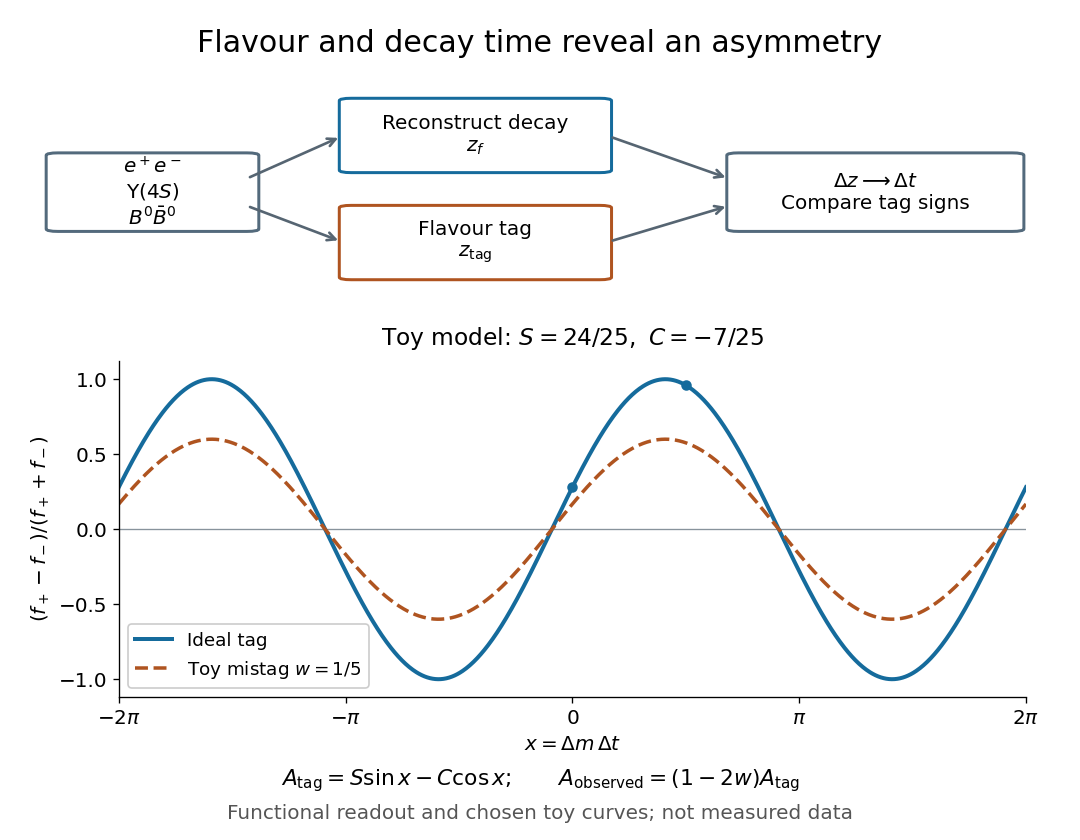
With CPT symmetry, write the propagating states of neutral meson mixing as , defining the coefficient ratio . Let be their mass splitting and use units .
For rates tagged as and , neglect the decay width difference and take . DefineHere are decay amplitudes. The tagged asymmetry is in this convention.[ref]
For a single weak phase in a charmonium-kaon CP eigenstate with eigenvalue , gives , , withThis connects the CKM unitarity triangle to quantum interference between direct decay and decay after neutral meson mixing.[ref]
Observation of CP violation in the B0 meson system by BABAR Collaboration. PDF p. 4, Eq. (1) and charmonium weak phase
For an independent teaching example choose , and an arbitrary common positive envelope . Then , andBecause , both rates remain nonnegative. At , the asymmetry is ; at , it is . These chosen values illustrate the sign convention and are not experimental estimates. More generally .
If a tag flips independently with probability , exchanging and for that fraction of events gives by direct subtraction. The plotted toy choice reduces the amplitude to of its ideal value; at the tag contains no flavour information. Finite time resolution additionally averages over nearby oscillation phases. Extracting a weak phase consequently requires calibrated readout as well as a CKM matrix prediction.
Articles by others on the same topic



The Cabibbo–Kobayashi–Maskawa (CKM) matrix is a fundamental concept in the field of particle physics, specifically in the study of the weak interaction and the quark sector of the Standard Model. It describes the mixing between the three generations of quarks and plays a crucial role in the phenomenon of flavor mixing as well as in the understanding of CP violation (charge-parity violation) in weak decays.