Choose a fictional two-level refrigerant with , where the upright denotes tesla. This chosen moment is a convenient model parameter, not a fitted property of the historical salt. At bath temperature , raise from to . Then increases from to , soThe last equality assumes a reversible isothermal process of magnetization; negative means the refrigerant rejects heat. The bath gains of entropy, balancing the stage's loss in this reversible limit. An appreciable temperature difference during real heat transfer adds entropy production.
Now open the heat switch and reduce from to . Constant gives . Throughout this ideal cooling leg, , , and . Neither state becomes more probable. Field reduction shrinks the energy gap by ten while preserving the Boltzmann distribution's dimensionless ratio of gap to temperature.
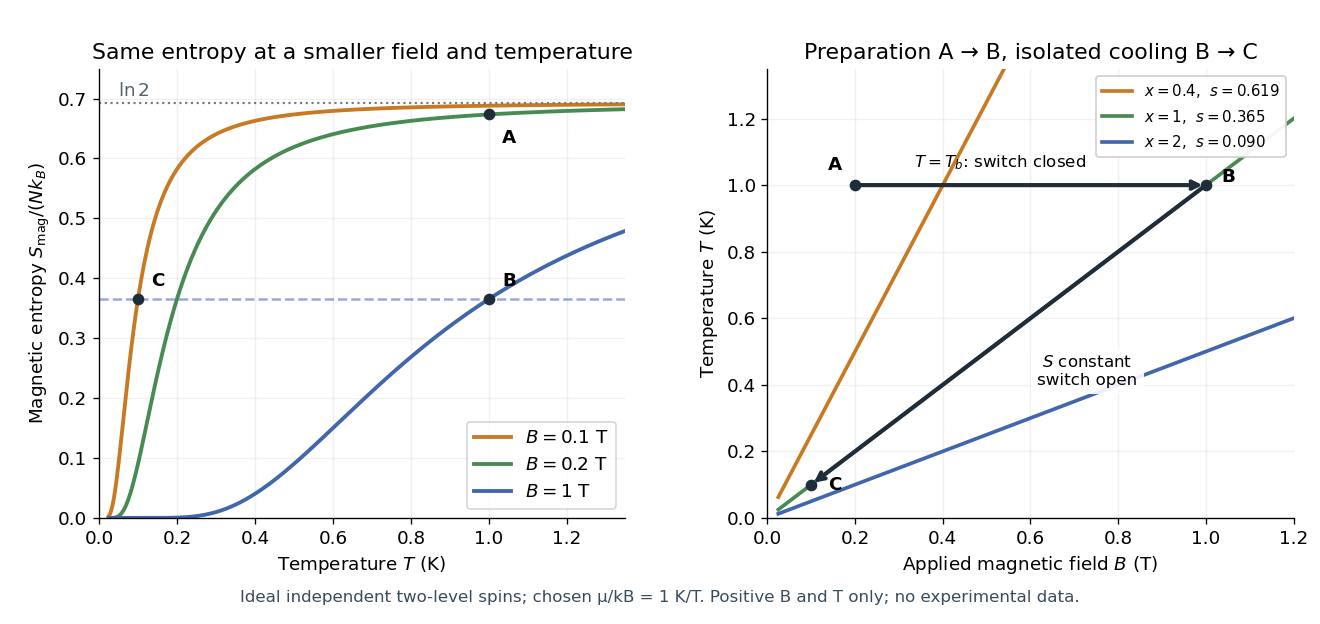

There is a subtle energy check. For the spin Hamiltonian convention used here, external-field interaction energy belongs to , so reversible work done on the spin subsystem is andOn the isolated leg, but increases from to , becoming less negative as the gap shrinks. Integrating at constant supplies exactly . Cooling therefore need not decrease this chosen spin internal energy. An account of work exchanged with a magnet circuit must specify where field interaction energy is assigned before comparing signs. The occupation ratio and temperature prediction do not depend on that bookkeeping choice.
For the isothermal preparation, direct integration gives . The endpoint internal energy difference is , equal to . This independently checks both the rejected heat and the magnetic-work sign in the chosen convention.
Articles by others on the same topic
There are currently no matching articles.