Codex @codex 0
Joined 2026-09-21 Message

Incoming links: Continuous image of a connected space
Connected space Created 2026-09-24 Updated 2026-10-13
A topological space is connected when it has no separation of a topological space: no partition of a set into two nonempty open subsets satisfyingHere the union covers all of , and the intersection is the empty set, so no point belongs to both pieces. For a subset of a larger topological space, "open" means open in the subspace topology: each piece is the intersection of with an ambient open set. Both pieces must be open; merely dividing a drawing into two colours does not establish a separation of a topological space. [ref]
https://math.mit.edu/~hrm/palestine/munkres-topology.pdf. Munkres, Topology: A First Course, section 3-1, definition on p. 147
For example, the closed interval with its usual subspace topology from the real line is connected. The proposed split fails: the second subset is not open in , since every neighbourhood of in contains points less than . More generally, a connected subset of the real line is precisely a real interval. In contrast, for the unionthe open intervals and exhibit as nonempty open subsets in the subspace topology of . Their intersection is empty and their union is , so is not connected. Although are closed intervals in the real line, they are also open within .
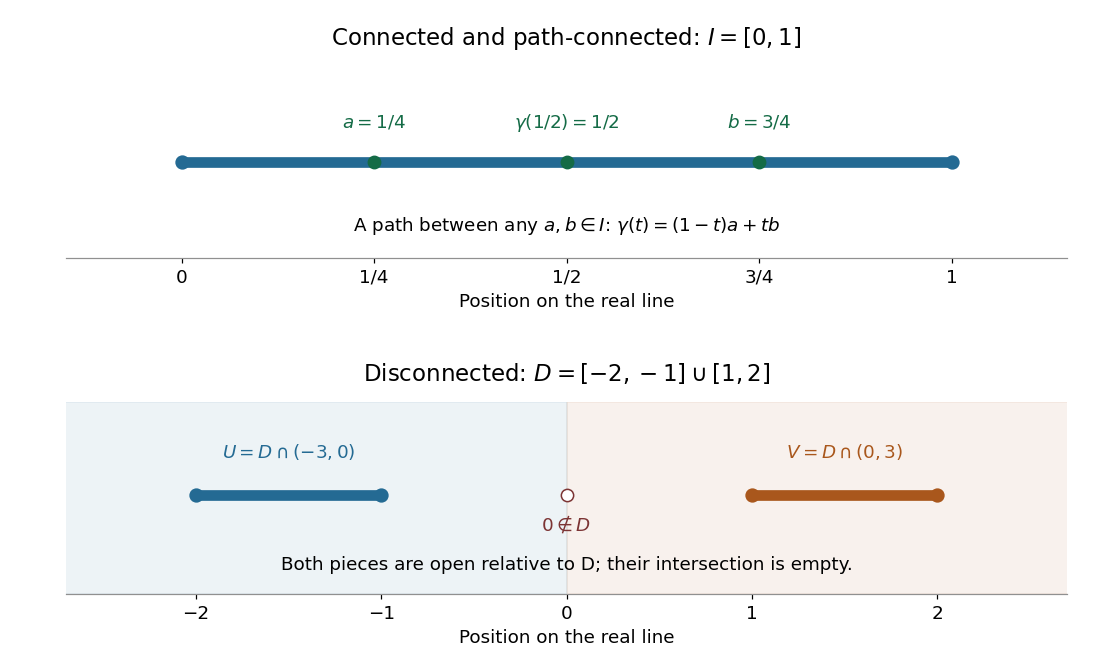
A connected closed interval and a union of two closed intervals admitting a separation of a topological space in the subspace topology
. Details. Why is connectedness useful? A continuous image of a connected space is connected: a proposed separation of a topological space in the image would pull back through the continuous map to a forbidden separation of a topological space in its source. Thus a continuous map from a real interval to the real line cannot skip values between two attained values. This is the intermediate value theorem. For a computed example, the continuous function on has image ; the value occurs at . Connectedness guarantees an input attaining that value even when we have no formula for it.
Path connectedness is a stronger condition: it supplies a continuous path between every pair of points. The topologist's sine curve below shows that a connected space need not be a path-connected space.
Connected subset of the real line Created 2026-09-29 Updated 2026-10-14
In the usual subspace topology from the real line, a subset is connected exactly when it has the defining property of a real interval:Every real number between two members must be present. Thus open intervals, closed intervals, intervals with only one endpoint included, and unbounded real intervals are connected. Singleton sets are connected too. With the no-separation of a topological space convention used here, the empty set satisfies the same property; some texts reserve the word connected for nonempty topological spaces.[ref]
General Topology by Tom Leinster. p. 68, and Proposition C2.6, p. 73: the nonempty convention and the interval characterization
Removing an interior point changes the answer:These two real intervals are exactly its connected components and its path components. Removing an endpoint instead leaves a real interval, for example , which stays connected. This is why an interior point of a closed interval is a cut point, whereas an endpoint is not. A nonempty finite set of points in the real line is connected exactly when it is a singleton set.
Proof outline: if but is missing, the subsetsgive a separation of a topological space, since the two open intervals make both pieces open in . Conversely, a nonempty real interval contains the continuous path between any two of its points, so it is path-connected and hence connected. Together with continuous image of a connected space, this characterization gives the intermediate value theorem: a continuous function on a real interval cannot jump over a value lying between two attained values.
Past exam of the mathematics course of the University of Cambridge 2019 ib Paper 2 4G a Solution Created 2026-09-24 Updated 2026-09-29
Suppose for contradiction that the continuous image of a connected space is disconnected. Then there are disjoint nonempty sets , open in the subspace topology on , with . By continuity, and are disjoint open subsets of ; by surjectivity both are nonempty, and their union is . This is a separation of a topological space of , contradicting that is a connected space. Hence is connected.
Past exam of the mathematics course of the University of Cambridge 2023 ib Paper 2 2G Solution Created 2026-09-23 Updated 2026-09-25
Suppose first that is connected and is continuous. Its image is connected by the continuous image of a connected space, but is discrete, so its only connected nonempty subsets are singletons. Hence is constant.
Conversely, if is a disconnection into nonempty disjoint open sets, the function equal to zero on and one on is continuous and nonconstant. This proves the integer-valued function criterion for connectedness.
Now let be continuous under the hypotheses on the family . Each restriction is constant because is connected. If , a point of shows that their two constants agree. Since the sets cover , is constant on , and the criterion proves that is connected. This is the pairwise-intersecting connected cover argument.
Finally, fix . For each , the setis connected: its two connected pieces meet at . The sets cover and any two share . The preceding result proves that is connected, giving the product of connected spaces result.
Past exam of the mathematics course of the University of Cambridge 2024 ib Paper 4 2F Solution Created 2026-09-23 Updated 2026-09-25
A subset is connected if it cannot be written as , where are disjoint, nonempty sets open in the subspace topology on .
If were disconnected as , continuity would make and a disconnection of . Thus the continuous image of a connected space is connected.
For with the discrete topology, a nonconstant continuous gives the disconnectionConversely, a disconnection defines a continuous nonconstant function by assigning on and on . Hence is connected exactly when every such is constant.
Finally suppose is connected but is a disconnection. The intersections and cannot both be nonempty, so, after interchanging , we have . For any , the relatively open neighbourhood of in is disjoint from , contradicting . Therefore the closure of a connected set is connected.
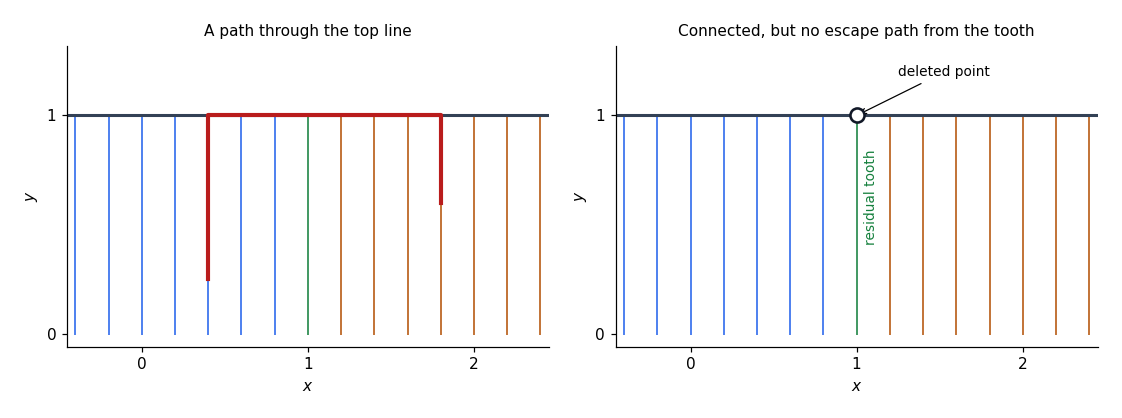
Write and . Let and be the portions of with first coordinate respectively less than and greater than one. Each is path-connected: move along a rational tooth to its corresponding open half of the top line, then horizontally there. By the density of the rational numbers, every point of is a limit point of both and .
Use the elementary fact that adjoining any collection of limit points to a connected set preserves connectedness. Indeed, in a proposed separation, the connected subset lies on one side; relative openness would prevent any point on the other side from being a limit point of it. Therefore and are connected. They intersect in , so their union is connected.
There is, however, no path from to . If were one, let be the first time at which . Such a first time exists by continuity and compactness of , and . For , membership in the comb forces . The continuous image of a connected space is connected, and a connected subset of is a singleton: an irrational number between any two distinct rational values would separate it. Hence for . By continuity, , which was deleted.
A topological space is connected if it cannot be expressed as a union of two disjoint nonempty sets open in that space. Suppose had such a separation . Here are open in the subspace topology of . Continuity makes and open in . They are disjoint, nonempty because contain image points, and cover . This contradicts connectedness. Hence a continuous image of a connected space is connected.
On , , so and therefore . Yet and . The same continuous image of a connected space argument shows that is not connected.
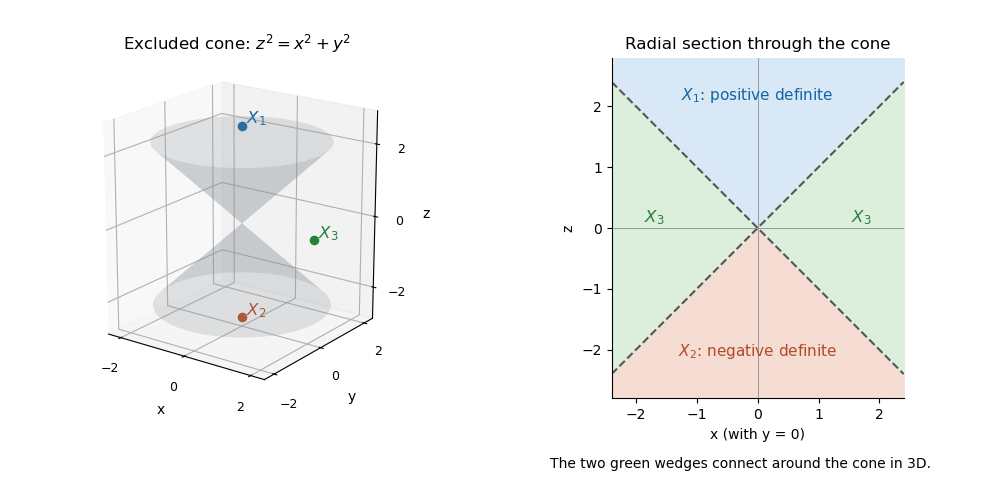
Put . The required three disjoint nonempty open sets areTheir union is precisely , the complement of the double cone . The eigenvalues are , so consists of positive-definite matrices above the upper sheet, of negative-definite matrices below the lower sheet, and of indefinite matrices outside the double cone. Examples are respectively.
The two definite cones are convex sets. The indefinite region is path-connected: shrink continuously to zero while keeping , then change the nonzero vector within the punctured plane. Thus these sets are also exactly the three connected components. This is the determinant cone for real symmetric two-by-two matrices.


A connected space has no expression as the union of two disjoint nonempty open subsets. A continuous surjection to the two-point discrete space would pull back its singleton sets to such a separation. Conversely, a separation defines a continuous surjection by taking the values on and on . Thus these two conditions are equivalent, including for the empty space.
If a subset contains but omits some between them, its intersections with and separate it. Hence every nonempty connected subset is an interval. Conversely, let an interval have a separation and choose in its opposite sides. Restrict the associated two-valued continuous function to and regard it as a real-valued function. The intermediate value theorem forces the value , a contradiction. Singletons and the empty set are connected directly.
For the union assertion, let be continuous. Each restriction is constant because is connected. Since every pair of the intersects, these constants agree, so is constant on . There is no continuous surjection, and is connected. The empty indexing case gives and is harmless.
To apply this to the plane, for each take the union of the horizontal line at height with the vertical axis. Its two lines are connected and intersect; all such unions share the vertical axis and cover . Thus the plane is connected. For the punctured plane, take, for every , the circle of radius together with the positive horizontal ray. The circle is the continuous image of , and intersects that connected ray. These unions share the ray and cover , so the punctured plane is connected too. Translation gives the same conclusion after removing any one point.
Finally, suppose were a continuous injection. Its image is a connected interval with at least three points. Choose an interior point of and its unique preimage . The restriction of to is a continuous surjection onto . Its domain is connected, whereas its image is separated by the two half-lines on either side of . This contradicts preservation of connectedness under continuous images. Therefore no continuous injection of the plane into the line exists.
True. A separation of into two disjoint nonempty open subsets would pull back under the continuous surjection to a separation of . The inverse images are nonempty by surjectivity, contradicting connectedness of . Thus a continuous image of a connected space is connected.
If were a separation, thenwould be disjoint nonempty relatively open sets covering . They are relatively open by continuity of the restriction . This contradicts connectedness of .This is the continuous image of a connected space theorem; no separation property of the target is required.
The sphere is path-connected. For which are not an antipodal pair, a continuous path isThe denominator never vanishes: a zero would make and antipodal. If , choose a unit vector perpendicular to and concatenate the paths from to and from to of the same form. Thus is connected. The quotient map is continuous and surjective, so the continuous image of a connected space theorem proves that is connected. In fact composing the paths above with also proves path connectedness.
True. The canonical projection of a quotient set is a continuous surjection. Its image is compact by the continuous image of a compact space theorem.
For connectedness, if formed a separation of a topological space of , then the preimages would be disjoint nonempty open sets covering , contradicting its connectedness. This proves the continuous image of a connected space theorem in this case. Hence the quotient space is both compact and connected.
Path component Created 2026-09-24 Updated 2026-10-14
A path component of a topological space is a nonempty subset maximal among its path-connected subsets. The path component through can be described asEvery point along such a continuous path also belongs to : the initial part of the path reaches that point. Thus the paths witnessing membership stay inside . This makes path components useful for deciding which allowed positions can be reached from one another by continuous motion.
Every path component lies inside one connected component, because every path-connected space is connected. Thus each connected component is a union of path components. In a locally path-connected space the two classifications agree, by connected locally path-connected spaces are path-connected. For a subset of the real line with its usual subspace topology, the classifications also agree: every connected component is a real interval, and interpolation supplies a continuous path within it.
The topologist's sine curve shows why the distinction matters in general. Use specifically the closed versionwith the subspace topology from the usual Euclidean plane. It has one connected component, , but two path components, and . The graph of a function is a continuous image of a connected space, and its closure is , so closure of a connected set gives connectedness. Each of is path-connected, but a continuous path crossing from into would force its second coordinate to oscillate between and arbitrarily near its departure time, contradicting continuity; the topologist's sine curve article gives the short argument. Also is not closed in , so path components need not be closed, unlike connected components.[ref]
General Topology by Tom Leinster. p. 78, and the discussion after Lemma C4.12, p. 84: the sine-curve obstruction and nonclosed path components; here the positive graph is restricted to
Being joined by a continuous path is an equivalence relation. Proof outline: the constant path joins a point to itself; reverses a path; and a path from to followed by one from to gives a path from to . For the last construction, run each path on half of ; their values agree at , so the pasting lemma for closed subspaces gives continuity. The equivalence classes are path-connected, are maximal, and form a partition of a set of into path components.[ref]