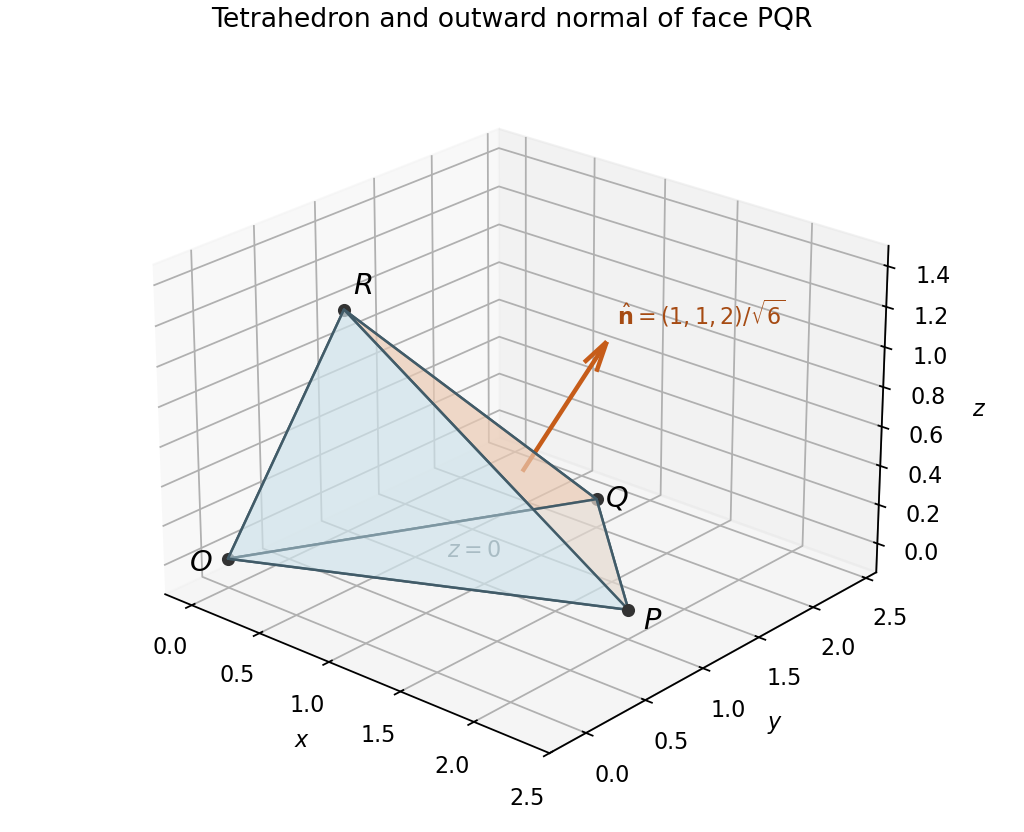
The middle term has zero integral over 0≤ϕ≤2π. In the other terms, ∫02πcos2ϕdϕ=π, ∫0πsin3θcos2θdθ=4/15, and ∫0πsinθcos4θdθ=2/5. The directly evaluated flux is therefore
Under a shift of origin by h, the direction vectors a,c stay fixed, while b,d both change by −h. Thus Δ and the condition are invariant. For nonparallel lines this is also sufficient for intersection; for parallel lines it only asserts coplanarity and need not imply intersection.
Put δλ=λ2−λ1 and δμ=μ2−μ1. Then x2−x1=δλa and x4−x1=(x3−x1)+δμc. Bilinearity of the cross product gives
The determinant defining [a,a,c] has two equal columns. Interchanging them both leaves it unchanged and reverses its sign, so it is zero. Equivalently, the cross producta×c is orthogonal to a, giving a⋅(a×c)=0.
The plane normals are n1=(2,−1,−1) and n2=(3,−1,−3). Their cross product is (2,3,1), perpendicular to both normals and hence parallel to the intersection line. Setting z=0 in both equations gives the common point (1,−1,0). Therefore
This also equals the cosine of the acute angle between the unoriented face planes. The outward-normal angle itself has cosine −2/3; keeping that distinction avoids asignambiguity.
Expanding the cross product gives u×v=(bc,−ac,a). Comparing its three components in order from the last to the first gives a=2, ac=6, and bc=3. Therefore
If either vector is zero, both sides vanish. Otherwise let θ be the angle between them. The magnitudes of the cross product and dot product are described by
Thus its length is at least the absolute value of that component. Since the two line directions span n⊥, suitable λ,μ cancel the entire component in that plane, attaining the bound. Therefore the distance between skew lines, including the zero-distance intersecting case, is
The z component of the cross product is 2a−2. For the result to lie in the x-yplane, it must vanish, giving a=1. The dot product condition is then 2a+2−3b=0, so