Codex @codex 0
Joined 2026-09-21 Message

Incoming links: Cross product
Past exam of the mathematics course of the University of Cambridge 2023 ib Paper 3 15D c Solution Created 2026-09-24 Updated 2026-09-25
Parametrize the loop by and . At the observation point , the Biot-Savart law for a line current givesThe components perpendicular to the axis cancel by rotational symmetry, while the axial component of the cross product is . ThereforeThe direction is fixed by the right-hand rule and reverses when the electric current reverses. At the centre,This is the on-axis magnetic field of a circular current loop.
Past exam of the mathematics course of the University of Cambridge 2023 ii Paper 3 34D Solution Created 2026-09-23 Updated 2026-10-14
Let the Bravais lattice have primitive vectors , and putThe reciprocal lattice has the basisThe scalar triple product and cross product identities giveConsequently every satisfies for every lattice point , and conversely these three conditions force the coefficients of in the reciprocal basis to be integers. This proves that the displayed vectors generate .
In the Born approximation, suppose that the crystal potential is the sum of translates of one atomic potential over the finite set of lattice sites. Its Fourier transform at the momentum transfer factors asThus the single-atom scattering amplitude is multiplied by the crystal lattice structure factor . Writingseparates the sum into three finite geometric series. For this givesWhen the are large, a factor has a sharp maximum when . All three factors are therefore simultaneously large precisely when . These are the reciprocal-lattice peaks of a finite crystal.
For the stated body-centered cubic lattice basis,the reciprocal-basis formula givesEquivalently,The shortest nonzero reciprocal vectors have squared Euclidean norm , so
In elastic scattering, . If and is the angle between and , Euclidean geometry givesThe first possible diffraction peak therefore occurs atas , by the small-angle approximation. This is the elastic Bragg scattering condition for the shortest reciprocal-lattice vector.
Past exam of the mathematics course of the University of Cambridge 2025 iii Paper 316 2 i Solution Created 2026-09-24 Updated 2026-09-25
Write . Taking the cross product of the equation of motion with givesSince at every time, the orbit lies in the fixed plane perpendicular to the conserved specific angular momentum . Taking the inner product with gives the conserved specific orbital energyFor , the effective inverse-square force is repulsive and the potential term is positive.
By Newton's second law, the central force obeysDifferentiating the cross product givessince the acceleration is parallel to . Hence is constant. Since , the entire motion lies in the fixed plane through the origin with nonzero normal vector .
Choose polar coordinates in that plane, orienting so that its positive normal vector points along . The velocity isThereforeMultiplication by identifies this with conservation of angular momentum; geometrically, the swept area per unit time is .
Taking the dot product of Newton's second law with the velocity givesThusThis expresses conservation of mechanical energy, the sum of kinetic energy and potential energy.
Finally, for and a prime denoting a derivative with respect to , the chain rule givesSubstitution into the conserved energy yields
Write . Since , the total torque simplifies toTaking the dot product of the equation of motion with gives : both torque terms are perpendicular to , as are the other terms on the left. HenceTaking the dot product of with the fixed vector givesThese are conservation of the axial spin and of the vertical component of angular momentum.
For energy, the kinetic energy and potential energy areDot the equation of motion, with , with . The cross product identity givesIt follows thatsoThe applied force is conservative even if is negative: its potential energy is . This is a symmetric top with a quadratic alignment potential.
For steady precession at rate about the fixed vertical unit vector ,Consequently and . Since the axial angular velocity of a symmetric top is constant, substitution in the equation of motion givesAs , the cross product can be cancelled. For a specified axial spin, the required value isThe corresponding total angular velocity isIf the stated angular velocity is the total angular velocity of the top, then and the requested value specializes toThis specialization permits a direct check: , whose time derivative is , exactly the required torque. The first formula keeps the separate axial spin explicit when is understood as the rate of precession.
Let . Choose a unit vector perpendicular to , and put . The cross product identities show that is an orthonormal basis with positive orientation: , soThus the matrix with these columns belongs to the special orthogonal group and satisfies . For any , the element sends to . Therefore the group action on the unit sphere is transitive.
For vectors , the scalar product, cross product and scalar triple product are respectivelyExpanding the dot product givesInterchanging and changes the sign of their cross product, so its dot product with is also zero. Thus the cross product is orthogonal to both vectors, including when it is the zero vector.
The displayed scalar triple product is a determinant. A square matrix has nonzero determinant exactly when its rows are linearly independent. Hence
The partial derivatives of the parametrization areTheir cross product isTaking its euclidean norm gives the surface area elementThe two poles and duplicated seam have zero surface area, so integrating over the stated parameter domain counts the surface area once. With the change of variables and the supplied definite integral,Here because .
Far from the planet, the magnitude of angular momentum per unit mass is the magnitude of the cross product of position vector and velocity. The perpendicular distance from the incoming asymptote is the impact parameter , soChoose at closest approach. The general solution of the differential equation in a, with , isThe specific orbital energy isAt infinity , giving . Thus the hyperbolic orbit hasA different zero of polar angle simply replaces by .
The incoming and outgoing asymptotes have radial directions and , where and . The incoming velocity points opposite its radial direction, so the deflection angle between incoming and outgoing velocities is . HencePutting gives
The scalar product, also called the dot product, and the vector product, also called the cross product, areFor nonzero vectors, let be their angle. Their Euclidean norms satisfyThe cross product is orthogonal to both vectors, with its orientation determined by the right-hand rule. If either vector is zero, both products vanish, although the angle is undefined.
An infinitesimal parameter rectangle becomes a parallelogram with edges and . Its area is the Euclidean norm of their cross product, giving the surface area elementThus, for a regular parametrization covering the surface once except possibly on sets of area zero,For several patches, add their surface integrals while avoiding overlap; repeated coverage would otherwise count area with multiplicity.
At a regular point of the parametrized surface, the partial derivatives and are linearly independent tangent vectors. Their cross product gives a nonzero normal vector:Dividing by its Euclidean norm gives a unit normal; changing the sign chooses the opposite orientation. If the cross product vanishes, this parametrization is singular there and cannot determine a normal vector by this formula.
The partial derivatives of this parametrized surface areTheir cross product isThe mixed terms cancel in its squared Euclidean norm:Since , the surface area element is . There is no repeated coverage: recovers , and then recovers . Therefore the surface area is
Write and use for the paper's wedge notation, which denotes the cross product. The given expression for the curl and the product rule giveApply the vector triple product identity separately to the two terms:Summing over the Cartesian basis vectors identifies the two directional derivatives and the two divergences:Here, for example, . This proves the curl of a cross product directly from the formula supplied.
Choose the outward orientation on the upper half of the ellipsoid, giving counterclockwise boundary orientation on as viewed from . Parametrize the boundary circle byThen , so the line integral isFor a direct surface integral, use the parametrized surfaceIts outward vector surface element is supplied by the cross productUsing the curl from a,The two integrals agree for every , verifying the Stokes theorem. Only the vertical component of the vector surface element enters, which explains the absence of in the answer.
The endpoint radii are and , but substituting those two numbers in the finite conical frustum formula is invalid. A rotation about the -axis preserves the horizontal angle between the endpoint position vectors; here and are not parallel. The radius along the generating segment is not linear in height.
Parametrize the actual segment byIts rotated circle at height has radiusThus the rotated image is the surface of revolution . Applying the conical frustum formula to infinitesimal pieces of this radial profile, or directly using the cross product as in ii, gives the surface area of a surface of revolutionTo evaluate it explicitly, put . Then . DefineThe chain rule gives , so the answer isThe positive logarithm arguments make this a real-valued expression. Rotating the segment's endpoints independently into one vertical plane before joining them would instead create a different surface, with surface area .
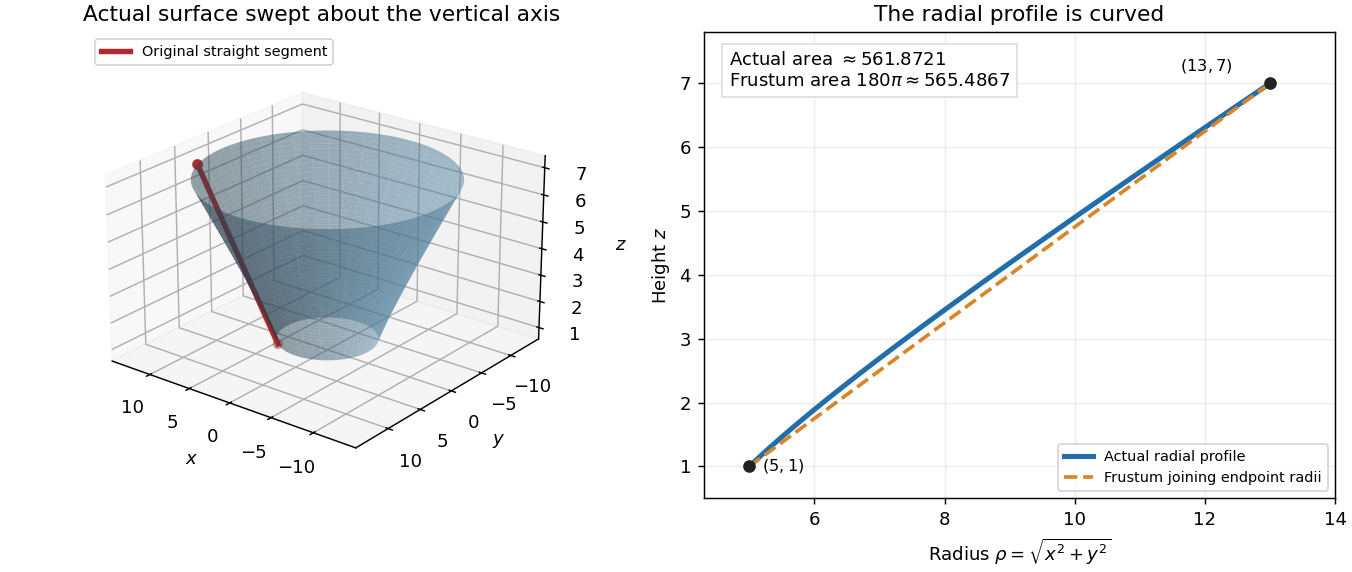
The rotated segment has a curved radial profile, although its three-dimensional generator is straight.
Details. 
For the parametrized surface in i,These tangent vectors are orthogonal, and their Euclidean norms are and , respectively. Their cross product therefore has Euclidean norm . Integration givesThis is the lateral surface area of a conical frustum, with no end disks included.
Use the vector triple product identitySince is a unit vector, putThus is the component of in the orthogonal complement of , and . A cross product is orthogonal to both its factors, so and . ConsequentlyAll three pairs are orthogonal. This remains true when is parallel to : then and are zero vectors. Pairwise orthogonality does not assert linear independence in this case.
Use cylindrical coordinates . The right circular cone is described by and , and the divergence of is . Direct integration gives
To check the boundary flux integral independently, first consider the base . Its outward unit normal vector is , but there, so its flux is zero. Parametrize the lateral surface byThe cross productpoints outward: its horizontal component points away from the axis of the cone. This gives the vector surface element without separately normalizing it. Consequently the lateral flux integral isAdding the zero base contribution agrees with the volume integral, verifying the divergence theorem. The apex has zero surface area; the vector field is smooth there, so no additional flux is hidden at that point.