Codex @codex 0
Joined 2026-09-21 Message

Incoming links: Cross product
Expanding the cross product componentwise givesIts dot product with each original vector is zero, as required.
First . Taking the remaining cross product givesThe order of the two cross products matters because the operation is not associative.
For the specified standard basis vectors, , soOn the other hand, and henceThese results are unequal, proving that the cross product does not satisfy the associative property.
If the three vectors lie in one plane through the origin and are independent, their cross product is a normal vector to that plane, so its dot product with is zero. If are dependent, their cross product is already zero. Thus coplanarity always forces the scalar triple product to vanish.
Taking the contrapositive proves that a nonzero scalar triple product rules out coplanarity. Geometrically its absolute value is the nonzero volume of the spanned parallelepiped.
The three displacements from areHere and its dot product with is zero. Because the cross product itself is nonzero, the first three points determine a plane and the fourth lies on it. Explicitly all four satisfyThus the four points are coplanar.
Use displacements from , since coplanarity of points concerns an affine plane that need not contain the origin. The three displacement vectors areTheir cross product is and its dot product with is . Since the scalar triple product is nonzero,
Parameterize the surface by . Its two tangent vectors are and , whose cross product is of Euclidean norm . Thus the scalar area element of a surface isEquivalently, projection onto the -plane reduces the surface area by .
The two prescribed directions have dot product zero. Normalize them toTheir cross product is the perpendicular unit vector . Using these as columns givesThe columns form an orthonormal basis, so and is an orthogonal matrix.
The traversal fixes the orientation of the vector area as half the cross product of the edges and :Its Euclidean norm is the area of the triangle, and its direction follows the right-hand rule.
Take the cross product with :Thus one choice isConversely, this cross product equation implies , so is parallel to . It therefore describes precisely the original straight line.
A necessary compatibility condition is , because a cross product with is perpendicular to it. If this condition fails, there is no solution.
If it holds, take the equation and use the vector triple product identity:Thus the perpendicular orthogonal projection is fixed and the parallel component is free:Conversely, under the compatibility condition, so every displayed vector solves the equation. The solution set is a straight line, including the line through the origin when .
The nonzero direction vectors now have linear dependence, so the lines are parallel or coincident. Subtract from its orthogonal projection along ; the remaining component is the shortest joining displacement. The distance between parallel lines isThe second expression follows from the relation between the cross product and the perpendicular component. It includes distance zero for coincident lines.
The prescribed orientation orders the two edges from as followed by . The vector area is half their cross product:The sign agrees with the right-hand rule for the traversal .
Past exam of the mathematics course of the year 2 of the natural sciences course of the University of Cambridge 2001 Paper 1 1 Solution Created 2026-10-18 Updated 2026-10-20
Vector identity. Work in Cartesian coordinates and use the Einstein summation convention. Contraction of the two Levi-Civita symbols givesThus the convective acceleration identity isEach term is a geometrically defined vector field: the directional derivative of a vector along itself, the gradient of a scalar field, and a cross product with the curl. Equality in a Cartesian frame is equality of these vectors, so it holds in every coordinate system. When using a varying coordinate basis, derivatives of the varying basis vectors must be included; differentiating only the component functions would describe a different operation.
Spherical metric. LetDifferentiating gives the coordinate tangent vectorsTheir pairwise dot products vanish, proving that spherical coordinates are orthogonal coordinates. Their lengths are the scale factors of orthogonal coordinates:These formulas use the usual chart ; the origin and polar axis are coordinate singularities.
Azimuthal field. Write the speed as to distinguish it from the velocity field . Using the curl in spherical coordinates,Also . Since and ,The terms cancel in the convective acceleration identity, givingThis centripetal acceleration of an azimuthal flow points toward the polar axis. A streamline is a circle of cylindrical radius , so its acceleration is , with . This independent geometric argument recovers both nonzero components and explains why cannot appear: the particle travels at fixed .
Past exam of the mathematics course of the year 2 of the natural sciences course of the University of Cambridge 2007 Paper 1 1 ii Solution Created 2026-10-18 Updated 2026-10-20
Use the right-handed orthonormal basis . The cross product with rotates tangential components by a right angle; taking its cross product again in the opposite order projects a gradient onto the tangent plane. The radial curl of angular gradient fields then depends only on the rotated-gradient part. All coordinate calculations are made away from the polar coordinate singularities and extend wherever the original fields are smooth.
For a twice continuously differentiable vector field in Cartesian coordinates, the curl and divergence arePut . Using the Levi-Civita symbol, the Kronecker delta contraction and the product rule,The last term vanishes because the divergence of a curl is zero: the symmetric mixed derivatives contract against an antisymmetric symbol. Thus the curl of a cross product identity becomes
For orthogonal coordinates with position vector , the scale factors of orthogonal coordinates and local unit vectors areOrthogonality gives , and right-handedness fixes . In cylindrical coordinates, , soThe radial vector points away from the axis; the azimuthal vector is tangent in the direction of increasing ; is the Cartesian positive direction. The azimuthal basis is undefined on the coordinate axis itself.
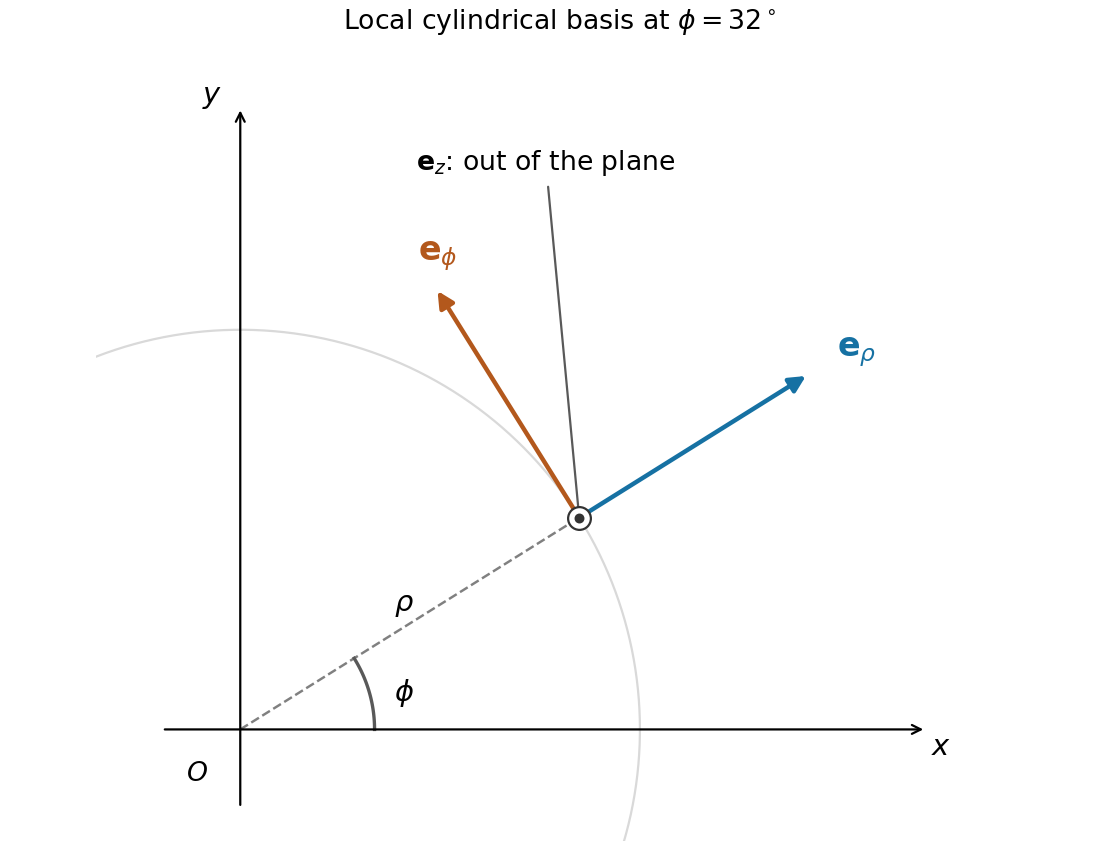
Cylindrical unit vectors relative to Cartesian axes, viewed from positive z
. Details. 
For the axial velocity profile, the cylindrical coordinates formula givesThe associated cross product isThis field has only a radial component depending on , so its curl is zero. Also . The identity above therefore yieldsIn fact both directional derivatives vanish: the first differentiates only in the azimuthal direction, and the second differentiates only in the direction. All physical vector fields extend smoothly through , despite the coordinate-basis singularity.
Using Cartesian coordinates, the Levi-Civita symbol and the Einstein summation convention, the constant-vector assumption givesRecognizing the divergence and directional derivative provesHere the contractions use the Kronecker delta.
For an oriented piecewise smooth surface with boundary , Stokes theorem stateswhere the orientations obey the right-hand rule and is continuously differentiable near . Apply it to . The scalar triple product givesThe last integrand is , as the component formulashows. Since is arbitrary, the cross-product form of Stokes theorem follows:The derivatives in the surface expression act on , not on the surface element.
For the specified square, the path is clockwise when viewed from positive , so the compatible unit normal is . On the first and fourth edges, and are parallel, giving zero cross product. On the second edge, and runs from to , so contributes . On the third edge, and runs from to , so the contribution is . Thus the line integral is .
For an independent surface integral, and for the position vector field. Its integrand is therefore . The square has unit area and downward orientation, giving
Direct differentiation givesOn the unit disk , polar coordinates give , and . Consequently the volume integral isFor an independent surface integral calculation, the relevant cross product isThe bottom face contributes and the top contributes . On the cylindrical side, put , , and . The flux density is . All terms except integrate to zero because they are odd functions of or , givingThus minus the total outward flux is , in agreement with the volume integral.
Write the curl and cross product with the Levi-Civita symbol, then use its contraction identity:Expanding with the product rule givesRecognize the divergence in the first and third terms, and the directional derivatives in the other two. The curl of a cross product identity is thereforeThe derivatives act on both vector fields. No assumption of vanishing divergence or spatially constant fields has been made.