Consider an original ideal model: of hydrochloric acid at , titrated with sodium hydroxide at . Treat these numbers as exact model inputs. Assume complete dissociation of an ionic compound, complete strong acid ionization, additive volumes, uniform mixing, and activity coefficients equal to one. Use stipulated , approximately appropriate near . These are calculated pH values, not measurements of these materials.
The chemical equation for neutralization isInitial acid inventory is , so the equivalence point is . Added water does not change this inventory. But the final volume , including the titrant, determines all concentrations.
Keep self-ionization of water even at the equivalence point. With , define the dimensionless acid excess , hydronium level , and hydroxide level byThe sodium cation and chloride anion inventories fix the electric charge balance , while chemical equilibrium gives . Eliminating yields a quadratic equation with exactly one positive root. For stable calculation on either side, writeThe second expression follows by multiplying by ; it avoids subtracting two nearly equal large quantities on the alkaline side. A logarithm acts on the dimensionless , as required by the pH definition.
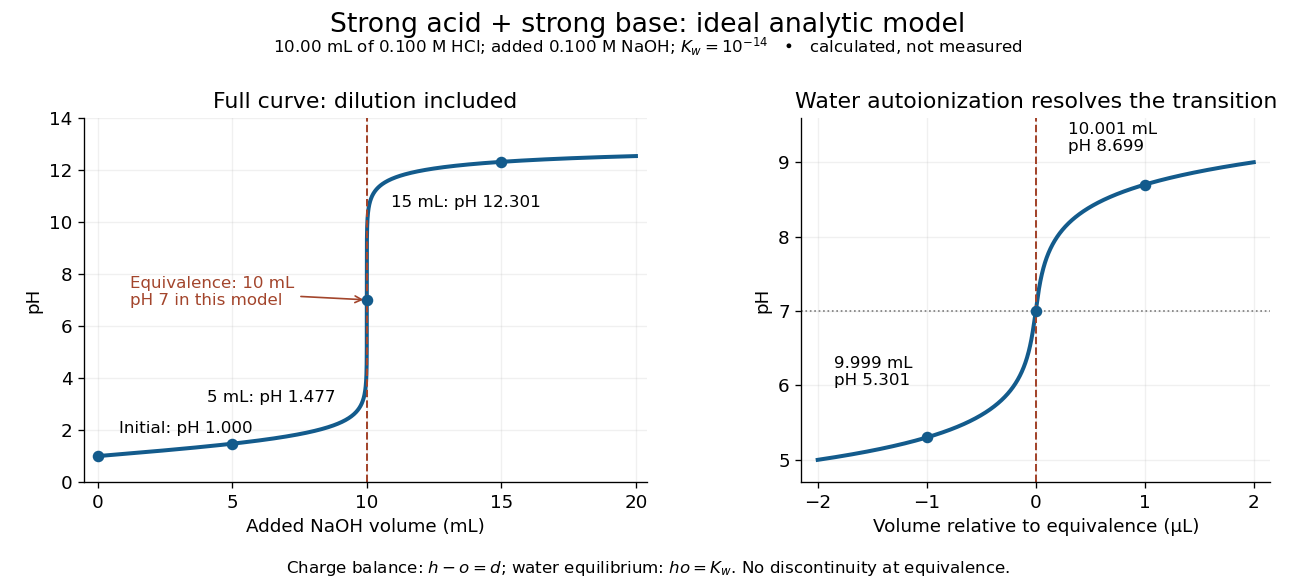
An ideal strong acid titration curve stays smooth through its equivalence point because of self-ionization of water
. Original analytic model for of hydrochloric acid and sodium hydroxide, with . Both panels use the complete electric charge balance and ideal chemical equilibrium. The right panel resolves microlitre additions around the equivalence point. The marked points are calculated, not measured. Details.
At , the excess is in , giving and pH . At , excess hydroxide is in , giving and pH . Neglecting dilution would give the wrong values even far from the equivalence point.
Exactly at , and , giving pH in this model. At and , the same smooth expression gives pH and . The familiar excess-only formulas would predict zero hydronium or zero hydroxide at the equivalence point; retaining self-ionization of water removes that failure. A steep curve is still continuous.
The sensitivity is especially revealing. Differentiating giveswhen . At this model's equivalence point, the derivative is about pH units per millilitre. This is a local derivative, not a linear prediction over a whole drop. Real endpoint accuracy also depends on dosing, mixing, measurement uncertainty, temperature, extra reacting chemical species, and nonideal thermodynamic activities.
Articles by others on the same topic
There are currently no matching articles.