For the Gauss-Seidel iteration for a two-variable positive-definite system, define the forward error by and . Subtract the two exact solution equations from the two update equations:The fresh first coordinate passes the old second-coordinate error through two successive factors. The iteration matrix is thereforeIts eigenvalues are and , as seen from the determinant. The zero eigenvalue explains why the old first-coordinate error disappears completely: the first row overwrites it. After one sweep, every remaining forward error lies on the eigenvector line spanned by .
For this zero start, , so the exact vectors for areThe Euclidean norm of the forward error decreases by exactly per sweep from onward. The first decrease is different because the initial error has not yet reached that eigenvector line. Each row update moves horizontally or vertically in the coordinate plane; sweep endpoints then approach the solution along one straight line.
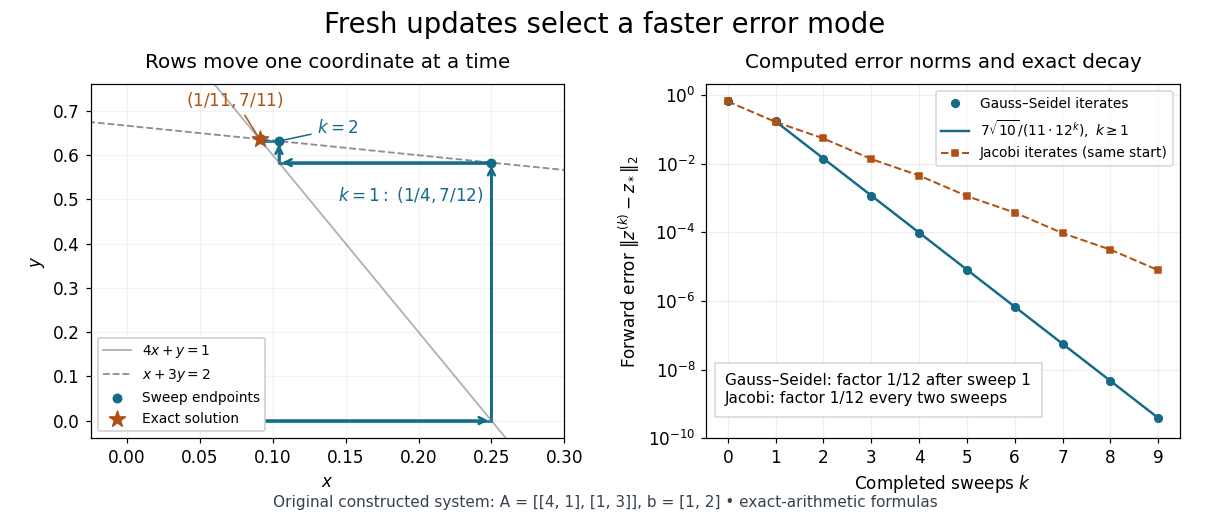
Computed row-by-row Gauss-Seidel method trajectory and exact forward error contraction for the original two-variable linear system
. Details. 
The linear-system residual is an independent way to check the calculation. Completing a sweep satisfies the second row exactly, but changing disturbs the first row:Thus a zero residual in the last updated row alone does not certify a solution; inspect the complete linear-system residual.
For the same matrix, the stale schedule of the Jacobi method gives the iteration matrixHere its eigenvalues are , whereas the fresh schedule gives . This comparison belongs to this particular linear system; it is not a universal relation between the two methods' spectral radii.
Articles by others on the same topic
There are currently no matching articles.