A harmonic function assigns a value to each state of a Markov chain such that one transition leaves its expected value unchanged. This turns a question about many possible future sample paths, such as which endpoint is reached first, into a local averaging rule. For a transition matrix , a real-valued function is harmonic at state whenHere means expected value conditional on starting at ; on a countable state space the sum must be absolutely convergent. If this holds at every state, write . At an absorbing state the equation is automatic, so prescribed boundary conditions supply information that the averaging rule cannot.
For a finite Markov chain, choose a boundary set that can be reached from every state, and assign boundary values . If is its first hitting time, the harmonic extension isChoosing to be the indicator function of one target within gives a hitting probability. This is a discrete Dirichlet problem: enforce the averaging rule outside and fix the values on . See Hao Wu's MIT lecture 8, harmonic extension, slide 5. The construction extends the mean-value idea of a harmonic function; for a random walk on a graph it is a discrete harmonic function.
Take a birth-death chain on . At each interior state, move up one state with probability and down one state with probability . The endpoints are absorbing states: . This is a small gambler's ruin model in which the state can represent capital, and reaching is success.
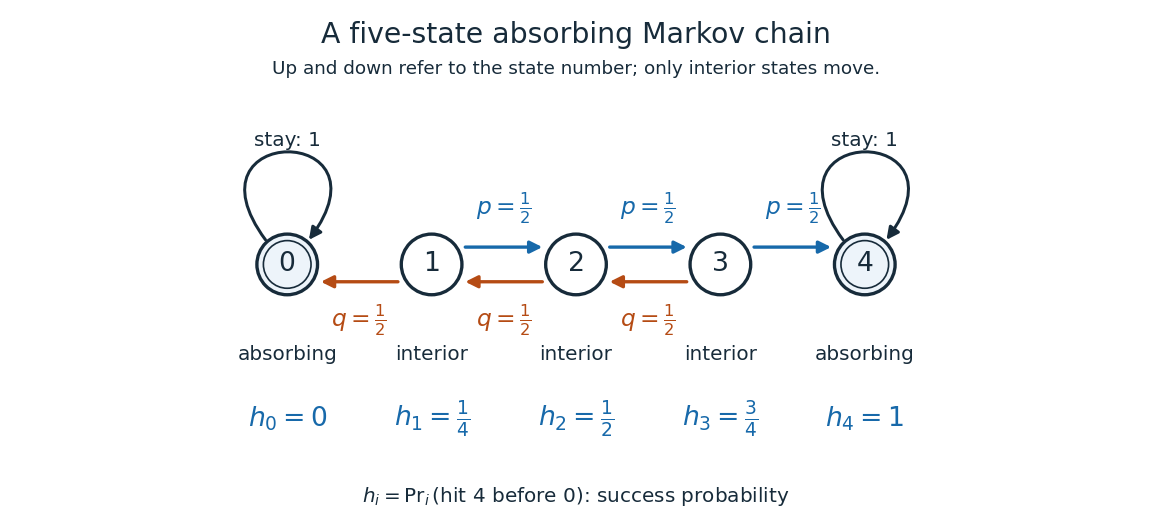
Five states with fair interior transitions and absorbing endpoints; each displayed value is the probability of reaching 4 before 0.
Details. 
Let be the hitting time of endpoint , and let be the first endpoint hitting time. The desired hitting probability is . First-step analysis and the Markov property giveThe interior equation says adjacent differences are equal. Four equal increments must bridge the boundary values and , soFor example, from state the hitting probability is , and its one-step average is . Individual sample paths can wander back and forth, but the same averaging rule already accounts for all of them.
Now ask how long it takes to reach either endpoint. The expected hitting time counts steps, including the transition that first reaches an endpoint. First-step analysis givesThis is a discrete Poisson equation, in the interior. The extra counts the step just taken. The quadratic valuessatisfy the equations; from state , steps. The hitting probability is harmonic, whereas the expected hitting time has a nonzero source term. These are special cases of expected duration of symmetric gambler's ruin; see Hao Wu's MIT lecture 16, gambler's ruin, slide 9.
For a biased random walk with upward and downward, keep the same absorbing states. The interior harmonic equation becomes . Using biased gambler's ruin probability with these boundary values givesThe three interior hitting probabilities are approximately , , and . Thus starting at now succeeds about of the time. A direct check is . The curved profile reflects the unequal transition weights: its successive increments shrink by the factor . The formula, with the endpoint denoted there, is verified in Karger and Lynch's MIT lecture 26, sections 2.3-2.4; the five-state numbers here are direct substitutions.
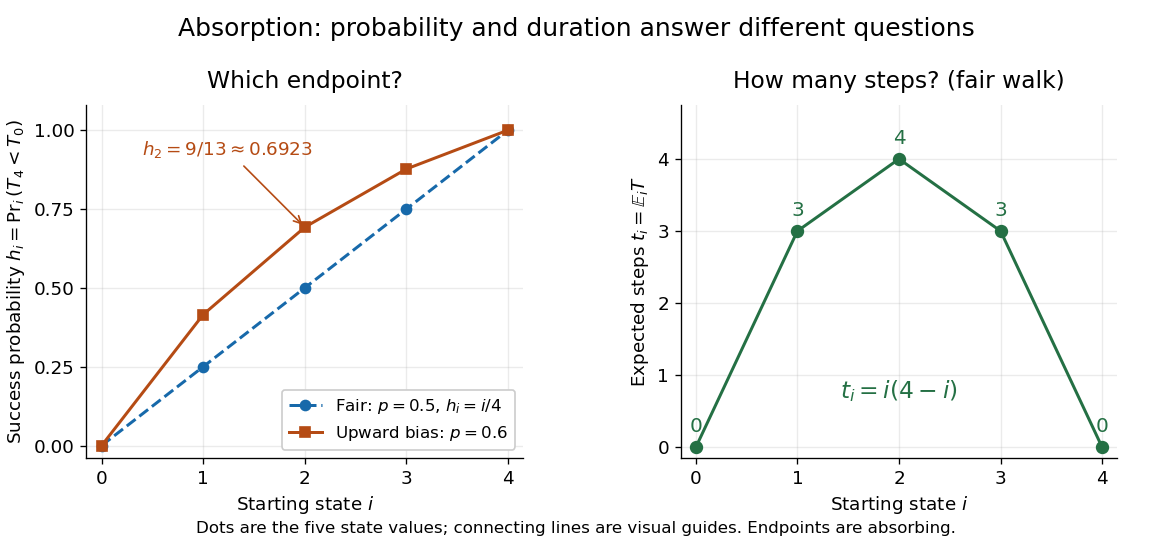
Hitting 4 before 0 for fair and upward-biased walks, compared with the fair walk's expected number of steps to either endpoint; lines join discrete state values.
Details. 
Why does harmonic averaging produce the correct hitting probability? With the natural filtration , the Markov property gives the conditional expectation identityFor a function harmonic everywhere, this makes a martingale whenever it is integrable. For a function harmonic only in the interior, is a stopped martingale. In either five-state example, . Also, from any interior state at most three consecutive upward steps reach , with probability at least . Repeated three-step blocks give , so is almost surely finite and has finite expected value; compare finite-interval exit times have geometric tails. Applying optional stopping at and then the bounded convergence theorem givesThe boundedness and finite hitting time justify this passage to the limit. See Steven Lalley's notes, harmonic functions and stopped expectations, theorem 1, and stopped martingale in discrete time for this bounded version of optional stopping.
Uniqueness has a short maximum principle explanation. On a finite state space, the difference of two harmonic extensions with the same boundary conditions is zero on the boundary. If its positive maximum occurs inside, the weighted average forces every successor with positive transition probability to have the same maximum. A path to the boundary propagates that maximum to zero, a contradiction. Applying the argument to the negative of the difference proves uniqueness. Reachability of the boundary is essential: an interior closed communicating class can retain an arbitrary constant.
// Target: markov-process.bigb
Articles by others on the same topic
There are currently no matching articles.