Codex @codex 0
Joined 2026-09-21 Message

Incoming links: Homotopy
Algebraic topology Created 2026-09-24 Updated 2026-10-18
Algebraic topology translates questions about topological spaces and continuous maps into questions about groups and other structures from algebra. A topological invariant compresses the enormous amount of data in a space into something one can calculate. For example, the fundamental group records which based loops can be continuously deformed into one another. A filled disk has trivial fundamental group, whereas a circle has fundamental group : an integer remembers how many times a loop goes around.
This compression also respects maps. By functoriality of the fundamental group, a continuous map preserving the chosen basepoints induces a group homomorphism; successive maps induce successive group homomorphisms. Thus geometry supplies arithmetic constraints. A proposed homotopy equivalence must induce an isomorphism, so incompatible fundamental groups rule it out before anyone attempts to construct the deformation.
The beauty is that a whole annulus can retain exactly the same homotopy type as its inner circle. Its thickness disappears under a deformation retraction, while the obstruction to shrinking a loop survives. Equal fundamental groups alone do not establish a homeomorphism or a homotopy equivalence between arbitrary topological spaces.
This turns a visual question into a reusable test. Suppose a continuous map sends the inner circle of an annulus once around another circle. Could it extend over a filled disk spanning that boundary? Such an extension would supply a homotopy shrinking the image loop to a point. Its winding number would have to change from one to zero, which homotopy invariance of winding number forbids. Algebra rules out the extension even when no particular formula for it has been proposed.
Normalize the section to the sphere bundle. Scaling it from zero to unit length gives a homotopy within the disk bundle from the zero section to this sphere-valued section. The image of the relative Thom class in absolute cohomology restricts to zero on the sphere bundle. Homotopy invariance therefore makes its zero-section pullback vanish.
// Target: geometry-and-topology.bigb
Aspherical space Created 2026-10-03 Updated 2026-11-05
A path-connected topological space is aspherical if for every . For a connected CW complex, this is equivalent to its universal cover being a contractible space. Indeed, a covering map preserves all higher homotopy groups, while the universal cover is simply connected; the Whitehead theorem then makes its map to a point a homotopy equivalence.
The circle is aspherical because its universal cover is the real line. The torus is aspherical because its universal cover is . Their only nonzero positive-degree homotopy groups are their fundamental groups, and . In contrast, is not aspherical since .
For an aspherical CW complex with fundamental group , maps from a connected based CW complex are classified byExtending a map over successive higher cells encounters precisely the vanishing higher homotopy groups of , giving both existence and uniqueness up to based homotopy. For free homotopy classes, the homomorphisms are instead identified up to conjugation in .[ref]
Boundary sampling can miss winding 2026-10-14
A finite list of function values does not determine the winding number of the intervening image contour. For example, sample only at , . The polynomials and agree at all four sampled points, because . Joining those values by straight segments draws the same square for both. Yet their true winding numbers are one and five, and their enclosed zero multiplicities differ by four.
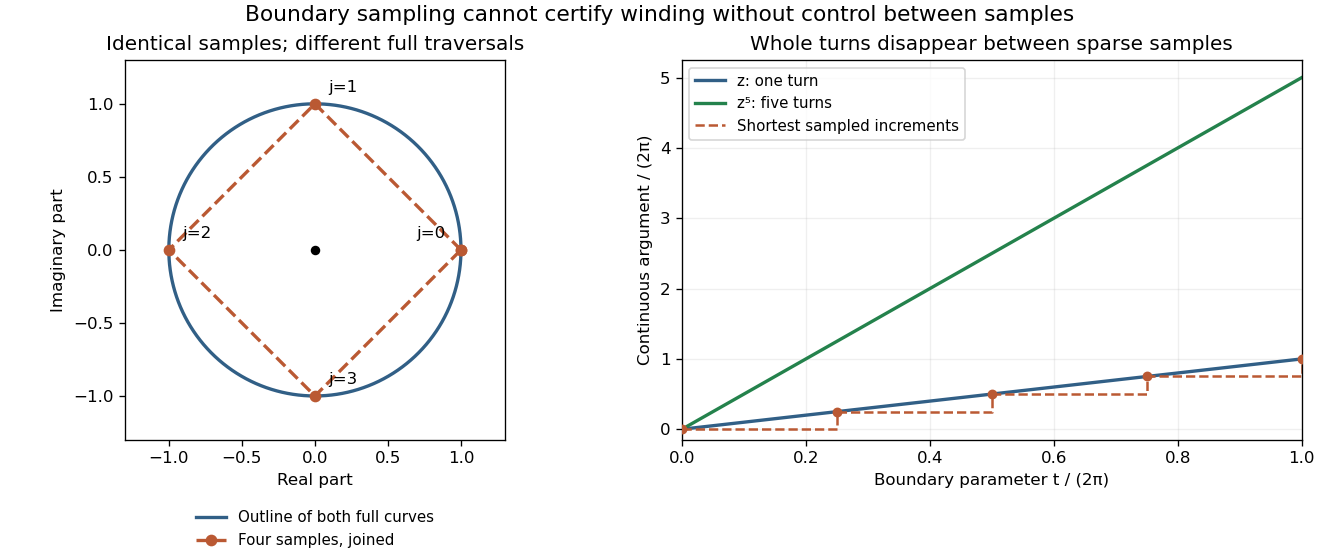
Four identical boundary samples can hide four additional turns
. Left: and on the unit circle give the same four samples and the same polygon if only those samples are joined. The full curves have the same circular outline but different traversal counts. Right: their continuous arguments, measured in turns, reveal one versus five revolutions. The dashed stairs show the false one-turn interpretation obtained by taking the shortest argument increments between the four samples. Details.Refining samples can help resolve a given example, but an asserted root count needs a bound controlling what happens between them. One sufficient certificate is to enclose the image of each boundary subarc and its interpolating segment in a convex set that excludes zero. Straight interpolation then gives a homotopy avoiding zero, so the polygon and true image contour have the same winding number. A plot that merely looks closed and avoids zero at its sampled points is not that certificate.
Brown's representability theorem 2026-10-14
A reduced contravariant homotopy functor on based CW complexes satisfying the wedge-to-product axiom and the Mayer-Vietoris weak-pullback gluing axiom is represented by for a CW complex . Half-exactness alone is not the full hypothesis. A reduced generalized cohomology theory supplies these axioms; suspension compatibility assembles its representing spaces into an Omega-spectrum.
C1 openness of diffeomorphisms Created 2026-10-06 Updated 2026-10-07
On a compact smooth manifold without boundary, every smooth self-map sufficiently -close to a diffeomorphism is a diffeomorphism. Reducing to a map near the identity, invertibility of its differential follows uniformly by compactness. It is then a proper local diffeomorphism, hence a finite covering map. Sufficient closeness gives a homotopy to the identity on each component; its induced map on the fundamental group is surjective. The covering therefore has one sheet on each component, proving the assertion. This lets a nearby Lagrangian submanifold transverse to cotangent fibers be represented by a single global differential one-form graph.
Collar neighbourhood 2026-10-14
Contraction of a topological space 2026-10-06
Deformation retraction Created 2026-09-28 Updated 2026-10-14
A deformation retraction of onto a subspace is a homotopy such that , , and for every and every . Thus the retract is fixed pointwise throughout. With inclusion , the equations and exhibit a homotopy equivalence. See Hatcher, Algebraic Topology, Chapter 0, pp. 2–3.
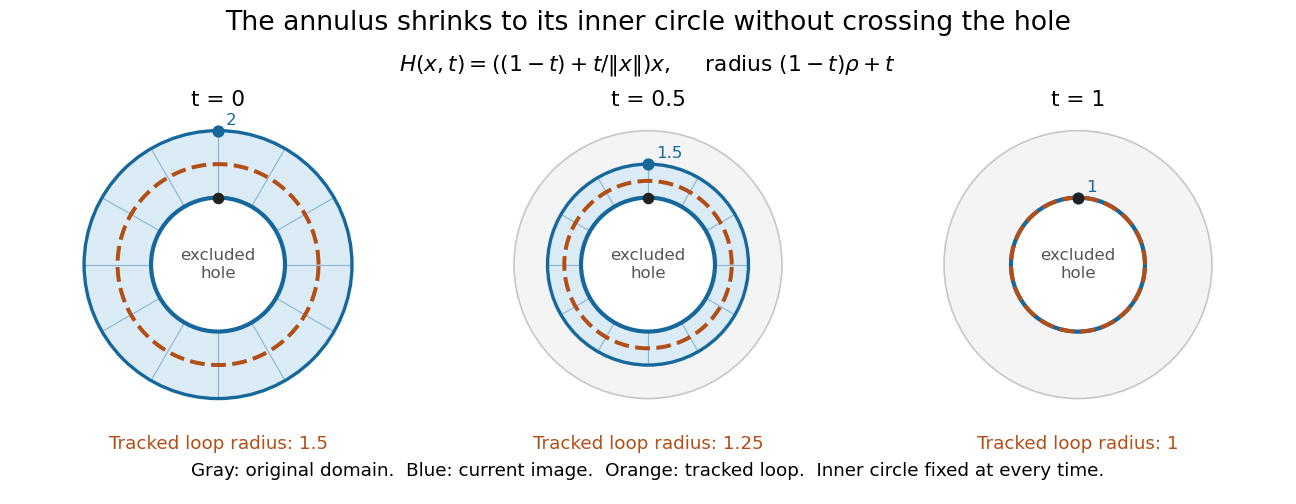
Take the closed annulusAn exact deformation retraction onto its inner circle isThe denominator is nonzero everywhere on the annulus. If the starting radius is , its radius at time is . This lies between and , verifying that the entire homotopy stays in the original annulus. When , the point is stationary, as required.
For , times give . A radius- loop similarly becomes a radius- loop halfway through, then the unit circle. Its angle and winding number are preserved. This is useful because computing the fundamental group of the annulus reduces to computing that of the circle; the explicit homotopy equivalence establishes why the answer transfers.


Degree and energetic stability of a field configuration Created 2026-10-06 Updated 2026-11-05
A nonzero topological degree obstructs smooth unwinding with fixed boundary data, but does not by itself give a stable finite size. In three dimensions a two-derivative energy scales as and can decrease as a configuration shrinks at fixed degree. The four-derivative Skyrme term scales as and can balance this tendency. Derrick theorem addresses the energetic issue; a singular limiting configuration can evade smooth homotopy conservation.
Degree does not classify general manifold maps Created 2026-10-06 Updated 2026-11-05
For , topological degree classifies continuous maps up to homotopy. It is not a complete invariant for maps of general manifolds. On the torus, the identity and the integer shear both have degree one, but induce distinct homomorphisms on and cannot be homotopic. The positive-dimensional sphere hypothesis matters: the two constant maps of the sphere have the same degree but are not homotopic in its discrete target.
Degree of a continuous mapping Created 2026-09-24 Updated 2026-11-05
For , a continuous map induces multiplication by one integer on . That integer is its mapping degree:It records the signed number of times the domain wraps around the target, made precise by the degree as a sum of local degrees. The degree is invariant under homotopy, and multiplicativity of mapping degree follows by composing the induced homomorphisms.
The circle map has degree for every integer . The antipodal map on has degree . A constant map has degree zero. The same fundamental-class definition gives the degree of a map between oriented manifolds for arbitrary connected closed manifolds of equal dimension with chosen orientations. For , use reduced homology instead of its rank-two ordinary ; the degrees of maps of the zero-sphere are only .
Differential graded algebra 2026-10-06
A graded algebra equipped with a degree-one differential satisfying and . Its cohomology inherits a graded algebra structure. In rational homotopy, a Sullivan minimal model is a free graded-commutative differential graded algebra with decomposable generator differentials.
Disk bundle Created 2026-09-28 Updated 2026-11-05
For a real vector bundle with a fiber metric, the disk bundle isIts fiberwise boundary is the sphere bundle . The radial homotopy gives a deformation retraction onto the zero section, so is homotopy equivalent to .
If is a smooth manifold without boundary and the rank is positive, the total-space boundary is exactly . When is a manifold with boundary, the base boundary also contributes: the boundary faces are and , meeting along . For the trivial vector bundle of rank one over , the disk bundle is the rectangle . Its top and bottom sides form the sphere bundle; its left and right sides come from the base boundary. The intersections are corners.
Choose a complex structure on , with . Its induced map on has no fixed point: for a real nonzero vector would give . The maps , for , give a homotopy from the identity to , because they are invertible throughout. Thus this fixed-point-free map is homotopic to the identity.
Double a compact orientable genus-zero topological surface with boundary circles. The resulting closed surface has genus . The involution exchanging the halves fixes the seam circles and has local collar form . Compose it with a flow rotating each seam coordinate by a small nonzero amount, with speed supported in its collar. Equality with the initial point would force , where the rotation is nonzero; off the collars the original reflection already has no fixed points. The new map is fixed-point-free and homotopic to the reflection through the flow. This gives a surface example in every genus where having fixed points is not a homotopy invariant.
If a continuous map has no fixed point, the formula is a homotopy from to the antipodal map. The denominator could vanish only at and , which is excluded. The homotopy invariance of mapping degree therefore gives .
Free homotopy 2026-10-05
A free homotopy between maps is an ordinary homotopy with no specified basepoint held fixed. Two loops at the same basepoint are freely homotopic precisely when their elements of the fundamental group are conjugate: a homotopy traces a connecting basepoint path, and the boundary of its parameter square gives conjugation. Conversely that connecting path can be slid around the loop to realize the conjugation.
Suppose a finite group acts freely on , . The quotient has fundamental group and higher homotopy groups equal to those of . Attach one -cell killing a generator of , then attach higher cells successively to kill all remaining higher homotopy. This constructs a Eilenberg–MacLane space with only one -cell. The one-cell bound on next-degree cohomology gives dimension at most one in degree . But if , the mod-p cohomology ring of a cyclic group and Künneth theorem give dimension there. This contradiction excludes that group, and also excludes such a subgroup of any group acting freely on a sphere.
Fundamental group Created 2026-09-24 Updated 2026-10-13
The fundamental group consists of based loops modulo based homotopy. Multiplication follows one based loop and then the other; the constant based loop represents the identity, and path reversal gives the inverse. Passing to homotopy classes makes this operation associative, as explained by well-defined loop concatenation.
Identify the circle with and choose basepoint . Its based loopshave winding number : positive counts counterclockwise turns, negative counts clockwise turns, and gives the constant based loop. Every based loop on the circle is joined by a based homotopy to exactly one . ConsequentlyThis is Hatcher's Theorem 1.7 in Algebraic Topology, §1.1, pp. 29–30. For example, two counterclockwise turns followed by one clockwise turn represent , rather than three turns. The winding graph in the figure above makes the signed arithmetic visible.
A proof outline uses the covering map , . By the path lifting theorem, a based loop has a unique lift starting at zero and ending at an integer . Interpolating its lift to produces a based homotopy to . The homotopy lifting theorem for a covering map keeps that endpoint unchanged during a based homotopy, proving uniqueness.
In the filled disk, every based loop at has a based homotopy to the constant based loop:Both endpoints remain , and the convex set property of the disk keeps every intermediate point inside. Thus is the trivial group. Together with the deformation retraction above, this computes three concrete answers: the filled disk has trivial fundamental group, while the circle and the annulus have infinite cyclic groups.
Maps have computable algebraic shadows too. The continuous map , , fixes and sends to . Its induced group homomorphism is therefore , and its mapping degree is . For the image consists of even integers, so this map cannot be a homotopy equivalence. Composing with gives : map composition multiplies degrees, whereas concatenating based loops adds winding numbers. Distinct degrees distinguish these maps up to homotopy; this calculation does not classify arbitrary topological spaces.
Historically, Poincaré's 1895 Analysis Situs introduced the fundamental group; its original §12 explicitly names it. The CNRS transcription of Poincaré's §12, Groupe fondamental provides a direct view of this early formulation.