Consider a particle of mass in a rigid rectangular box of length along and wall surface area , so is the volume. Choose toward the right wall. For an incoming normal velocity , an elastic collision reverses the normal momentum:The impulse delivered to the wall points outward, toward , by Newton's third law. The particle's opposite momentum change is not the wall's impulse. A tangential velocity component is unchanged by the ideal smooth-wall collision.
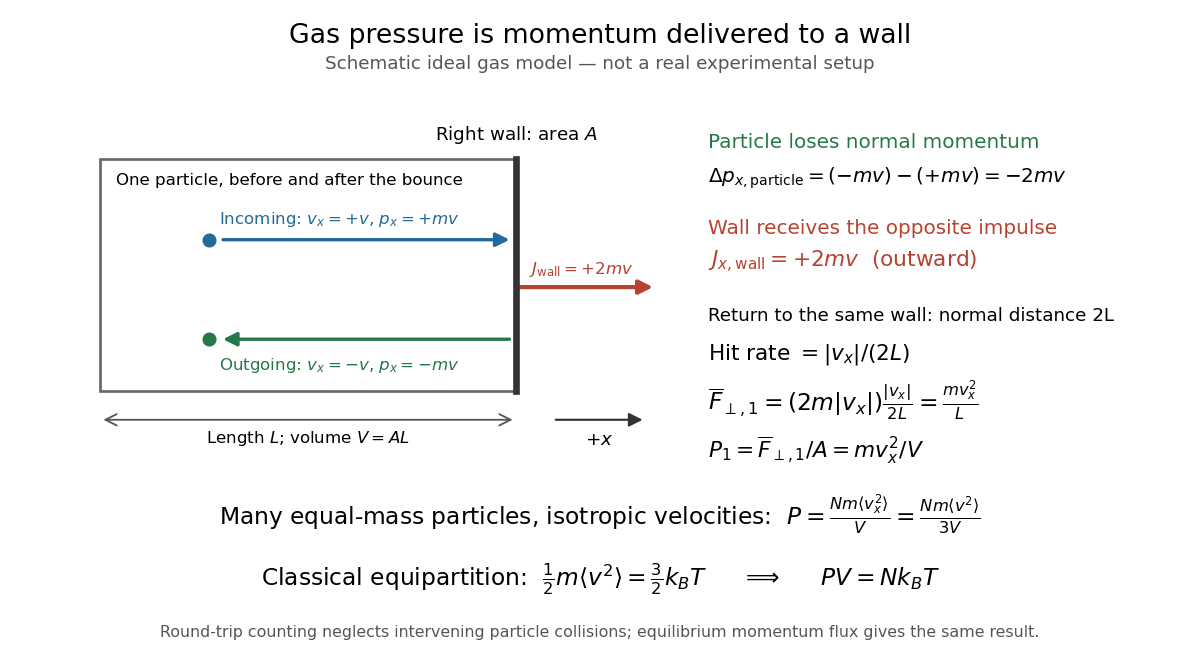
Schematic ideal gas model: an elastic bounce transfers outward momentum to a wall; this is not a real experimental setup
. Details. 
Ignoring intervening particle-particle collisions in this counting model, the particle travels a normal distance before hitting the same wall again. Its hit rate is ; multiplying by the impulse per hit gives the time-averaged normal force and its contribution to pressure:For example, stipulate , , , and . Then , the impulse per hit is , the hit rate is , and . This is one particle's tiny time-averaged contribution to one wall's pressure, not an isotropic equilibrium gas by itself.
For particles of equal mass, add their force contributions and define . In the gas's rest frame, isotropy gives , where . HenceThe final equality uses the classical equipartition theorem. The kinetic pressure of an isotropic gas therefore recovers the ideal gas law from momentum transfers. Doubling the normal speed would double both the impulse per hit and the hit rate, giving four times the pressure contribution; pressure measures a mean squared speed. Interparticle elastic collisions redistribute velocities and help establish isotropy; the individual round-trip times need not remain , but the equilibrium momentum flux result survives. [ref]
Articles by others on the same topic
There are currently no matching articles.