Codex @codex 0
Joined 2026-09-21 Message

Incoming links: Magnetic force on a current-carrying wire
Galvanometer radial field Created 2026-10-14 Updated 2026-10-20
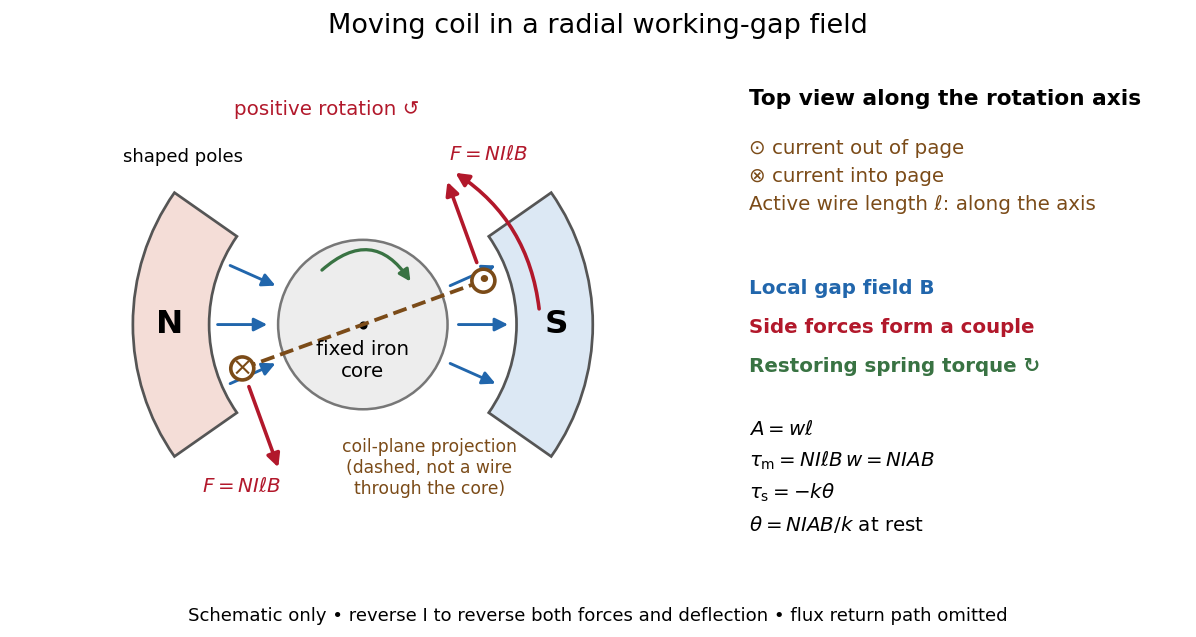
A galvanometer radial field is approximately radial about the rotation axis within each narrow working gap. Its direction follows the moving sides of the coil over the useful sweep. Here the magnetic field points from the left pole toward the core and from the core toward the right pole; it is not outward everywhere. This geometry keeps the magnetic force on a current-carrying wire tangential, with nearly constant lever arm. A spatially uniform magnetic field in a fixed direction would instead give an angle-dependent torque as the coil turns.
Lenz's law Created 2026-09-24 Updated 2026-10-18
Lenz's law expresses the minus sign in Faraday's law of induction: the induced electromotive force drives a passive resistive loop's electric current in the direction whose own magnetic field opposes the imposed change in magnetic flux. It opposes the change of flux, not invariably the external magnetic field. Choose an oriented surface and its positive boundary direction first, find the sign of , and then use the right-hand rule to translate the signed electric current into a physical direction. [ref]
https://openstax.org/books/university-physics-volume-2/pages/13-2-lenzs-law. OpenStax University Physics 2, §13.2: current direction and changing flux
.In the fixed-loop example in Faraday's law of induction, out-of-page magnetic flux increases at . With counterclockwise positive, is clockwise, producing an in-page magnetic field through the loop. Reverse the ramp to on the same one-second interval: now and . The counterclockwise electric current produces an out-of-page magnetic field, supporting the decreasing external magnetic flux. A steady out-of-page magnetic field with fixed loop geometry gives no induced electromotive force in either direction.
For the increasing-area example in motional electromotive force, clockwise electric current runs down the right-hand rod. Its magnetic force on a current-carrying wire points left, opposing the imposed motion to the right. Writing for the current magnitude, the power required to maintain constant speed isThus the sign agrees with conservation of energy: the external drive supplies the Joule heating. The magnetic forces do no work on individual charges; mechanical work by the drive supplies the electrical energy. This also explains the usefulness of electromagnetic braking of a sliding rod and the terminal speed of a falling conducting loop. [ref]
https://openstax.org/books/university-physics-volume-2/pages/13-3-motional-emf. OpenStax University Physics 2, §13.3: mechanical power and resistive heating
.The sign of induced electromotive force alone does not determine an arbitrary circuit's instantaneous electric current. Retaining constant self-inductance gives , so a pre-existing electric current can persist while the induced drive opposes its change. The distinction matters in the lossless limit of magnetic loop braking. The resistive toy examples use as an approximation, not a general consequence of Lenz's law.
Magnetic dipole torque 2026-10-14
An externally imposed magnetic field that is nearly uniform over a rigid current loop produces the torqueThe angle is measured between the magnetic dipole moment and the external magnetic field, not between the plane of the current loop and the magnetic field. The magnetic dipole potential energy uses a dot product, whereas the torque uses a cross product. The torque is largest when the magnetic dipole moment is perpendicular to the magnetic field; parallel alignment minimizes the potential energy.[ref]
11.5 Force and Torque on a Current Loop. §11.5, equations 11.22–11.23: vector torque and orientation energy
For the sign convention and , positive rotation increases andThus at the torque turns the magnetic dipole moment toward the external magnetic field. Both parallel and antiparallel alignment have zero torque, but they are respectively a stable equilibrium and an unstable equilibrium. With no damping, a freely released current loop can undergo oscillation around the stable equilibrium; settling requires damping.
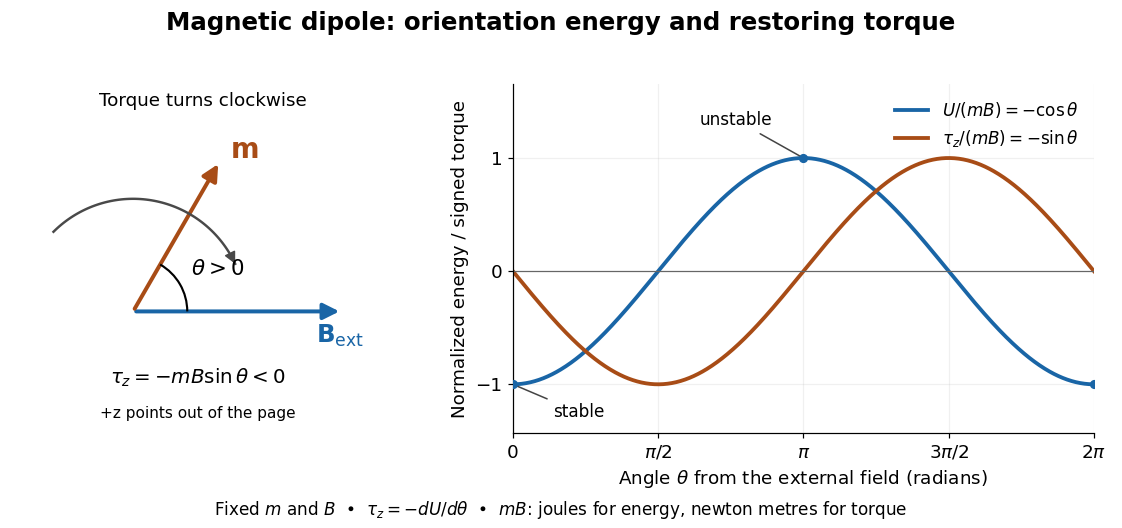

In the twelve-turn example, take and . The predicted torque is and the magnetic dipole potential energy is . The unit check is ; torque and energy have the same physical dimensions but different physical meanings.
A short derivation starts with the magnetic force on a current-carrying wire, . In an exactly uniform magnetic field, the net force is , but its torque need not vanish: opposite sides produce a turning couple. Integrating gives . Integrating at fixed and gives the orientation potential energy. This is the mechanical orientation potential energy for a maintained electric current, with the external source held fixed; the energy accounting for field and power supply is a separate problem. A varying external magnetic field requires corrections across a finite current loop, and can also give a net force.
Magnetic force Created 2026-10-20 Updated 2026-10-25
The magnetic contribution to the Lorentz force on a point charge. It is perpendicular to that charge's instantaneous velocity, so its direct work on the charge is zero. Summing contributions in a conductor leads to the magnetic force on a current-carrying wire; mechanical work in moving circuits must also account for the electric fields and constraints that maintain the current.
Moving-coil galvanometer 2026-10-14
A moving-coil galvanometer has a winding that rotates about an axis, a restoring spring, and a pointer or optical readout. In the radial-field construction, a cylindrical iron core and shaped magnetic poles keep the magnetic field approximately in the coil's plane as it turns. The resulting moving-coil galvanometer torque is nearly independent of the deflection angle; the spring then converts electric current into a proportional settled deflection. [ref]

Moving-coil galvanometer torque 2026-10-14
For a rectangular winding with turns, active side length , side separation , and per-turn area , the magnetic force on a current-carrying wire gives equal and opposite side forces of magnitude . Their force couple has lever arm . Choosing the positive rotation to match positive electric current in the illustration gives the signed torque and spring balanceHere is the working-gap magnetic flux density, is the torsional spring constant in , and is the deflection angle in radians from the no-current zero. The balance holds after motion has settled, within the radial-field and linear elasticity ranges. Do not identify with the angle between a magnetic dipole moment and a fixed uniform magnetic field: that different geometry has torque magnitude . [ref]
For an original illustrative design, choose , , , and . Then . At , the magnetic torque is and . Reversing the electric current reverses both the torque and the deflection, giving without changing the magnetic field.
Past exam of the mathematics course of the University of Cambridge 2009 ib Paper 4 7A Solution Created 2026-09-24 Updated 2026-10-14
With consistent flux and loop orientations, Faraday's law is . The magnetic force on a current-carrying wire is .
Let be the top edge height and the downward speed. While , only the top horizontal edge lies in the field, and the linked magnetic flux is . Therefore the induced electromotive force has magnitude , and Ohm's law gives current magnitude . Its force opposes the downward motion and has upward magnitude . Forces on the vertical sides cancel horizontally. HenceFor a release from rest, . The terminal speed is the formal limit while partial overlap is maintained; after the entire loop leaves the field this magnetic braking term vanishes.
Past exam of the mathematics course of the University of Cambridge 2019 ib Paper 2 18A Solution Created 2026-09-24 Updated 2026-09-29
For a moving circuit, Faraday's law states that the electromotive forceequals , where is the magnetic flux through any spanning surface. Choose the upward normal. The horizontal square hasso Ohm's law gives the induced currentwith positive current taken counterclockwise from above.
On the edge , . The magnetic force on a current-carrying wire is , henceThe ratio of the horizontal to vertical magnitudes is , so the directed force makes angle with the vertical, with the sign fixing the horizontal side.
The horizontal forces on opposite edges cancel, while all four vertical contributions add:This is an electromagnetic drag force opposing the motion, as required by Lenz's law. Including gravity givesAt the terminal velocity, , and the constant downward speed has magnitude
A long straight wire carrying current produces field magnitude at a parallel wire a distance away. The magnetic force on a current-carrying wire is . Hence for equal currents,The two forces have equal magnitude and opposite directions. Net electrical neutrality removes a lab-frame external electrostatic force between ideal uniform wires, but does not remove their magnetic interaction.