Mark and recapture estimates the cardinality of a finite set of individuals when counting everybody is impractical. The useful information is the overlap between observations: with fixed sample sizes, finding many of the same individuals again suggests a smaller population, while finding few suggests a larger one. More elaborate capture-recapture models also estimate survival and changing probabilities of detection.
In a closed-population capture-recapture model, let be the unknown population cardinality. Capture distinct individuals, mark them, release them all, and allow them to mix with the rest. Next take a second sample of distinct individuals using sampling without replacement, and count the individuals carrying a mark. The observed marked fraction estimates the population's marked fraction , giving the Lincoln-Petersen estimatorRelease happens between the two samples; sampling without replacement means that an individual is counted at most once within the second sample. See Richard J. Barker, Open Population Mark-Recapture Models, §1.1.1.
For a constructed teaching example, mark individuals and later capture , including marked individuals. One fifth of the second sample is marked, suggesting that the twenty marked individuals are one fifth of the population:Let and be the sets of individuals in the first and second samples. Their intersection has cardinality five. By the inclusion-exclusion principle, the set union containsThus is an observed lower bound, whereas is the output of an estimator based on the capture-recapture model. These are toy counts, not measurements from a medical or ecological study.
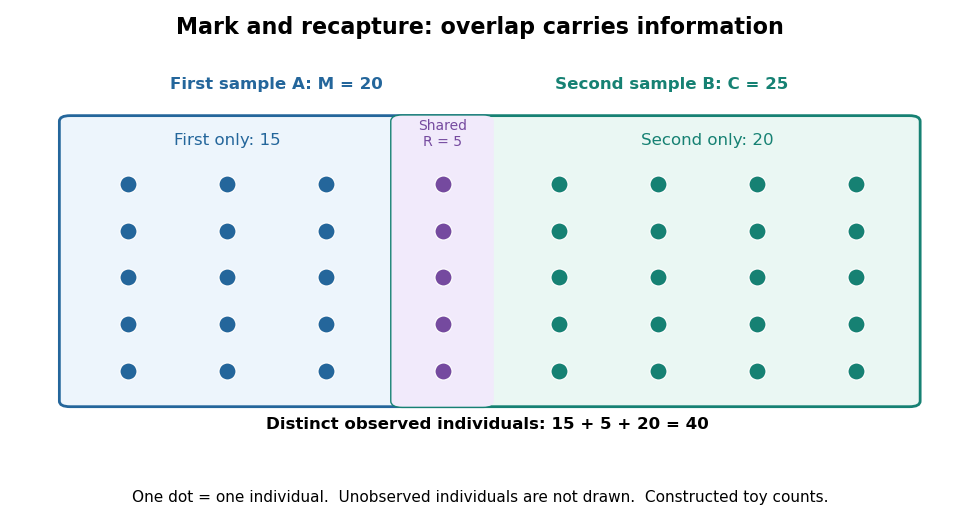
Forty distinct observed individuals: fifteen in the first sample only, five shared, and twenty in the second sample only
. Details. The diagram shows only observed individuals. It does not draw an assumed population of one hundred. The capture-recapture model uses the overlap to infer how many individuals may have escaped both samples; its likelihood function shows why one estimator output cannot describe all that uncertainty.
Articles by others on the same topic


Mark and recapture is a scientific technique used to estimate the size of animal populations in ecology. The basic idea is to capture a sample of individuals from a population, mark them in a harmless way, and then release them back into the environment. After allowing some time for the marked individuals to mix back into the population, a second sample is captured. By comparing the ratio of marked to unmarked individuals in the second sample, researchers can use mathematical formulas to estimate the total population size.