The Mellin transform is an integral transform suited to changes of scale: replacing by multiplies its transform by for . For a locally integrable function , definewhere the improper integral converges. The complex number uses the real natural logarithm because . Its absolute value is , so absolute convergence depends on the real part rather than the imaginary part . The Mellin fundamental strip records the open range of such real parts.[ref]
A familiar example is the exponential function :This is exactly the Gamma integral. Near zero tends to one, so absolute convergence requires ; at infinity for every real , so there is no upper boundary. The Gamma function has a meromorphic continuation with simple poles at , but a finite continued value elsewhere in does not make the defining improper integral converge.[ref]
The Mellin transform of an interval indicator gives an elementary example with absolute convergence for every complex number . The Mellin transform in logarithmic coordinates explains why changes of scale become translations, connecting the scaling property of the Mellin transform to the Fourier transform.
For , the indicator function has Mellin transformThe interval stays away from both zero and infinity, so the integral is absolutely convergent for every complex number . Its Mellin fundamental strip is the whole complex plane. Evaluating the antiderivative proves the formula for ; at , integrating gives the real natural logarithm . The apparent division by zero is a removable singularity, since by the Taylor series of the exponential function. The transform is an entire function.
For example, gives with value at zero. On , the Mellin transform sums oscillations over the width of the interval in natural logarithm coordinates; this is the same cancellation mechanism as in the Fourier transform of an interval indicator.
The fundamental strip of a Mellin transform is the interior of the set of real parts for whichViewed in the complex plane, it is a vertical strip ; either bound may be infinite, and the interior may be empty. Both endpoints of the improper integral must be checked. Convergence on a boundary line, whether absolute convergence or conditional convergence, requires a separate test. The Mellin transform is holomorphic throughout a nonempty fundamental strip.[ref]
NIST Digital Library of Mathematical Functions. Chapter 2, §2.5(i), equation 2.5.1 and the following description of the vertical domain of analyticity
A practical sufficient test uses Big O notation: if near zero and near infinity, with real , then comparison with elementary improper integrals givesThus guarantees absolute convergence. These upper bounds on need not locate the maximal Mellin fundamental strip; faster actual decay can widen it. The strip property itself follows by bounding the weight at any intermediate by the sum of two weights already known to be integrable. On a closed narrower strip, neighboring integrable weights also dominate the natural logarithm factors introduced by differentiation under the integral sign, making the transform a holomorphic function.
An exact two-endpoint example isHere both bounds are sharp: at the zero-end absolute convergence test contains , and at the infinity-end test contains . The displayed rational function continues meromorphically outside the Mellin fundamental strip and has simple poles at and . Its other finite continued values outside the strip are values of a meromorphic continuation, not of a convergent defining integral. More general endpoint information leads to meromorphic continuation of a Mellin transform from an asymptotic expansion.
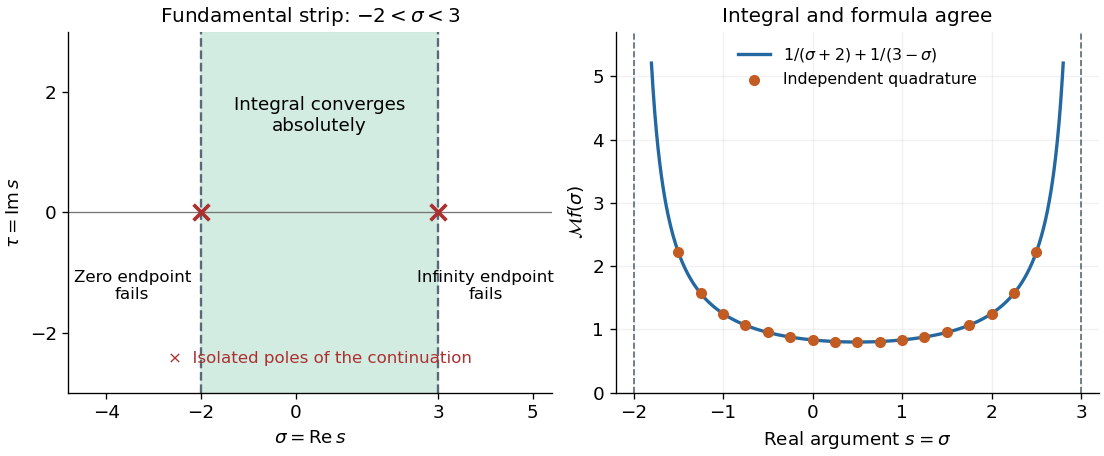
Two endpoint conditions define the Mellin fundamental strip
. Left: the Mellin fundamental strip for below one and above one is . Crosses mark the two poles of the continued rational function, not whole lines of isolated singularities. Right: the formula and independently computed integrals agree on the real slice inside the strip. The curve is drawn only where the defining integral converges. Details.For , let . Whenever the Mellin transform of is absolutely convergent,The Mellin fundamental strip is unchanged: the corresponding integrals of absolute values differ by the finite positive factor . The change of variables gives , proving the rule. For , the transform's absolute value changes by , while the factor changes its phase. On the line , wherever absolute convergence holds, the transform's absolute value is preserved.
For the Mellin transform of an interval indicator, replacing by givesAt the removable singularity , both sides have value . Scaling leaves the width measured by the natural logarithm unchanged. Likewise, the exponential function has Mellin transform on .
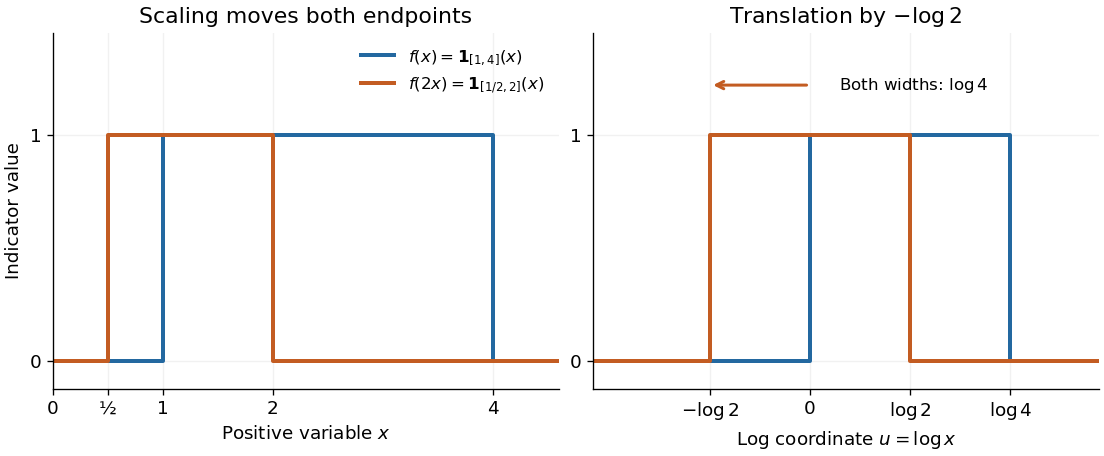
Scaling a positive variable translates its logarithmic coordinate
. Left: moves the support interval to . Right: turns the same change into a translation to the left by ; the interval width remains . The scaling property of the Mellin transform multiplies the transform by . Details.The change of variables , using the exponential function, turns the Mellin transform intoThe factor changes to ; missing this factor would shift every exponent by one. With and the Fourier transform convention , the identity isChoosing inside the Mellin fundamental strip makes a Lebesgue integrable function. The minus sign in the Fourier transform argument follows from the stated convention. For the Mellin transform of an interval indicator with and , : the Fourier transform of an interval indicator is literally the same computation in a different coordinate.
Splitting the real line at also connects the Mellin transform to two unilateral Laplace transforms. If and for , thenwhere both integrals converge absolutely. Their Laplace convergence regions impose opposite endpoint conditions, explaining the two sides of the Mellin fundamental strip. Finally, shows that a change of scale is a translation in . Weighted Fourier transforms of this translation give exactly the factor in the scaling property of the Mellin transform. For a smooth function with compact support inside , the Mellin inversion theorem follows from Fourier inversion; the existing formula states the corresponding hypotheses.
At exponent zero the complex integral fails absolute and ordinary convergence through its real part, proportional to . The imaginary-part kernel displayed above instead decays as and is integrable. Thus a positive-exponent family can have a well-defined imaginary-part boundary limit even when its full complex limit is invalid. Endpoint expansion coefficients need not be uniform in that limiting exponent: a sine zero can cancel a gamma-function pole and introduce a new nonzero constant term.
Suppose decays faster than every power at infinity and, near zero, for every , with strictly increasing and tending to infinity. Subtracting finitely many terms in the integral over givesThe last integral is holomorphic on . These expressions continue the Mellin transform meromorphically to the whole plane, with simple poles precisely at for nonzero .
Strict increase alone does not suffice in the preceding theorem. Let , and , where is continuous, equals one on and vanishes on . After division by the next power, every finite remainder extends continuously to zero. Nevertheless the Mellin transform has genuine poles at accumulating at , so it cannot be a meromorphic function on the whole plane.
Under standard decay and regularity hypotheses,If is smooth and compactly supported in , its Mellin transform is entire, decays faster than every power on vertical lines, and the formula holds for every real and every .
Articles by others on the same topic



The Mellin transform is an integral transform that converts a function defined on the positive real axis into a new function defined in the complex plane. It is particularly useful in number theory, probability, and various branches of applied mathematics, especially in solving differential equations and analyzing asymptotic behavior.