A mixed state is a density operator that is not a rank-one orthogonal projection. In finite dimension it is characterized by , so its purity of a density operator distinguishes it from a pure state.
Compare a pure state quantum superposition with an equal classical choice between two computational-basis states of a qubit:A projective measurement in the computational basis gives for both density operators. An projective measurement in the Hadamard basis distinguishes them: the Born rule gives for and for . These comparisons use separate copies of each preparation; measuring first changes the state tested by a subsequent measurement.
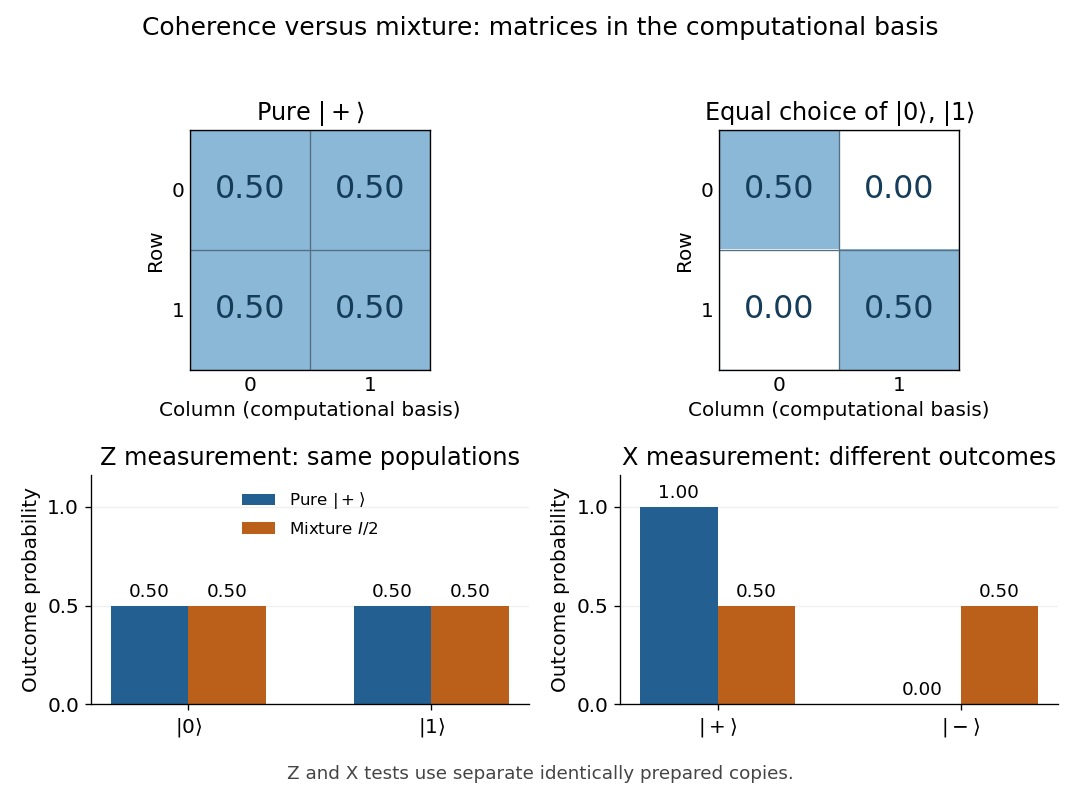

The off-diagonal entries of encode quantum coherence in the computational basis. Such quantum coherence depends on the basis: is diagonal in the Hadamard basis but remains a pure state. Mixedness is independent of the basis, because a unitary change of basis preserves the eigenvalues and the purity of a density operator.
Even the quantum state ensemble is not unique:The off-diagonal entries of the two Hadamard basis projectors cancel. Thus the density operator retains precisely what measurements on the system can reveal, while an accessible preparation label carries additional information. A mixed state can also be the reduced density matrix of an entangled state, even when the whole system is in a pure state; classical ignorance about a selected component is not its only physical origin. [ref]
Articles by others on the same topic
There are currently no matching articles.