The slip length measures tangential wall mobility in the Navier slip boundary condition. Where the wall shear rate is nonzero,The numerator is a velocity and the denominator has units , so has units of length. Geometrically, take a local inward normal coordinate , with the wall at . The tangent line to the relative velocity profile isIt reaches zero at , a fictitious distance inside the solid. This extrapolation does not assert that fluid exists there. At a moving wall, extrapolate to the wall's velocity, rather than to zero laboratory velocity. If both the wall shear rate and relative velocity vanish, their ratio cannot determine .
The useful comparison is , where is the channel gap. A small absolute slip length can noticeably change volumetric flow rate in a micrometre-scale channel. Measured effective slip length may summarize unresolved interfacial structure; it need not mean literal molecular sliding at every point. The review distinguishes intrinsic, apparent and effective slip and discusses how surface conditions affect measurements. [ref]
https://arxiv.org/pdf/cond-mat/0501557. Lauga, Brenner and Stone (2005), §§2.2 and 3.1: slip terminology and measurement
Consider steady flow of a Newtonian fluid in incompressible flow with constant dynamic viscosity between parallel plates at and . The bottom plate is stationary and obeys the Navier slip boundary condition with slip length . The top plate moves at velocity and obeys the no-slip boundary condition. There is no streamwise pressure gradient or body force. The Couette flow solution isHere is the constant shear stress magnitude. The lower wall's Navier slip boundary condition holds exactly because . At the top, is exactly the prescribed no-slip boundary condition; no finite upper-wall slip length is imposed in this example.
For a numerical example, stipulate , , and . The bottom velocity is and the shear stress is , compared with when both plates obey the no-slip boundary condition. The extrapolated profile reaches zero at .
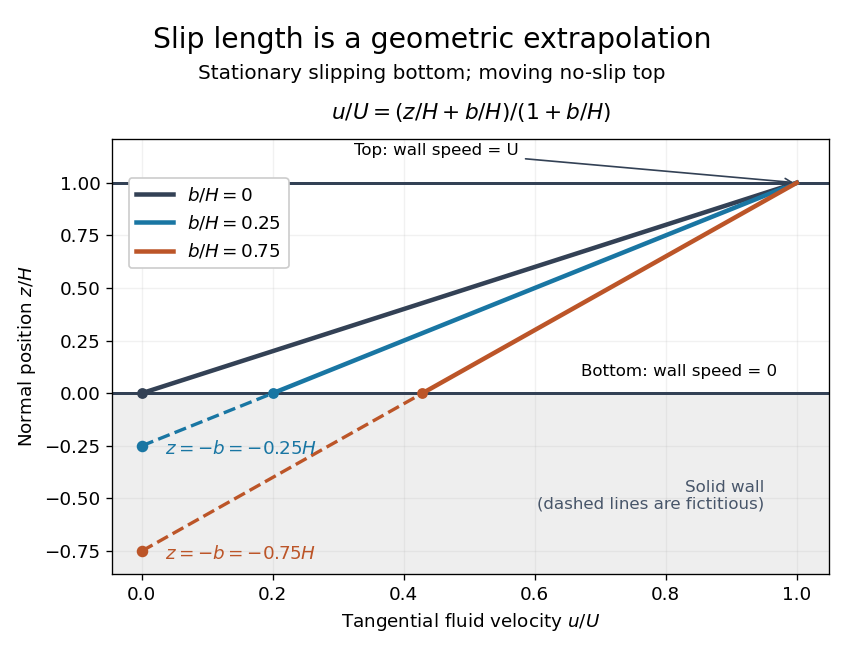

For fixed , and , recovers . As , throughout the gap and : the moving upper wall selects the limiting uniform velocity, while the lower wall approaches a stress-free boundary condition. The dynamic viscosity stays positive; the disappearing shear stress comes from the disappearing velocity gradient.
A short derivation uses unidirectional flow: the convective acceleration vanishes and the Navier-Stokes equation reduces to . Write . The bottom condition gives and the top condition gives .
Now both plates at and are stationary and both obey the Navier slip boundary condition with the same slip length . Drive steady flow of a Newtonian fluid in incompressible flow by the constant pressure gradient , with constant dynamic viscosity and no other streamwise body force. The planar Poiseuille flow profile and its volumetric flow rate per unit width areThe full volumetric flow rate for channel width is when side-wall effects are negligible. Thus has units , while has units . Denote the value at by .
The two wall checks expose the normal signs:Both Navier slip boundary conditions therefore hold exactly. The two walls exert backward tangential tractions of magnitude on the fluid. Increasing at fixed adds a uniform velocity offset, leaving the velocity gradient and wall shear stress unchanged. This differs from Couette flow with a slipping lower wall, where upper-wall velocity is fixed and shear stress decreases.
For , , and , the wall velocity is , the centre velocity is , and . The enhancement is . Equivalently, a prescribed volumetric flow rate needs only of the original pressure gradient. This makes slip length useful for estimating pumping requirements in small channels.
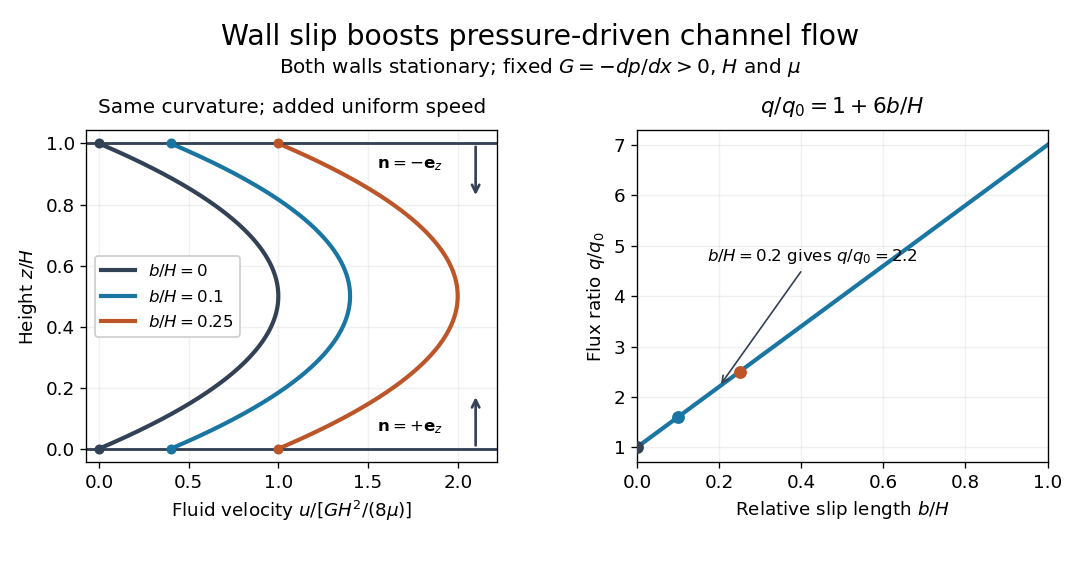
Equal slip at both channel walls increases pressure-driven flow
. Both walls are stationary and obey the Navier slip boundary condition. Left: normalized planar Poiseuille flow profiles at fixed pressure gradient , gap and dynamic viscosity for , and . Arrows show inward unit normals in opposite directions at the two walls. Right: volumetric flow rate per unit width increases by the factor at fixed . Details.
At fixed , and , recovers ordinary planar Poiseuille flow. As , the velocity and grow without bound in this model, although the varying part of the profile stays the same. At exactly zero tangential wall traction, no steady solution can balance this nonzero pressure gradient: conflicts with . Unlimited enhancement is consequently not a prediction for a real channel; finite wall friction, finite driving capacity and the validity of the assumed steady flow must be assessed. At fixed finite instead, and the profile approaches uniform velocity .
A short derivation integrates the reduced Navier-Stokes equation twice. Equal slip lengths and the opposite inward unit normals give . Its integral over the gap supplies the enhancement factor .
Articles by others on the same topic
There are currently no matching articles.