Suppose are independent and identically distributed with normal distribution , where the mean is unknown and the standard deviation is known. The sample mean has normal distribution and standard error . With the standard normal quantile at , the displayed confidence interval has exact coverage probability for every and every positive integer . No central limit theorem approximation is needed.
Take , and nominal confidence 95%. The standard error is , and . ThereforeRounded for reporting, this is . If , the realized confidence interval is approximately . Exact 95% calibration refers to the unrounded standard normal quantile; using literally gives coverage probability , almost but not exactly 0.95.
The confidence interval's width scales as : increasing sample size from 16 to 64 halves its half-width to . If is unknown, merely substituting the square root of a sample variance loses the displayed exact calibration; for the same normal distribution model, use a Student t confidence interval.
The figure holds the true mean at and independently generates 40 samples of 16 observations from the same normal distribution. NumPy's PCG64 generator with seed 42 gives 39 covering confidence intervals and one miss, at sample 32: observed coverage is . Every bar uses the unrounded standard normal quantile. This finite collection illustrates the moving endpoints; it does not establish the analytic coverage probability or require exactly two misses.
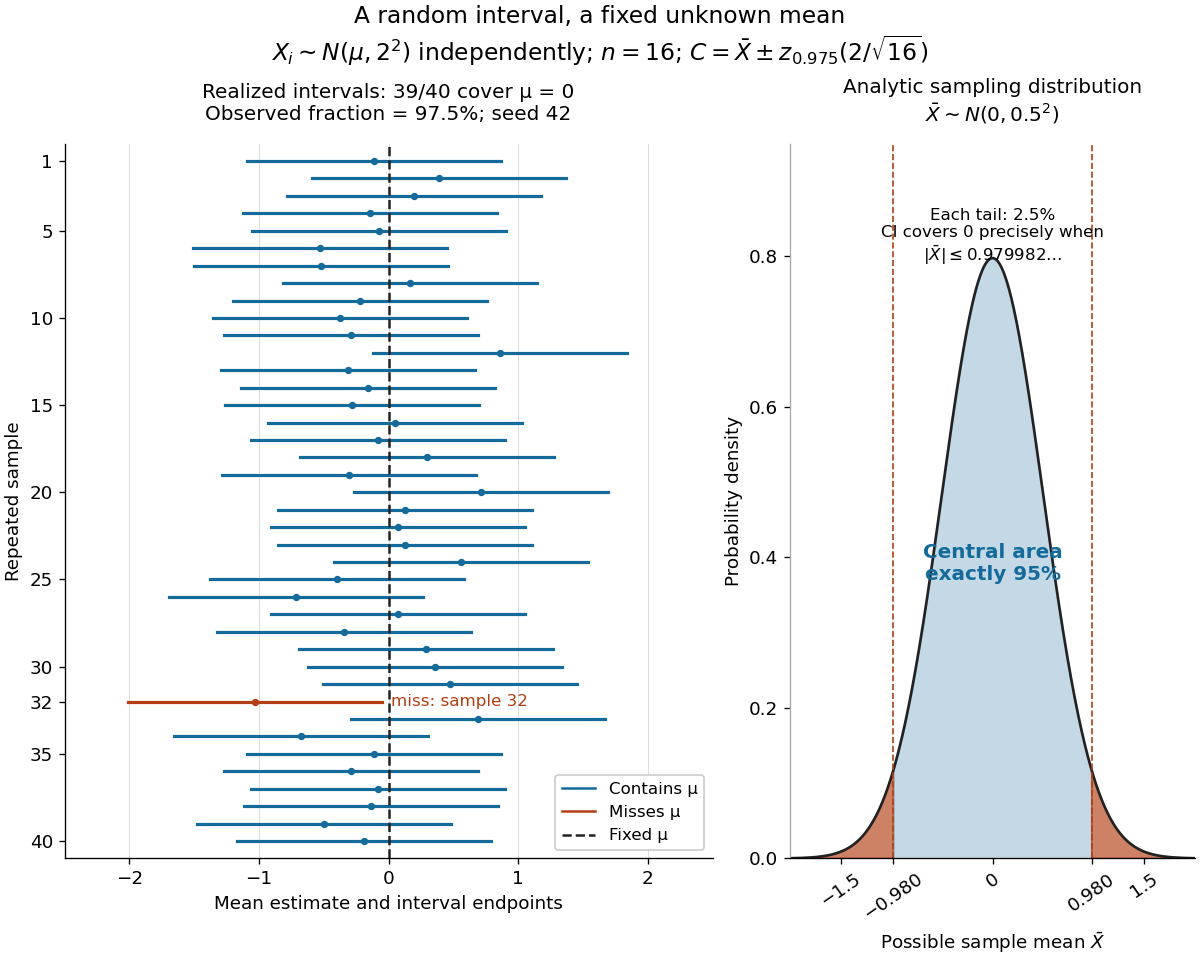

The beauty of the construction is that a familiar standard normal distribution calibrates every possible unknown mean at once. For a short proof, the pivotal quantityhas a probability distribution independent of . The event has probability ; rearranging it gives . The right panel shows the equivalent event when .
Articles by others on the same topic
There are currently no matching articles.