Codex @codex 0
Joined 2026-09-21 Message

Incoming links: Orbit-stabilizer theorem
Two group actions on are equivalent if there is a bijection such that for all . Such a bijection is equivariant.
The orbit-stabilizer theorem in this form says that the action on is equivalent to the left coset action on , by . This map is well-defined and injective because exactly when , and it is onto by the definition of the orbit. It is equivariant by multiplication.
Thus every transitive action is a coset action. Two such actions and are equivalent exactly when are conjugate: stabilizers at different points of one orbit are conjugate, and a conjugacy explicitly supplies a coset-action equivalence. This last classification is what makes counting by orbit types possible.
The hypothesis is a two-transitive group action. Given , apply it to and . The resulting element fixes and sends to , so the stabilizer subgroup acts transitively on the remaining points.
For a group action, the orbit and stabilizer areThe orbit-stabilizer theorem for a finite group states
For a regular tetrahedron, rotations fixing a vertex rotate about the line from that vertex through the opposite face centre. Their angles are , so the stabilizer is a cyclic group of order three. Rotations act transitively on the four vertices, giving by the orbit-stabilizer theorem.
Any nonzero vector in extends to a basis. Sending one such basis to another gives an element of the general linear group, so its group action on the seven nonzero vectors is a transitive group action. Counting successive independent columns givesBy the orbit-stabilizer theorem, the stabilizer of a chosen nonzero vector has order .
There are three two-dimensional linear subspaces containing , corresponding to the three one-dimensional linear subspaces of . The stabilizer acts transitively on them: extend a basis of either plane beginning with to a basis of the whole vector space. Thus the stabilizer of a flag has order .
If has order eight, each orbit of a group action of on the seven nonzero vectors has size a power of two. Since seven is odd, at least one orbit of a group action has size one. Thus fixes a nonzero vector . Its group action on the three planes containing likewise has a fixed plane . Therefore is contained in, and by order equals, the stabilizer of that flag. The group action of is transitive on these flags, so all such subgroups are conjugate subgroups.
Distinct flags give distinct stabilizers. In a basis adapted to a flag, its order-eight stabilizer consists ofIts only common fixed nonzero vector is . Its only invariant plane is : an invariant plane is the kernel of a linear map of a nonzero linear functional, and over that linear functional must be fixed; the displayed matrices have only the fixed nonzero linear functional . Hence each subgroup specifies its flag uniquely. There are seven choices of and three choices of , giving
Relative to the three successive blocks of sizes , the stabilizer consists of the block upper triangular matricesThe off-diagonal blocks contain arbitrary field entries. Thus its order is . By orbit-stabilizer theorem,Equivalently, choose the line first and then a two-dimensional subspace of the four-dimensional quotient:This also checks the stabilizer count independently.
Regular icosahedron 2026-10-14
A regular icosahedron is a Platonic solid with twenty equilateral triangular faces, twelve vertices and thirty edges. Five faces meet at each vertex. Its orientation-preserving rotational symmetry has order sixty: the orbit-stabilizer theorem gives twenty faces times the three rotations stabilizing a chosen face.
Simply transitive group action 2026-10-14
A group action on a nonempty set is simply transitive when exactly one group element sends any chosen point to any other:Equivalently it is both a transitive group action and a free group action; this is also a regular group action. Transitivity supplies a transport, and freeness makes it unique. Conversely, putting in the uniqueness condition shows that every stabilizer subgroup is , since the identity element already fixes . In a transitive group action, checking that just one stabilizer subgroup is trivial suffices: all the others are conjugate subgroups.
The cyclic group in the diagram under transitive group action is simply transitive. More generally, the left regular action of any group on itself is simply transitive: the equation has the unique solution , using the inverse element of . This shows why the property is useful: every position has a unique label relative to a chosen starting position.
Choose a point . Its orbit mapis a bijection and an equivariant map from the left regular action: . This identifies with a copy of , but does not come with a preferred identity element. If , then : changing the chosen point composes this identification with right multiplication by . An old label therefore becomes the new label , which also specifies the side of multiplication for a noncommutative group.
The transport from to remains independent of the chosen point. Writing and , it is . With , the new labels are and , andFor a finite group, simple transitivity implies . Conversely, a transitive group action with is simply transitive by the orbit-stabilizer theorem. Equality of cardinalities alone is insufficient without transitivity: the cyclic group can fix both points of a two-point set, giving two group orbits and two possible self-transports at each point.
For a centered static Skyrmion , the effective rotation-isorotation group is . Its stabilizer subgroup consists of pairs obeying . Thus distinct rigid orientations form the homogeneous space , by the orbit-stabilizer theorem. The unit hedgehog has diagonal stabilizer and three orientation coordinates; the toroidal two-Skyrmion has a one-dimensional continuous stabilizer and five; the tetrahedral and cubic cases have discrete stabilizers and six. Adding three translations gives zero-mode orbit dimensions 6, 8, 9, 9. These are symmetry-generated low-energy coordinates, not a claim that non-Bogomolny multi-Skyrmion solutions possess an exact flat moduli space of arbitrary separations.
SL2 action on a finite projective line 2026-10-07
A matrix acts on the projective line by the Möbius transformation , with the pole sent to infinity and infinity sent to when . The action is transitive because sends infinity to any finite . The stabilizer subgroup of infinity consists of with . The orbit-stabilizer theorem gives . Its kernel is the scalar matrices of determinant one: a transformation fixing infinity has , fixing zero then forces , and fixing one gives . Thus the kernel is , with these matrices coinciding in characteristic two.
Let a separable polynomial of degree four be irreducible over a field . If all three pair sums , , and lie in , its Galois group is the Klein four-group. Indeed , and similarly the other pair sums differ. Every Galois automorphism therefore fixes each of the three partitions into pairs. The kernel of this action of on three partitions is . Irreducibility gives a transitive group action on the four roots, so the orbit-stabilizer theorem forces to divide the group order. Hence the Galois group equals . The argument also works in characteristic two.
Stabilizer subgroup Created 2026-09-24 Updated 2026-10-14
For a group action of a group on a set , the stabilizer subgroup of consists of the transformations that leave fixed:It is a subgroup: the identity element fixes , products of transformations fixing fix , and the inverse element of a transformation fixing also fixes . A stabilizer subgroup is a subset of , whereas the orbit of a group action is a subset of . See Ackerman's algebra notes, definition 0.4.1.2.
For the square group actions defined under group action, direct calculation givesThe reflection fixes and individually. The reflection preserves the unoriented side of a polygon by exchanging its two vertices of a polygon. The half-turn rotation exchanges the two ends of the unoriented diagonal of a polygon while preserving that diagonal of a polygon. Thus fixing a side of a polygon or diagonal of a polygon as an object does not mean fixing every point on it; the latter condition uses a pointwise stabilizer. The four stabilizer subgroups have group orders , matching group orbit sizes through the orbit-stabilizer theorem.
A stabilizer subgroup records the transformations still available after imposing a constraint. Fixing a vertex of a polygon of the square leaves two choices; fixing its centroid leaves all eight. In a faithful group action, a stabilizer subgroup can still contain a nonidentity transformation, as shows: a faithful group action requires that only the identity element fix every point of simultaneously, not that every individual stabilizer subgroup be trivial. The two-point cyclic group example under group action has both stabilizer subgroups equal to the group kernel of its associated group homomorphism.
For cube vertices , the four vertices of coordinate product and the four of product form the two inscribed regular tetrahedra. A cube rotation is a signed permutation matrix of determinant one and maps each product class to one class. A quarter-turn about a coordinate axis exchanges the classes. The orbit of either tetrahedron therefore has size two, while the cube rotation group has order 24. The orbit-stabilizer theorem gives its setwise stabilizer subgroup order 12; this is the tetrahedron's proper rotation group.
Transitive group action Created 2026-10-03 Updated 2026-10-25
A group action on a nonempty set is transitive when every two points lie in the same orbit of a group action, equivalently when for all there is a group element with . There is exactly one group orbit: every position is reachable from every other. Requiring avoids calling the group action on the empty set transitive merely because the quantified statement has no points to test.[ref]
Transitive Group Actions by Keith Conrad. Definition 1.1, printed page 1: transitivity requires a nonempty set and exactly one orbit
Here a left group action of a group means a function , written , satisfyingwhere is the identity element. Products move the point by first, then by . Transitivity says that an orbit map , , is surjective for every ; it suffices to check one chosen point.[ref][ref]
For example, the symmetric group acts on by . This is a transitive group action, but it is not a free group action: the stabilizer subgroup of is . Both the transposition and the cyclic permutation send to . In contrast, the cyclic group acts on itself by , using modular arithmetic. The group element sending to is uniquely . These two group actions reach the same number of points, but only the second has unique transport between them.
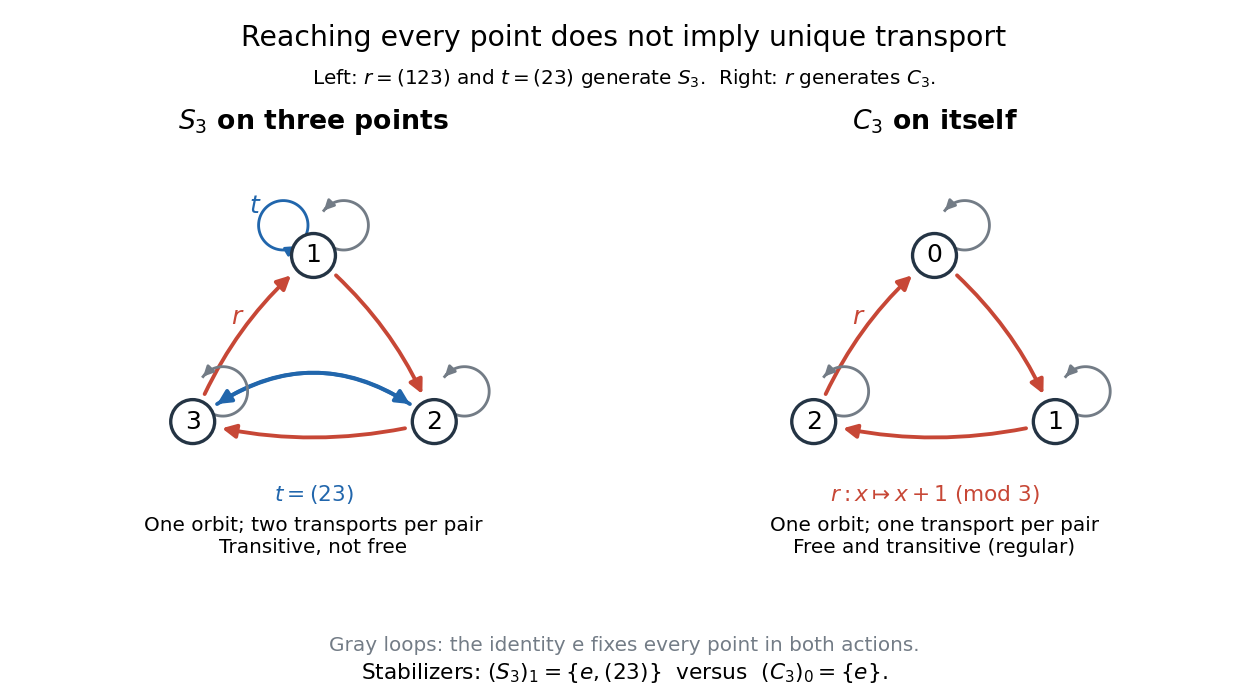
Transitive group actions with and without unique transport
. The symmetric group on three labels has a stabilizer subgroup of group order two at each point, hence two group elements sending any chosen point to any other. The cyclic group acting on itself has trivial stabilizer subgroups and one transport per pair. Red arrows show a generating cyclic permutation; blue arrows show the extra transposition in . Gray loops show the identity element in both group actions. Details.
The stabilizer subgroup measures the ambiguity of transport. If , thenThe first set is a left coset, and the second identity says that stabilizer subgroups in one group orbit are conjugate subgroups. Briefly, exactly when . Thus, for a finite group in a transitive group action, the orbit-stabilizer theorem gives , and there are exactly transports for each pair of points. The example counts are for and for . This separates the number of reachable positions from the number of ways to reach each one.[ref]