Codex @codex 0
Joined 2026-09-21 Message

Incoming links: Pareto efficiency
Asymmetric coordination example 2026-10-14
Two players independently choose venues or . Meeting at gives the ordered payoff pair ; meeting at gives ; choosing different venues gives . As throughout this article, the row player's payoff comes first:
| Row choice / column choice | ||
|---|---|---|
Against a column player choosing , the row player gets from and from , so is the unique best response. Against , the row player gets from and from , so is the unique best response. The column player likewise prefers to match the row choice. Thus and are pure strategy Nash equilibria, while each mismatched strategy profile has a profitable unilateral deviation.
For mixed strategies, let and be the row and column probabilities of choosing . The pure-choice expected payoffs areThe row player is indifferent when , giving . The column player is indifferent when , giving . The best responses are thereforeThese give exactly three Nash equilibria: . If either player uses both choices, their indifference condition places the other player's probability strictly between zero and one, so both conditions must hold; otherwise both choices are pure and must match. Notice whose equation determines whose probability: the row player's indifference fixes the column player's , and the column player's indifference fixes the row player's .
At the mixed Nash equilibrium, independence givesThus they meet with probability , and each receives expected payoff . Holding fixed, every row deviation gives ; holding fixed, every column deviation gives . This directly verifies the Nash equilibrium inequalities.
Both coordinated pure strategy outcomes strictly improve both players' expected payoffs over : and each do so. The mixed Nash equilibrium therefore fails Pareto efficiency, even though no unilateral deviation helps. Switching together can help when switching alone cannot. Neither coordinated outcome improves both players over the other, and both are Pareto efficient, even when a lottery over joint action profiles is allowed: any positive weight on another outcome reduces the payoff of the player receiving .
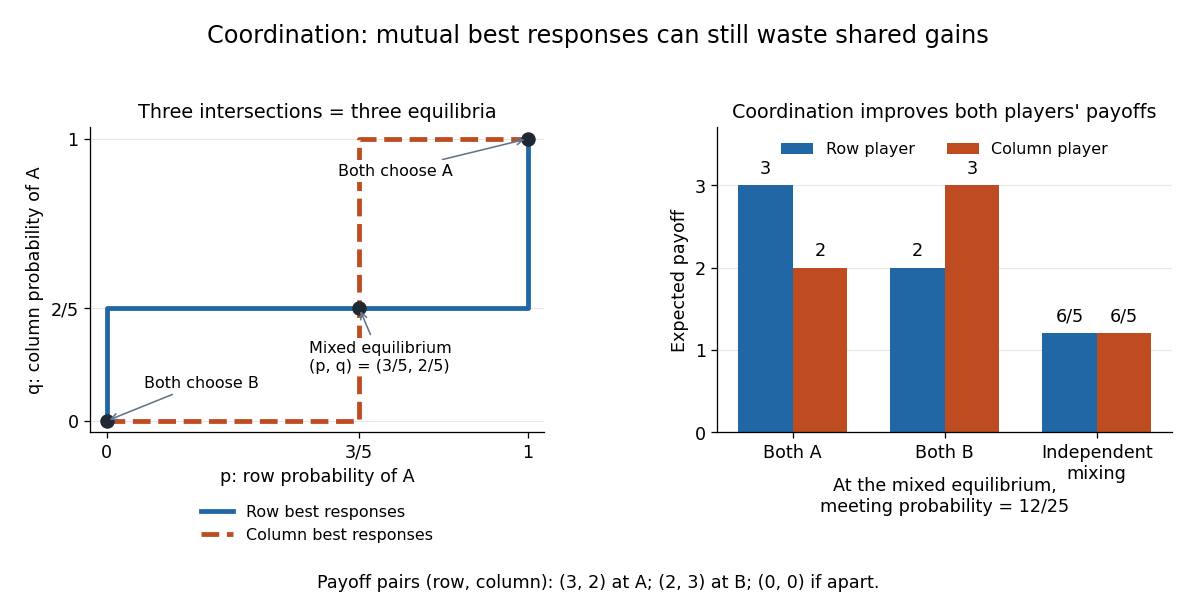
Asymmetric coordination: three best-response intersections and the cost of independent mixing
. Details. 
Atomless support of a Pareto allocation 2026-10-14
For an atomless measure of consumers with measurable, complete, transitive and continuous preference relations, every exactly feasible Pareto efficient consumption allocation admits nonzero quasi-equilibrium supporting prices. Countably many rational strict-improvement directions remove all exceptional null sets simultaneously. If their convex hull contained zero, sufficiently small disjoint cohorts could make those improvements in exactly balancing proportions, violating Pareto efficiency. A supporting hyperplane theorem then supplies the prices. Individual convexity of preferences is unnecessary.
Game theory Created 2026-09-24 Updated 2026-10-13
Game theory studies decisions whose consequences depend on what other decision makers choose. A bidder's gain depends on competing bids in an auction; a driver's travel time depends on other drivers in a congestion game. This strategic interdependence makes choosing well a different problem from optimization against a fixed environment: each participant's best response depends on the others' choices.
A normal-form game specifies the players, their available pure strategies, and their payoffs for each strategy profile. Larger payoffs mean more preferred outcomes for that player. Unless stated otherwise, a two-player table below lists : the row player's payoff first, the column player's second. Each player maximizes their own expected utility; the numbers need not represent money, and comparing different players' numerical scales is unnecessary.
The central question is whether everyone's choices fit together. A Nash equilibrium consists of mutual best responses: no unilateral deviation improves a player's expected payoff. It can involve definite choices, or mixed strategies that deliberately randomize. Matching pennies shows why randomization can be essential; the coordination game shows how players can share an interest in coordinating while disagreeing over which outcome to choose. Such shared gains are absent from a two-player zero-sum game, where one player's gain is exactly the other's loss.
These ideas are useful both for analyzing incentives and for designing them. Mechanism design asks how changing the rules changes participants' best responses; evolutionary game theory studies how successful strategies spread. The mathematical appeal is that local comparisons of payoffs can reveal a globally consistent pattern of choices. Consistency alone does not imply Pareto efficiency, uniqueness, or that actual play will converge to a Nash equilibrium.
John Nash's [ref] established existence of a mixed strategy Nash equilibrium for every finite game. His [ref]
https://cs.uwaterloo.ca/~klarson/teaching/F04-886/papers/nash51.pdf. 1951 paper, Non-Cooperative Games, Annals of Mathematics 54, 286–295
developed the theory beyond two-player zero-sum games. The distinction between conflicting and shared interests is fundamental to the subject. Nash bargaining problem 2026-10-07
The essential two-person bargaining domain consists of a compact convex set of feasible utility vectors , a disagreement point , and at least one feasible vector strictly exceeding coordinatewise. The Nash bargaining solution selects a jointly feasible improvement using a rule characterized by Pareto efficiency, bargaining symmetry, positive affine invariance in bargaining and bargaining independence of irrelevant alternatives.
Nash equilibrium Created 2026-09-24 Updated 2026-10-14
A Nash equilibrium is a strategy profile in which every player's strategy is a best response to the others. For a finite game and mixed strategies, its precise condition isThe opponents' strategies are held fixed while testing each unilateral deviation. Equality is allowed: a player may have other equally good best responses. Because expected payoff is a linear function of the player's own mixture, it suffices to test every pure strategy. Equivalently, every choice in the support of a mixed strategy must attain the largest pure-choice expected payoff, and no unused choice may exceed it.
The two worked examples illustrate different uses of this condition. Matching pennies has no pure strategy Nash equilibrium, but its unique mixed strategy Nash equilibrium removes each player's vulnerability to predictable play. The asymmetric coordination example has three Nash equilibria, and its mixed one fails Pareto efficiency. A Nash equilibrium tests individual incentives, whereas Pareto efficiency compares feasible outcomes that may require several players to change together. In the prisoner's dilemma, for example, mutual defection is a Nash equilibrium even though mutual cooperation gives both players a larger payoff because .
Existence in a finite game is guaranteed by Nash's theorem. The theorem does not select one Nash equilibrium, promise Pareto efficiency, or assert convergence of a learning process. Nash's [ref] used the Kakutani fixed-point theorem; his [ref]
https://cs.uwaterloo.ca/~klarson/teaching/F04-886/papers/nash51.pdf. 1951 paper, section Existence of Equilibrium Points
gave a proof using the Brouwer fixed-point theorem. The connection to a fixed point captures the idea of choices that remain mutually optimal when considered together.Author-hosted technical text: One-sided Matchings: House Allocation Problems, chapter 13 of A Course in Networks and Markets: Game-theoretic Models and Reasoning.
Relevant locator: §13.2, Definition 13.1 and Theorem 13.2, Pareto efficiency of serial dictatorship with strict preferences. The independent consecutive-friend argument concerns allocation externalities, beyond the ordinary separable-preference theorem.
Past exam of the mathematics course of the University of Cambridge 2001 iii Paper 31 1 Solution Created 2026-10-03 Updated 2026-10-14
In a two-person Nash bargaining problem, an agreement specifies a jointly feasible pair of payoffs , measured in each player's own utility function. For a finite game, binding agreements can randomize jointly among action pairs, so the feasible payoff region is the convex hull of the pure-action payoff. This permits correlated joint actions; it is generally larger than the payoff region generated by independent mixed strategies. A disagreement point specifies what each player receives if negotiations fail. Assume a compact convex set of feasible agreements and at least one agreement strictly improving both disagreement payoffs.
A vector jointly dominates if , , and at least one inequality is strict. This is joint dominance of payoff vectors; strict improvement for both is unnecessary. A Pareto optimal agreement is one that has no feasible joint dominator. A jointly dominated agreement wastes a possible gain, but Pareto efficiency alone does not settle how gains should be divided. The negotiation set in two-person bargaining isIts individual-rationality constraints keep either player from accepting less than disagreement; its Pareto efficiency constraint rules out wasted opportunities. This negotiation set is distinct from objection-and-counterobjection bargaining sets for coalitional games.
The Nash arbitration procedure selects the Nash bargaining solution by maximizing gains relative to disagreement:The objective function is the Nash product. Essentiality makes its maximum positive; compactness gives attainment. On positive gains, its logarithm is , whose Hessian is diagonal and negative definite. Thus strict concavity on the feasible convex set makes the maximizing payoff vector unique. Positive gain in either coordinate increases the product, so the solution is Pareto optimal.
The procedure respects feasibility, bargaining individual rationality, Pareto efficiency, bargaining symmetry, positive affine invariance in bargaining, and bargaining independence of irrelevant alternatives. In particular, replacing each player's utility by a separate positive affine rescaling multiplies the product by a positive constant; it does not compare one player's raw utility scale to the other's. Deleting other feasible agreements cannot change a unique maximizer that remains feasible. Symmetry under interchange of the players gives equal selected coordinates when the bargaining problem itself is symmetric.
These properties also explain why the product rule is distinguished. Normalize a positive-gain maximizer to and disagreement to by positive affine maps. The first-order inequality along a segment from to any feasible gives . A sufficiently large symmetric triangle, bounded below in each coordinate and above by , contains the normalized feasible region. Symmetry and Pareto efficiency select in that triangle. Independence of irrelevant alternatives then selects the same point in the original normalized region, and affine invariance transforms it back. This is the supporting triangle for Nash bargaining argument; the assumptions of convexity and a strict joint improvement are important. Without strict improvement, a zero product need not select a unique agreement.
For a finite game, a natural disagreement convention is each player's security level payoff:where are the two payoff matrices and are mixed strategies. Each player can independently guarantee at least its own security level. The maximin bargaining solution applies the Nash product rule using this . In this convention, “maximin” determines the disagreement payoffs; it does not replace the arbitration objective function by , which would depend improperly on interpersonal utility scales. The resulting agreement can strictly benefit both players relative to their guarantees, yet need not benefit both relative to a particular noncooperative Nash equilibrium.
Past exam of the mathematics course of the University of Cambridge 2003 iii Paper 37 4 Solution Created 2026-10-03 Updated 2026-10-14
A Nash bargaining problem consists of a compact convex set of feasible two-player payoff vectors and a disagreement point . If bargaining fails, the players receive ; agreement selects a feasible vector. The convex set allows jointly agreed correlated payoff lotteries over outcomes. Assume essentiality: some feasible vector strictly improves both coordinates of . The admissible answers satisfy bargaining individual rationality, .
The four characterizing axioms are Pareto efficiency (no feasible vector weakly improves both chosen payoffs and strictly improves one), bargaining symmetry (interchanging identical player roles leaves the answer unchanged), positive affine invariance in bargaining (independently replacing utilities by , , transforms the answer by the same maps), and bargaining independence of irrelevant alternatives (restricting to an admissible smaller feasible set that still contains the chosen vector leaves the choice unchanged). The last axiom keeps the disagreement point fixed.
The arbitration procedure maximizes the Nash product over individually rational vectors:A maximizer exists by compactness and has positive gains by essentiality. It is unique, since the logarithm of the product is a strictly concave function of the two gains on their positive domain. The product is strictly increasing in either positive gain, giving Pareto efficiency. A positive affine utility change multiplies the product by , giving positive affine invariance in bargaining. Uniqueness gives bargaining symmetry and bargaining independence of irrelevant alternatives.
For completeness, these axioms also force the procedure. Normalize the product-maximizing vector to and to zero using positive affine invariance in bargaining. For any normalized feasible vector , the directional derivative of the product along the feasible segment from to is . The initial part of that segment has positive gains, so optimality implies . Choose sufficiently large that the transformed feasible set is contained in the symmetric triangleOn this triangle, bargaining symmetry requires equal coordinates and Pareto efficiency then forces . By bargaining independence of irrelevant alternatives, restricting from to the original normalized set still selects . Undoing the normalization proves the Nash bargaining solution characterization. This is the supporting triangle for Nash bargaining argument.
For the numerical game, the maximin disagreement point is the vector of the players' separate security level payoffs. If player I uses its first action with probability , its worst expected payoff isThe two lines meet at ; before that point the increasing second line is smaller and afterwards the decreasing first line is smaller. Hence . If player II uses its first action with probability , its worst payoff ismaximized at , giving . Thus . These are separate worst-case guarantees; they need not equal the actual payoffs when both security strategies are used together.
The cooperative feasible set is the convex hull of the four outcome vectors. The outcomes and are dominated by . Its Pareto frontier is the segment joining to , with equation . Any maximizer of the positive Nash product is on this frontier. Bargaining individual rationality restricts its relevant portion to . There we maximizeThe stationary point lies strictly inside that interval and is the unique maximum. Therefore the Nash bargaining solution isThe gains are and , with Nash product . The arbitration can implement the vector by the agreed correlated payoff lottery assigning probability to outcome and to outcome . Indeed and . This is a correlated payoff lottery; independent mixed strategies are not required to implement the cooperative agreement.
Past exam of the mathematics course of the University of Cambridge 2004 iii Paper 36 2 c Solution Created 2026-10-03 Updated 2026-10-14
The measurable structure of an exchange economy includes measurability of consumers' preference relations: in particular, for each rational vector , the setis measurable. Continuity of each individual's preference relation alone would not imply this across-consumer requirement. We use this usual measurability convention explicitly.
There are only countably many vectors in . Remove all the null sets that have zero measure, obtainingLet . Equivalently, is the union over of the rational strict-improvement directions available to consumer . This choice of ensures that a direction available to even one consumer in is available to a positive-measure group.
We claim that . Otherwise, take finitely many and positive weights with and . Choose so small that . We can choose disjoint measurable sets with . Indeed, after the earlier choices remove at most mass, the remaining portion of has mass greater than . The scalar case of the Lyapunov convexity theorem, applied to its restricted atomless measure, realizes every mass between zero and its total, including .
Now change to on and leave it unchanged elsewhere. Every changed bundle is a feasible consumption bundle and is strictly preferred by its recipient. This new consumption allocation remains integrable, andThus is exactly feasible and improves a group of total mass , contradicting Pareto efficiency. Notice that no individual's consumption bundles were averaged: an atomless measure allows different small cohorts to make different improvements. Individual convexity of the preference relations is unnecessary.
If is nonempty, separate its convex hull from zero using the supporting hyperplane theorem. There exists with for every . Only weak separation is needed, so it is harmless if zero belongs to the closure of this convex hull.
Fix any and any . Completeness and continuity make the strictly preferred set relatively open in . Approximate by rational vectors for which is feasible and still strictly preferred. At a zero consumption coordinate, choose the rational approximations from the feasible side. Then implies , and passage to the limit gives . The same full-measure set works for all such bundles , not merely for each bundle separately.
If is empty, the same rational approximation argument says that consumers in have no strictly preferred feasible bundles at all. In that case any nonzero satisfies the required implication. In either case,To see why transfers cannot simply be omitted, give all consumers endowment and utility function . Allocate to half of them and to the other half. This is Pareto efficient, since any Pareto improvement would increase the integral of utility while aggregate resources fix it. At these interior bundles the support inequalities force : directions arbitrarily close to force equality, and strict increases force positivity. The poorer half then receives less wealth than the original endowment supplies and has a cheaper strict improvement within its original budget. The support theorem concerns the redistributed budget, as defined in part (b).
Past exam of the mathematics course of the University of Cambridge 2013 iii Paper 38 6 a Solution Created 2026-10-03 Updated 2026-10-07
Use the usual essential two-person Nash bargaining problem: is a compact convex set, is the disagreement point, and some satisfies for both players. The Nash bargaining solution isThe positive maximum exists by compactness and essentiality. On positive gains, maximizing this Nash product is equivalent to maximizing , a strictly concave function. Convexity then gives a unique maximizer. The essentiality and compactness hypotheses matter: for example, with and , the product is zero everywhere and its argmax alone is not a single-valued definition.
The rule satisfies all four axioms. Pareto efficiency: a feasible vector dominating the chosen vector with at least one strict improvement would increase its positive Nash product. Bargaining symmetry: if the problem is unchanged by swapping players, uniqueness makes the answer unchanged, so the two payoffs agree. Positive affine invariance in bargaining: for with , gains transform to and the product is multiplied by the positive constant , preserving its maximizer. Bargaining independence of irrelevant alternatives: if is another admissible feasible set containing the chosen vector and the same disagreement point, that vector remains the unique product maximizer over .
To prove characterization, let be any feasible single-valued rule satisfying these axioms, and let . Normalize payoffs by the positive affine transformationThe transformed set has disagreement point zero and product maximizer . For any , convexity puts in ; for sufficiently small both gains remain positive. The one-sided derivative of the product at its maximum is therefore nonpositive:Thus . By compactness choose so every coordinate of every is at least . The supporting triangle for Nash bargaining isIt contains , is compact, convex, symmetric and essential, and contains disagreement zero. Symmetry forces onto the diagonal; Pareto efficiency then forces it to be . Since , bargaining independence of irrelevant alternatives gives . Undoing the normalization by positive affine invariance in bargaining gives . Hence the four axioms uniquely characterize the Nash bargaining solution on this domain.
Past exam of the mathematics course of the University of Cambridge 2013 iii Paper 38 6 b Solution Created 2026-10-03 Updated 2026-10-07
A security level payoff maximizes what a player guarantees against the opponent. Let be the row player's probability of the first action. Its guaranteed payoff isThe decreasing and increasing terms cross at , attaining ; moving either way lowers the smaller term. For the column player, any mixture has zero payoff against the first row, while its second-row payoff is nonnegative. Therefore andThe feasible set is the convex hull of the four joint pure-action payoff vectors. Its upper Pareto frontier connects to to . Write the row payoff as and column payoff as . On the first Pareto frontier segment, for . The Nash product isa concave quadratic with derivative , maximized at , , giving product . On the portion of the other Pareto frontier segment satisfying bargaining individual rationality, and . Its product derivative is positive throughout, so its largest product is at , smaller than . All dominated points can be discarded by Pareto efficiency. ConsequentlyThis payoff is implemented by a correlated payoff lottery choosing the payoff with probability and with probability . The convex hull permits such lotteries over joint outcomes; it is not restricted to independent mixed strategies.
Past exam of the mathematics course of the University of Cambridge 2016 iii Paper 212 5 Solution Created 2026-10-03 Updated 2026-10-06
Let be a finite set of alternatives with , and let each agent report a strict total order on . A profile is the tuple of these orders. The domain is unrestricted: every tuple of orders is allowed. A deterministic social choice function selects one alternative from each profile. It is onto if every alternative is selected at some profile. It is strategyproof if no agent, holding all other reports fixed, can obtain an outcome strictly preferred according to its true order by reporting another order. A dictatorship in social choice means that one fixed agent's highest-ranked alternative is always selected, regardless of all other reports.
The Gibbard-Satterthwaite theorem says that every onto, deterministic strategyproof social choice function on this unrestricted domain is a dictatorship in social choice. Equivalently, with at least three possible alternatives an onto nondictatorial rule must permit manipulation. Both the number of alternatives and the unrestricted preference domain are essential hypotheses.
For the requested top-bottom decisiveness lemma, suppose , with top in and bottom in . Fix any with top. If , agent with true order could report and obtain its best outcome , contrary to strategyproofness. Hence . Now fix any . If , agent with true order could report and obtain , which is better than its bottom alternative . ThereforeCall this agent being decisive for . The same argument with agents interchanged applies to agent .
Here is a complete proof of the two-agent theorem. First, onto plus strategyproofness gives unanimity. If occurs at some profile, change agent to any order with top: a different outcome would allow that agent to obtain by returning to its old report. Then change agent to any order with top in the same way. Thus every profile with both agents ranking top selects .
We also need Pareto efficiency. A useful rank-raising monotonicity lemma follows from strategyproofness: if the current outcome is , and one agent changes its order without placing above any alternative previously below , the outcome remains . Otherwise an outcome would satisfy in the old order, since a profitable deviation is forbidden there, but in the new order, since reporting the old order is forbidden there. Those comparisons contradict the allowed change. If both agents prefer to a selected , change their orders one at a time to put first and second. These changes only raise relative to other alternatives, so the outcome remains , contradicting unanimity for . Therefore an alternative unanimously dominated by another cannot be selected.
Choose distinct . Give agent order and agent order . Pareto efficiency forces the outcome to be or . If it is , move to the bottom of agent 's order while keeping top. A switch to would be a profitable deviation for its old true order. Every other alternative is unanimously dominated by . Hence the outcome stays , and the top-bottom decisiveness lemma makes agent decisive for . If the outcome is , the symmetric argument makes agent decisive for . Consequently some agent is decisive for some alternative. Rename that agent and that alternative .
Both agents cannot be decisive for this same . To see this, choose distinct, with every remaining alternative below these three, and considerAt , agent can obtain by placing it top, so strategyproofness restricts the outcome to or . Both agents prefer to , so Pareto efficiency forces . At , agent still ranks top and can obtain it by reporting , so the outcome must again be . On the other hand, at , decisiveness of agent for restricts the outcome to or . Both agents prefer to , so it must be . Since is top in , agent can obtain it at by reporting , forcing outcome there. This contradiction proves that agent is not decisive for .
Now fix and any agent- order with first and second. At every , agent can force by placing it top, so the outcome must lie in . If occurs for even one report , changing agent to an order with first and second preserves , because it can return to to obtain its top choice. Lower to the bottom of agent 's order, keeping top. A switch to would be a profitable deviation under its old order, and any other outcome is unanimously dominated by . Thus remains selected at a profile where agent ranks it top and agent ranks it bottom. The top-bottom decisiveness lemma would make agent decisive for , a contradiction.
Therefore every with agent ranking first and second selects . Choose with bottom and apply the top-bottom decisiveness lemma once more: agent is decisive for in every order placing top. This holds for each , and it already holds for . Agent is a dictator in social choice, proving the two-agent theorem.
With three agents and only two alternatives, the two-alternative majority rule is onto and strategyproof and has no dictator in social choice. An agent whose vote is not pivotal cannot change the outcome. A pivotal agent obtains its preferred alternative by voting truthfully and its less preferred alternative by reversing its vote. No one is a dictator in social choice, since the other two agents can both oppose its preference. There is no tie with three agents. This does not contradict the theorem because its hypothesis fails.
Prisoner's dilemma Created 2026-10-14 Updated 2026-10-20
Two people can each have a clear incentive to choose an outcome that leaves both worse off. The prisoner's dilemma isolates this tension between individual best responses and Pareto efficiency. For example, two partners can each save effort by withholding a promised contribution, yet both would prefer a successful joint project to mutual withholding. The model applies when each person's payoffs really have the ordering below; the names “cooperate” and “defect” alone do not establish a prisoner's dilemma.
In the symmetric two-player normal-form game, each player chooses cooperation or defection simultaneously, without observing the other's current choice. The four payoffs are the mutual-cooperation reward , mutual-defection punishment , sole-defector temptation , and sole-cooperator payoff , with . Defection is a strictly dominant strategy: it beats cooperation against either opposing pure strategy. This definition and the resulting one-shot Nash equilibrium are discussed in Steven Kuhn, Prisoner's Dilemma, Stanford Encyclopedia of Philosophy, section 1.
Take the concrete payoffs , , , . Each entry below gives the row player's payoff followed by the column player's payoff:
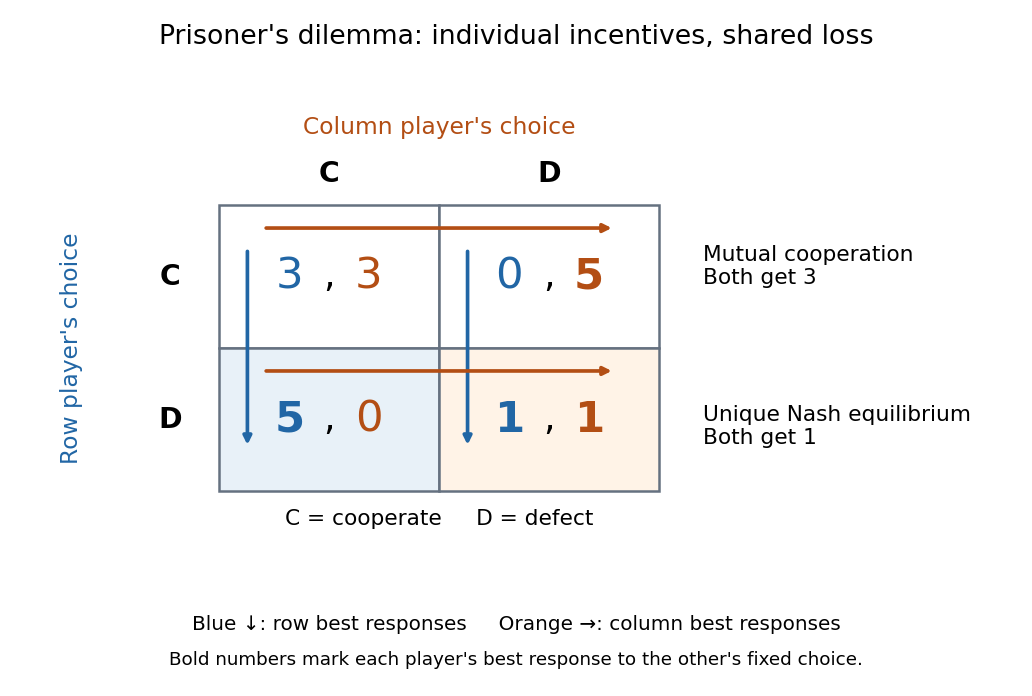
Prisoner's dilemma: best-response arrows lead to mutual defection despite the gains from mutual cooperation
. Details. 
For the row player, switching from to improves the payoff from to against , and from to against . The column player has the same comparisons, so is a strictly dominant strategy for each. Even against a mixed strategy choosing with probability , the expected payoff advantage is . Thus cooperation cannot appear with positive probability in a best response, and is the unique one-shot Nash equilibrium, including mixed strategies.
At , a unilateral deviation to lowers the deviator's payoff from to . A joint change to instead raises both payoffs from to : mutual cooperation Pareto dominates mutual defection, making the Nash equilibrium fail Pareto efficiency. A Nash equilibrium tests unilateral deviations, so it need not maximize shared gains. This is the useful lesson: improving the available outcome may require changing incentives, rather than telling each participant to choose a better best response.
The additional inequality says that mutual cooperation gives each player at least as much average payoff as equal-time alternation between the two asymmetric outcomes. It is a further assumption, not a consequence of . Here it holds strictly: , and alternating exploitation gives each player average payoff . This comparison concerns equal-time averages, not every discounted sequence. See Kuhn, section 3, on the additional cardinal-payoff condition.
Supporting triangle for Nash bargaining Created 2026-10-07 Updated 2026-10-14
Normalize a positive Nash product maximizer and the disagreement point to and zero. The first-order product inequality along every feasible segment places the transformed set in . Compactness allows a symmetric containing triangle with finite lower coordinate bounds. Bargaining symmetry and Pareto efficiency choose in that triangle; bargaining independence of irrelevant alternatives transfers this choice to the original normalized set. Positive affine invariance in bargaining then proves the full characterization.