A stellar wind carries matter away from a star, altering its mass, angular momentum and surroundings. Hot coronal gas can escape through pressure-driven expansion; radiation transfers momentum to gas through continuum or spectral line absorption, or to dust that then drags gas. A magnetic field can transfer rotational energy and angular momentum to an outflow. These mechanisms need not give the same terminal speed or mass loss rate.
For a steady spherical pressure-driven model, conservation of mass gives . Combining the radial Euler equation with an isothermal equation of state gives the Parker wind equationA smooth transonic branch passes through at , connecting a subsonic inner atmosphere to an escaping supersonic wind. The isothermal Parker wind requires continuing heat input as the gas expands; a polytropic stellar wind instead tracks a changing temperature and must satisfy its own terminal-energy condition. A subsonic isothermal breeze generally tends to a nonzero external pressure, so outward velocity alone does not select the escaping solution.
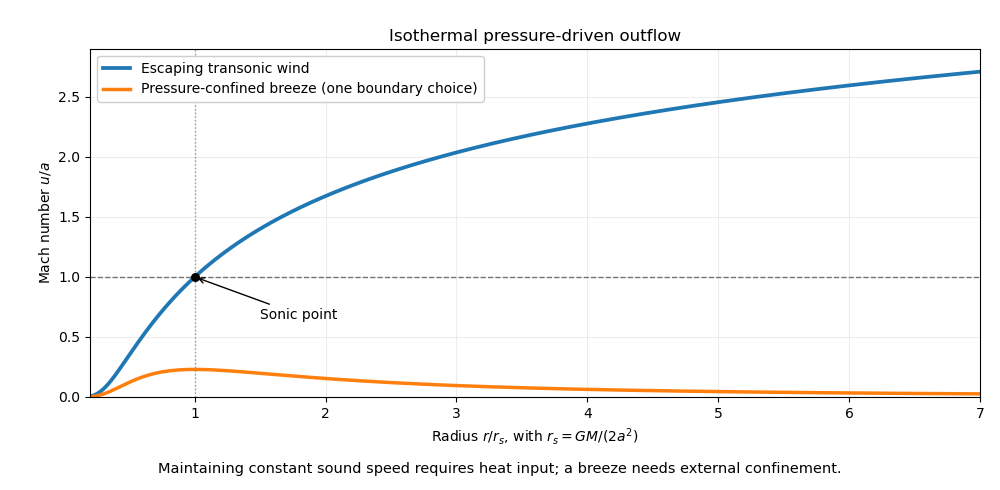

The solar wind supplies a nearby example of an outward plasma flow carrying a magnetic field. Profiles of spectral lines, especially absorption shifted by the Doppler effect together with emission, diagnose more distant stellar winds. The critical-point condition and boundary heating constrain ; it is not determined by an escape-speed estimate alone.
Articles by others on the same topic
There are currently no matching articles.