A stellar wind carries matter away from a star, altering its mass, angular momentum and surroundings. Hot coronal gas can escape through pressure-driven expansion; radiation transfers momentum to gas through continuum or spectral line absorption, or to dust that then drags gas. A magnetic field can transfer rotational energy and angular momentum to an outflow. These mechanisms need not give the same terminal speed or mass loss rate.
For a steady spherical pressure-driven model, conservation of mass gives . Combining the radial Euler equation with an isothermal equation of state gives the Parker wind equationA smooth transonic branch passes through at , connecting a subsonic inner atmosphere to an escaping supersonic wind. The isothermal Parker wind requires continuing heat input as the gas expands; a polytropic stellar wind instead tracks a changing temperature and must satisfy its own terminal-energy condition. A subsonic isothermal breeze generally tends to a nonzero external pressure, so outward velocity alone does not select the escaping solution.
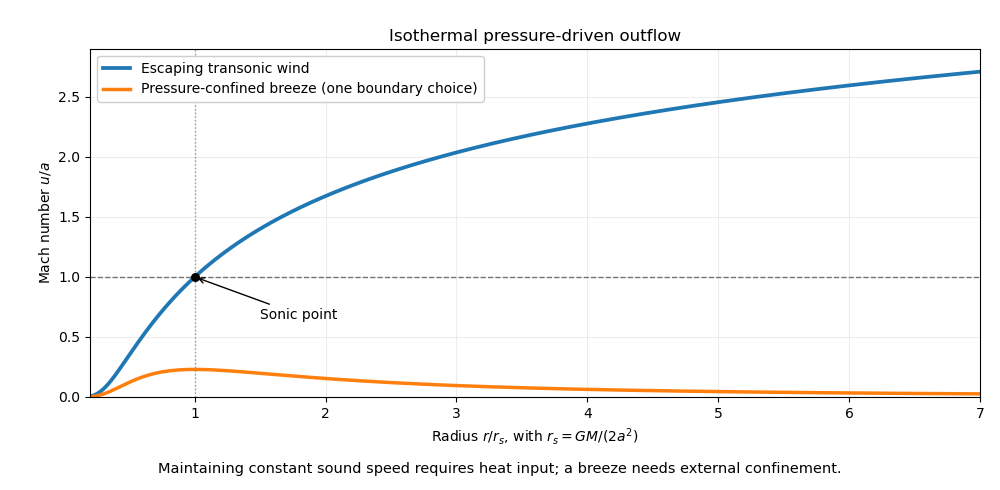

The solar wind supplies a nearby example of an outward plasma flow carrying a magnetic field. Profiles of spectral lines, especially absorption shifted by the Doppler effect together with emission, diagnose more distant stellar winds. The critical-point condition and boundary heating constrain ; it is not determined by an escape-speed estimate alone.
An accretion disk forms when inward-moving gas retains enough angular momentum to orbit a compact object. In a geometrically thin Keplerian disk, radial force balance gives and vertical hydrostatic equilibrium gives a thickness . Matter cannot fall far inward while keeping its original specific angular momentum : stresses must transport angular momentum outward.
The viscous torque in an accretion disk has outward magnitudewhere is the effective kinematic viscosity and the surface density. With constant inward accretion rate and zero inner torque at , conservation of angular momentum givesThe associated standard thin-disk dissipation flux from each face isOrbital gravitational potential energy becomes heat and, in a radiatively efficient disk, escaping radiation. Integrating both faces gives the standard thin-disk luminosity under this boundary condition. A central stellar surface or an inner torque can release or redistribute additional energy.
The alpha disk prescription summarizes an effective stress rather than a claim that molecular viscosity alone explains observed rates. In an ionized disk, magnetorotational instability can produce magnetic and fluid stresses. The inward evolution occurs on the viscous timescale , much longer than an orbit for a thin disk with . Hot inner annuli and cooler outer annuli naturally give a range of emitted temperatures; the blackbody approximation additionally requires sufficient optical depth.
A local thermal imbalance can amplify a gas perturbation even without an initial displacement of an interface. Let denote net cooling per unit mass, including heating with a negative sign, and suppose . When the sound-crossing time is short compared with the thermal evolution time, pressure equilibrates and an ideal gas perturbation is approximately isobaric. The linearized thermal equation isThus a negative constant-pressure derivative produces isobaric thermal instability: a cooler parcel experiences a net loss that cools it further, while a warmer parcel heats further. For example, isobaric thermal stability of a heated ideal gas with gives and instability for . Different heating laws and fixed-density perturbations give different criteria; thermal conduction damps sufficiently short-scale temperature contrasts. Such feedback helps a gas separate into denser cool and rarer warm regions when stable thermal branches exist.
The Rayleigh-Taylor instability instead releases gravitational potential energy when a heavier fluid lies above a lighter fluid in a downward gravitational field. For two inviscid incompressible half-spaces with no surface tension or magnetic field, a horizontal perturbation of wavenumber hasThe Atwood number measures the density contrast. A descending heavy-fluid finger and an ascending light-fluid bubble both lower the total gravitational potential energy, increasing the original displacement. Interchanging the layers gives an oscillatory stable interface. An accelerating or decelerating astrophysical shell has an analogous effective acceleration, allowing mixing at suitable ejecta interfaces in a supernova remnant. Finite interface width, viscosity, surface tension and magnetic tension modify the short-wavelength behavior; the ideal sharp-interface formula does not select a finite fastest-growing wavelength.
Articles by others on the same topic
There are currently no matching articles.