Original public paper: Physical PDF pages 303–306. All optional notes and both long questions are covered. The cloud-mass conventions, magnetic-collapse assumptions and entropy normalization are distinguished explicitly.
For an ideal gas of fixed composition, the central temperature satisfies . Keeping fixed therefore requires , rather than keeping the polytropic constant fixed. Substitution in the Lane-Emden equation scalings givesConsequently the homologous polytropes at fixed central temperature obeyThe polytropic index and mean particle mass must be common to this homologous sequence: varying either changes the dimensionless structural coefficient. The fixed-central-temperature assumption is the idealization being used here, rather than a universal property of real stars.
In an adiabatic outflow without additional heating, the reservoir's specific enthalpy supplies both escaping kinetic energy and the work against gravity. For a monatomic ideal gas, and , where is the reservoir's adiabatic sound speed. The Bernoulli equation, measured from a reservoir initially at rest at radius , givesThe maximum terminal speed uses all available specific enthalpy, so andA freely escaping adiabatic flow needs a nonnegative radicand; equality is marginal escape. If the radicand is negative, this reservoir cannot supply an unheated escaping outflow. The initial rest condition is a stagnation-reservoir approximation: an exactly stationary finite-density surface cannot simultaneously carry a nonzero steady mass flow rate. Further heating, radiation forces or an imposed confining pressure would change the terminal-energy budget.
Once swept-up matter dominates the ejecta and radiative cooling is negligible, the Sedov-Taylor blast wave has its shock radius fixed by dimensional analysis:Here is a dimensionless constant of order unity fixed by the adiabatic index. Treating the ambient matter as hydrogen gives , while . ThusFor a monatomic gas, the usual similarity normalization instead gives about . An estimate of a few parsecs is therefore appropriate. Negligible ejecta mass does not by itself guarantee this energy-conserving stage: substantial radiation losses or a strongly nonuniform ambient mass density would invalidate the assumed similarity law.
A stellar wind carries matter away from a star, altering its mass, angular momentum and surroundings. Hot coronal gas can escape through pressure-driven expansion; radiation transfers momentum to gas through continuum or spectral line absorption, or to dust that then drags gas. A magnetic field can transfer rotational energy and angular momentum to an outflow. These mechanisms need not give the same terminal speed or mass loss rate.
For a steady spherical pressure-driven model, conservation of mass gives . Combining the radial Euler equation with an isothermal equation of state gives the Parker wind equationA smooth transonic branch passes through at , connecting a subsonic inner atmosphere to an escaping supersonic wind. The isothermal Parker wind requires continuing heat input as the gas expands; a polytropic stellar wind instead tracks a changing temperature and must satisfy its own terminal-energy condition. A subsonic isothermal breeze generally tends to a nonzero external pressure, so outward velocity alone does not select the escaping solution.
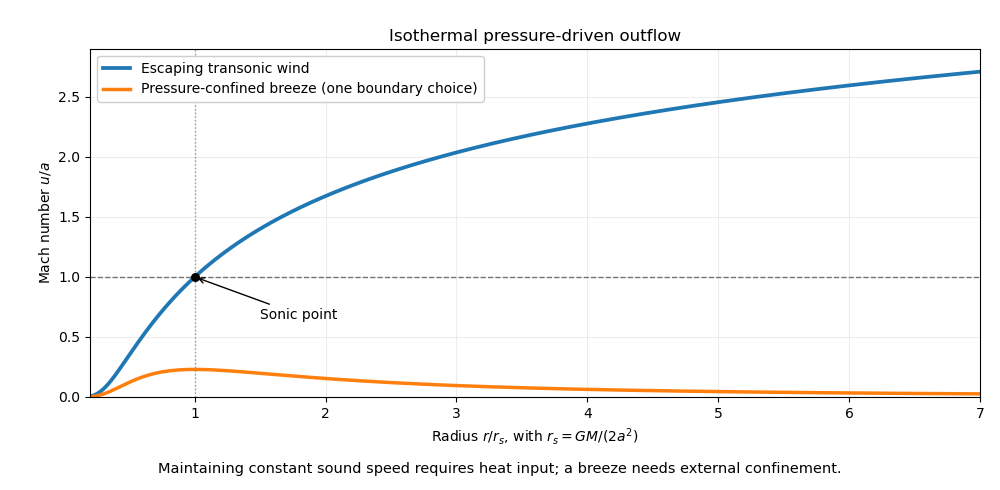
The solar wind supplies a nearby example of an outward plasma flow carrying a magnetic field. Profiles of spectral lines, especially absorption shifted by the Doppler effect together with emission, diagnose more distant stellar winds. The critical-point condition and boundary heating constrain ; it is not determined by an escape-speed estimate alone.
An accretion disk forms when inward-moving gas retains enough angular momentum to orbit a compact object. In a geometrically thin Keplerian disk, radial force balance gives and vertical hydrostatic equilibrium gives a thickness . Matter cannot fall far inward while keeping its original specific angular momentum : stresses must transport angular momentum outward.
The viscous torque in an accretion disk has outward magnitudewhere is the effective kinematic viscosity and the surface density. With constant inward accretion rate and zero inner torque at , conservation of angular momentum givesThe associated standard thin-disk dissipation flux from each face isOrbital gravitational potential energy becomes heat and, in a radiatively efficient disk, escaping radiation. Integrating both faces gives the standard thin-disk luminosity under this boundary condition. A central stellar surface or an inner torque can release or redistribute additional energy.
The alpha disk prescription summarizes an effective stress rather than a claim that molecular viscosity alone explains observed rates. In an ionized disk, magnetorotational instability can produce magnetic and fluid stresses. The inward evolution occurs on the viscous timescale , much longer than an orbit for a thin disk with . Hot inner annuli and cooler outer annuli naturally give a range of emitted temperatures; the blackbody approximation additionally requires sufficient optical depth.
A local thermal imbalance can amplify a gas perturbation even without an initial displacement of an interface. Let denote net cooling per unit mass, including heating with a negative sign, and suppose . When the sound-crossing time is short compared with the thermal evolution time, pressure equilibrates and an ideal gas perturbation is approximately isobaric. The linearized thermal equation isThus a negative constant-pressure derivative produces isobaric thermal instability: a cooler parcel experiences a net loss that cools it further, while a warmer parcel heats further. For example, isobaric thermal stability of a heated ideal gas with gives and instability for . Different heating laws and fixed-density perturbations give different criteria; thermal conduction damps sufficiently short-scale temperature contrasts. Such feedback helps a gas separate into denser cool and rarer warm regions when stable thermal branches exist.
The Rayleigh-Taylor instability instead releases gravitational potential energy when a heavier fluid lies above a lighter fluid in a downward gravitational field. For two inviscid incompressible half-spaces with no surface tension or magnetic field, a horizontal perturbation of wavenumber hasThe Atwood number measures the density contrast. A descending heavy-fluid finger and an ascending light-fluid bubble both lower the total gravitational potential energy, increasing the original displacement. Interchanging the layers gives an oscillatory stable interface. An accelerating or decelerating astrophysical shell has an analogous effective acceleration, allowing mixing at suitable ejecta interfaces in a supernova remnant. Finite interface width, viscosity, surface tension and magnetic tension modify the short-wavelength behavior; the ideal sharp-interface formula does not select a finite fastest-growing wavelength.
For small isentropic perturbations of a fixed-composition gas, linearizing its equation of state gives . The adiabatic sound speed is evaluated at the uniform background, so it is spatially constant at this order. If fast heat exchange instead enforces constant temperature, use the isothermal sound speed consistently. A completely arbitrary entropy perturbation would require an additional thermodynamic variable.
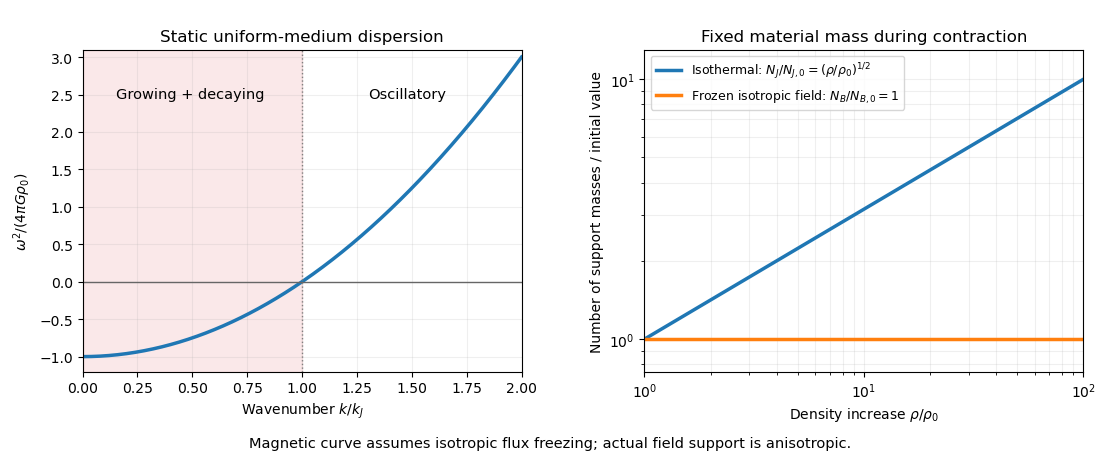
The uniform static infinite medium requires the Jeans swindle: its background gravitational field is subtracted or externally balanced, and only the perturbation sources the Poisson equation for Newtonian gravity. Linearizing the continuity equation, Euler equation and gravitational equation then givesTaking one more time derivative of the first equation and substituting the other two yieldsA Fourier mode proportional to therefore obeys the Jeans instability relationFor , the mode oscillates as a sound wave. For , gives a growing and a decaying mode; the static Jeans growth-rate spectrum has no preferred finite fastest-growing wavelength in the infinite-medium approximation. The threshold is marginal at linear order. The Jeans length is . Defining the Jeans mass as a sphere whose diameter is this wavelength givesOther radius conventions alter its numerical coefficient; the mass scale compares self-gravity with pressure communication.
For the pressureless finite cloud, the shell theorem gives an edge acceleration , with fixed enclosed . Multiplication by and integration from rest givesThe negative root describes collapse. Substituting gives the free-fall time of a uniform sphereThe surface and inner shells reach the origin together in pressureless homologous spherical collapse; pressure, rotation or shell crossing would change this ideal solution.
Equating this time to the specified radius-based sound-crossing time gives . The resulting crossing-time cloud support mass isThis is the same dimensional mass scale as , with a different coefficient because the adopted length and time criteria differ. In particular, is not the exact marginal dispersion-relation condition.
With the requested isotropic support approximation, replace by the Alfvén speed . In the crossing-time convention the Magnetic Jeans mass isUsing the wavelength-based Jeans mass convention instead replaces by . The scaling, rather than a convention-independent coefficient, is the shared prediction.
For a fixed cloud mass undergoing isothermal homologous contraction, and is constant. Its number of thermal Jeans masses therefore grows asA cloud initially close to the support threshold has of order one, so smaller pieces can subsequently become independently unstable: this is isothermal fragmentation.
For approximately isotropic contraction with magnetic flux freezing, stays constant, so . Hence stays constant andThis ideal magnetic support therefore does not create progressively more unstable masses in the way thermal isothermal support does. The same conclusion follows from the conserved mass-to-flux ratio. A magnetically subcritical cloud cannot initiate unrestricted cross-field collapse under ideal flux freezing alone; flux loss or initially supercritical conditions are needed. A real magnetic field also gives anisotropic support: motion and fragmentation along its field lines are not excluded by this scalar-speed estimate.
The Mach number is , comparing the flow speed relative to a disturbance with the local sound speed. For a body moving supersonically, spherical acoustic disturbances emitted earlier have a tangent envelope with Mach cone half-angle . Signals cannot propagate arbitrarily far upstream. Compressive characteristics can converge and steepen into a shock wave, within which microscopic dissipation prevents a multivalued fluid state; supersonic motion alone does not require every flow to contain a shock.
Work in the shock frame with steady normal velocities . Integrating conservation of mass, normal momentum and total energy over a thin pillbox, neglecting gravity across the thin layer, gives the Rankine-Hugoniot conditions for a perfect gas:The energy equation includes pressure work through specific enthalpy. The shock is adiabatic if negligible heat escapes the layer, but its irreversible dissipation means it is not isentropic.
Put and . Momentum conservation gives . Substitution in the energy equation produces the unshocked root and the compressive rootSince , the strong-shock limit has negligible upstream thermal pressure compared with ram pressure. The Strong-shock Rankine-Hugoniot conditions giveFor unchanged composition, the ideal gas law implies , soFor , the compression tends to four and , where is mean particle mass.
With constant specific heat , entropy production in a perfect-gas shock is measured by the change in specific entropyThe strong-shock expression is thereforeThe exact jump is positive for every compressive shock with , in accordance with the Second law of thermodynamics; the asymptotic expression is only for . There is a normalization issue in the printed description: this logarithmic formula with constant describes entropy per unit mass. The true entropy density is , so its difference is , rather than the same logarithmic jump with a constant heat capacity per unit volume. A material parcel's irreversible entropy increase should be assessed using .
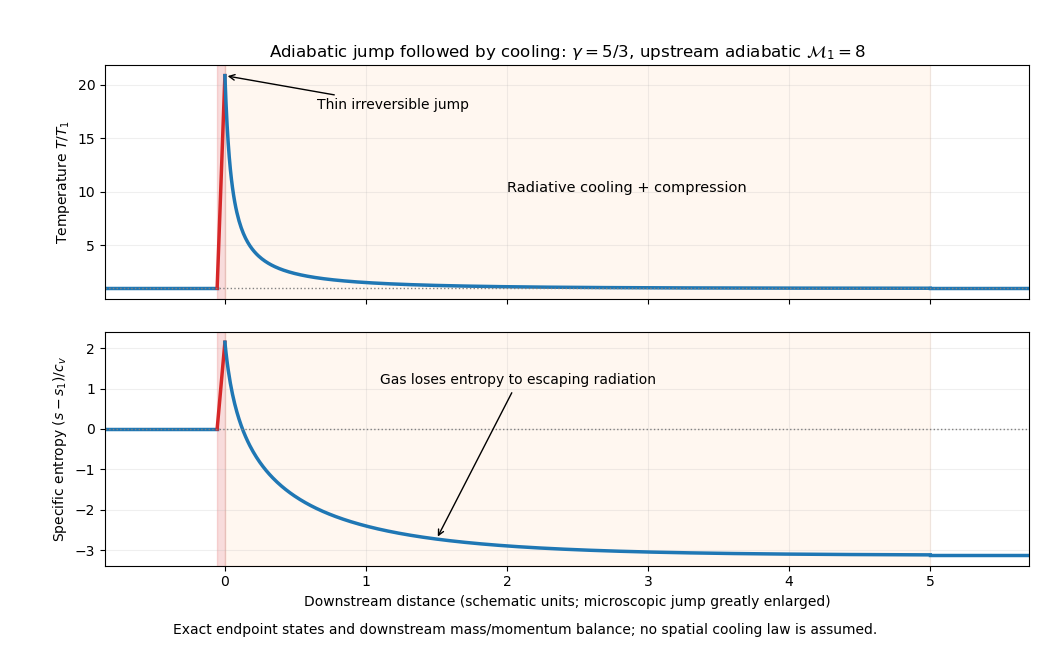
Downstream gas is denser and hotter. For optically thin collisional emission the loss per unit volume is typically , whereas stored thermal energy scales approximately as . Compression can therefore reduce the radiative gas cooling time; excitation and ionization at the higher temperature can open additional cooling channels. The actual efficiency still depends on the astrophysical cooling function, composition and optical depth. In a radiative shock with separated scales, the temperature first rises across a narrow dissipative layer, then decreases through a much broader cooling region of characteristic length . Subsonic cooling usually brings further compression with approximately constant pressure. The immediate microscopic shock thickness and the macroscopic cooling length are distinct.
Let state be the fully cooled gas, with and the same composition. Set , the isothermal sound speed squared. Across the entire shock plus cooling layer, mass and momentum are still conserved, but gas energy alone is not. With ,The nontrivial isothermal shock therefore hasIf the upstream Mach number were defined with instead, this would be . Retaining the distinction avoids losing the factor .
The gas's specific entropy rises irreversibly at the hot shock and then decreases as escaping radiation removes heat. Since the final temperature equals the initial temperature,This decrease for the gas is consistent with the Second law of thermodynamics: the emitted radiation and its eventual surroundings carry entropy away. It does not make the microscopic compressive shock reversible. The figure illustrates both the hot entropy jump and the subsequent cooling; its spatial cooling profile is schematic because no cooling law has been specified.


Articles by others on the same topic
There are currently no matching articles.