Write the polytropic law as , with constant and . Its pressure potential, or polytropic enthalpy relative to zero density, isHydrostatic balance is . If the surface has zero density and potential , integration gives . At the centre, . ThereforeInsert and into the spherical Poisson equation for Newtonian gravity:The central conditions are and ; the latter follows from a regular spherically symmetric centre. This reproduces the supplied coordinate and potential scaling rather than introducing an unrelated normalization.
For the sound-speed task, the adiabatic sound speed of a perfect polytropic gas isA diatomic gas with active rotational but frozen vibrational degrees of freedom has and . With the requested surface-potential gauge ,The interior potential is then negative. Choosing zero potential at the surface is legitimate; for a finite isolated sphere it is a different additive gauge from setting potential to zero at infinity. Both choices cannot generally be imposed simultaneously.
For the mass-radius task, let be the first zero of the regular Lane-Emden function and . A finite-radius polytrope hasThusAt fixed central temperature, fixed composition and fixed polytropic index, . These are homologous polytropes at fixed central temperature. They do not in general have constant ; imposing constant entropy instead gives a different polytropic mass-radius sequence. If or varies between stars, the displayed dimensionless structure factor and composition factor must be retained: equal alone is not a universal exact proportionality for arbitrary stellar models.
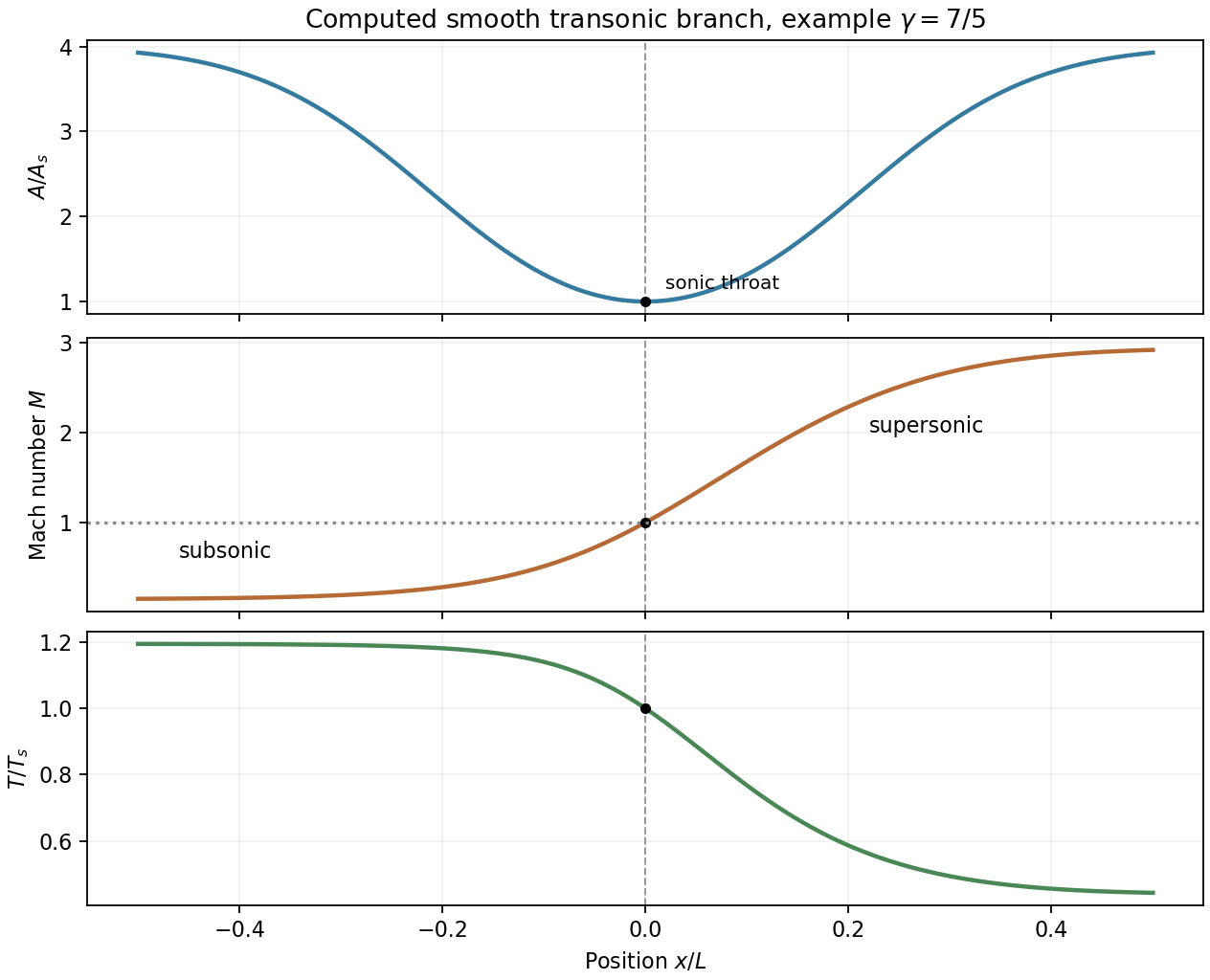
Treat the gas as a smooth quasi-one-dimensional flow through a rigid passage, neglecting axial body forces and heat input. It is the confining medium that is incompressible; the flowing gas must remain compressible. With area and axial speed , continuity and inviscid momentum balance giveCombining their logarithmic differentials yields the nozzle area-velocity relationA smooth crossing of requires an area extremum. The given radius is positive and has derivative , which vanishes only at within the slab and changes from negative to positive there. Thus this station is the unique throat, with and . The specified subsonic inlet and supersonic outlet select the smooth accelerating branch, soA throat by itself does not guarantee transonic flow for arbitrary reservoir and back pressures; that branch is specified here. Before the throat a converging section accelerates subsonic flow; beyond it a diverging section accelerates supersonic flow.[ref]
Nozzle Design by NASA Glenn Research Center. Supersonic and Subsonic Flow, continuity/momentum derivation of the area-velocity relation and choked throat
For the temperature task, evaluate the mass flux and sound speed at the throat using :The ideal-gas relation then givesThis expresses the sonic temperature in terms of the entropy constant, geometry, mass flux and composition; no numerical value of or is provided. Equivalently and . The slab length drops out because the sonic thermodynamic state depends on the minimum area, not on the axial distance over which a lossless smooth nozzle contracts. As a check, conserved stagnation enthalpy gives .[ref]
Mass Flow Choking by NASA Glenn Research Center. equations 1–10 and 19, sonic mass-flow maximum and temperature/Mach relation
The result assumes cross-sectional thermodynamic uniformity and negligible transverse kinetic energy. Exact multidimensional flow through a sharply varying passage can have a curved sonic surface; the radius profile alone does not solve that boundary-value problem. The original numerical plot below computes the standard quasi-one-dimensional branch, rather than reproducing the supplied passage sketch.

Articles by others on the same topic
There are currently no matching articles.