The notes below cover all three topics.
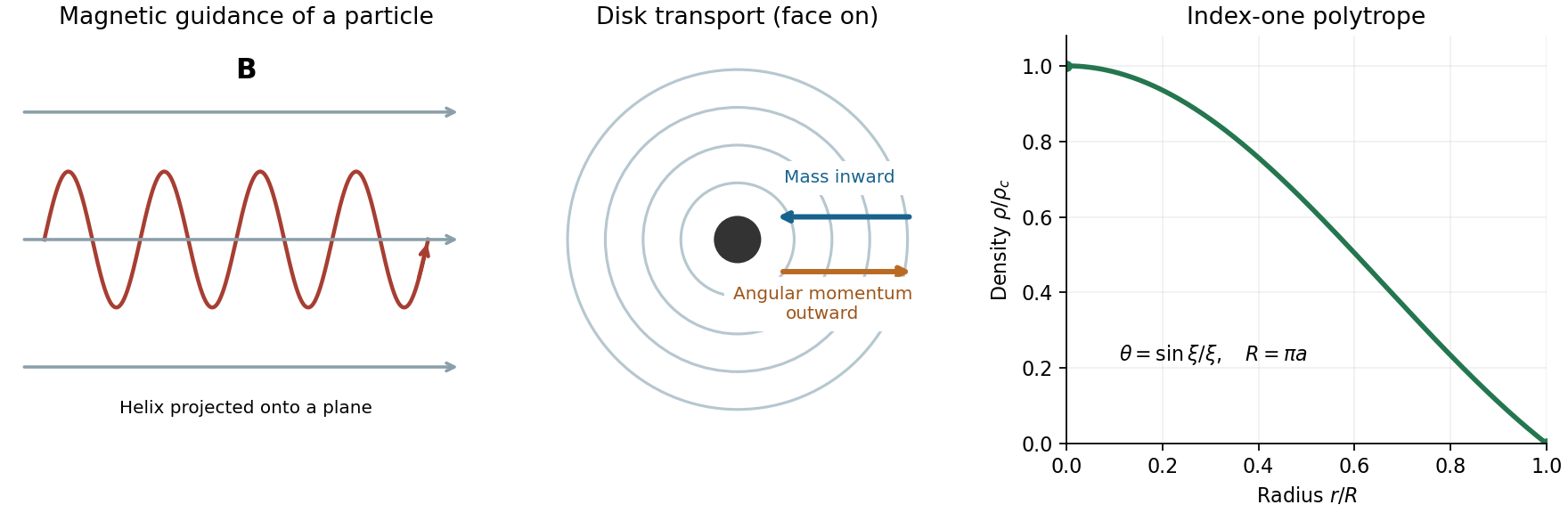
Magnetic guidance, disc transport, and an index-one stellar polytrope
. Details. 
A plasma contains mobile charged species whose collective electromagnetic response matters. On scales large compared with the Debye length, positive and negative charge densities nearly cancel: this is quasineutrality, not the absence of electric currents or electric fields. For electrons of temperature and number density , the characteristic plasma screening and oscillation scales areA collective plasma description requires many particles within a screening volume; long-wavelength, sufficiently slow behavior can often be described by magnetohydrodynamics with an appropriate fluid closure.
An individual particle feels the Lorentz force . In a uniform magnetic field, its transverse motion gyrates while its parallel motion remains free, giving a helical path when both components are present. The nonrelativistic cyclotron frequency and gyroradius areWhen the system scale is much larger than and the relevant time scale longer than , the field strongly organizes transport across it, provided collisions do not interrupt the gyromotion. A perpendicular electric field also gives the common guiding-centre drift .
For a conducting fluid, the macroscopic Lorentz force density has the useful decompositionThese terms are magnetic pressure and magnetic tension. Magnetic tension resists bending, while magnetic-pressure gradients resist nonuniform compression. The plasma beta compares thermal and magnetic stresses.
With uniform magnetic diffusivity , the resistive induction equation isIf the magnetic Reynolds number , ideal magnetohydrodynamics applies approximately and magnetic flux freezing links the field geometry to fluid motion. Finite diffusivity permits field slippage and magnetic reconnection. Field tension supports Alfvén waves with ; coupled magnetic and gas compression also supports magnetosonic waves. These effects allow a field to transmit forces and angular momentum between distant parts of an astrophysical plasma.
An accretion disk forms when infalling material has enough angular momentum to orbit before it can reach the central object. In a thin disc dominated by a central mass , the orbital motion is approximately Keplerian rotation:Vertical hydrostatic equilibrium gives the disk scale height ; a geometrically thin disc has . The surface density is , and a steady inward mass flow rate is .
Moving inward requires losing specific angular momentum. Internal stresses transport angular momentum outward; much of the mass can then accrete while an outer fraction spreads to larger radius. Molecular viscosity alone is generally inadequate for rapid astrophysical accretion. Turbulent and magnetic stresses, including those generated by the magnetorotational instability, provide effective transport. A common parametrization is for an effective kinematic viscosity, with a dimensionless stress parameter.
For a thin Keplerian accretion disk, the evolution equation isThis viscous evolution of an accretion disk occurs on the viscous timescale , much longer than an orbital period in a thin disc with moderate effective stress.
The orbital specific energy is , so inward motion releases binding energy. In a steady, optically thick, radiatively efficient disc with zero torque at its inner edge, the emergent flux from each face isThe Stefan–Boltzmann law identifies the local effective temperature. Far from the inner boundary, , so the emitted spectrum combines hotter inner and cooler outer annuli. Integrating both faces gives under these assumptions. This is not a universal spectrum or efficiency: optical depth, inner torque, energy advection and outflows can change the radiation. The essential connection is outward angular-momentum transport, inward accretion, and release of binding energy.
A stellar polytrope approximates a spherical self-gravitating star by the structural relationwhere is constant and is the polytropic index. Combining hydrostatic equilibrium with mass conservation givesThe Lane-Emden variables for a stellar polytrope separate the dimensional scales from the profile:For these substitutions give the Lane-Emden equationThe central conditions express finite central mass density and spherical symmetry. If is the first zero, a zero-pressure surface hasthe Lane-Emden mass formula. For this surface is at finite radius. For example, the polytrope of index one has and , giving the density profile shown in the overview figure.
An isentropic ideal monatomic gas has and hence , a useful approximation for a fully convective ideal-gas star. Nonrelativistic electron degeneracy pressure has the same density exponent. The exponent , giving , occurs for ultrarelativistic electron degeneracy and in appropriate radiation-dominated stellar models. The structural index should not be confused with the adiabatic index controlling a perturbation unless the model is actually isentropic.
Polytropes give useful mass-radius scalings and central concentration with very few parameters. They do not by themselves specify nuclear fusion, energy transport, or the star's thermal evolution. Nor does a structural profile alone establish dynamical stability; that requires the response of pressure to the perturbation.
Articles by others on the same topic
There are currently no matching articles.