Assume a constant downward gravitational acceleration , constant composition, and an ideal gas law , where is the gas constant per unit mass. Here is the unified atomic mass unit; this convention makes the specified mean molecular weight dimensionless. Hydrostatic equilibrium givesIntegrating from sea level yieldsDividing by the temperature ratio gives the hydrostatic atmosphere with a constant temperature lapse rate:The model requires and is used here only within the troposphere.
Convert the atmospheric lapse rate to . At , . With , , and , the density exponent is . HenceThe mass density is therefore approximately one third of its sea-level value in this model.
The original PDF has absolute-value bars around both gradients; they are missing from the transcription. The stability argument must respect the sign of the upward coordinate.
Displace a small parcel upward by . Assume it remains in pressure equilibrium with its surroundings but exchanges negligible heat, so it follows an adiabatic process. For a perfect gas with adiabatic index , along that parcel's adiabat. Its temperature gradient is thereforeThe last step uses hydrostatic equilibrium, and is the specific heat capacity at constant pressure. At its new height, the temperature difference between the parcel and the environment is . At equal pressure, its relative density excess is the negative of its relative temperature excess. The upward buoyancy acceleration is thusThis is the squared Brunt–Väisälä frequency. Convective stability requires , or, in signed-gradient form,For a temperature decreasing upward, this is exactly the PDF's Schwarzschild criterionThe absolute-value condition is also sufficient more generally, although a sufficiently steep temperature inversion remains stable even when that stronger condition fails. Reversing the signed inequality, as the bar-free transcription does, would instead describe an unstable temperature decrease.
Take incidence from A into B and first specify pressure amplitude. For a plane acoustic wave traveling normally to the interface, the acoustic impedance is . A right-moving wave has pressure amplitude , where is its fluid-velocity amplitude; a left-moving reflected wave has .
Let denote incident, reflected, and transmitted pressure amplitudes. Continuity of pressure and normal velocity at the interface givesSolving the two linear equations gives the acoustic reflection and transmission at an interface coefficientsFor the same perfect gas, take a common adiabatic index . The adiabatic sound speed satisfies . The equal equilibrium pressure therefore implies , givingThe word amplitude is otherwise ambiguous. For fluid velocity, or displacement at the same frequency, the corresponding answer isThese are consistent because pressure and velocity amplitudes differ by the impedance. As an energy check, the time-averaged acoustic intensity is , so its transmission coefficient is , even when the transmitted pressure amplitude exceeds the incident one.
Equal mean molecular weight alone does not logically guarantee equal . If the gases have different values of the adiabatic index, replace in these formulas by ; a density-only answer requires the common- assumption.
The notes below cover all three topics.
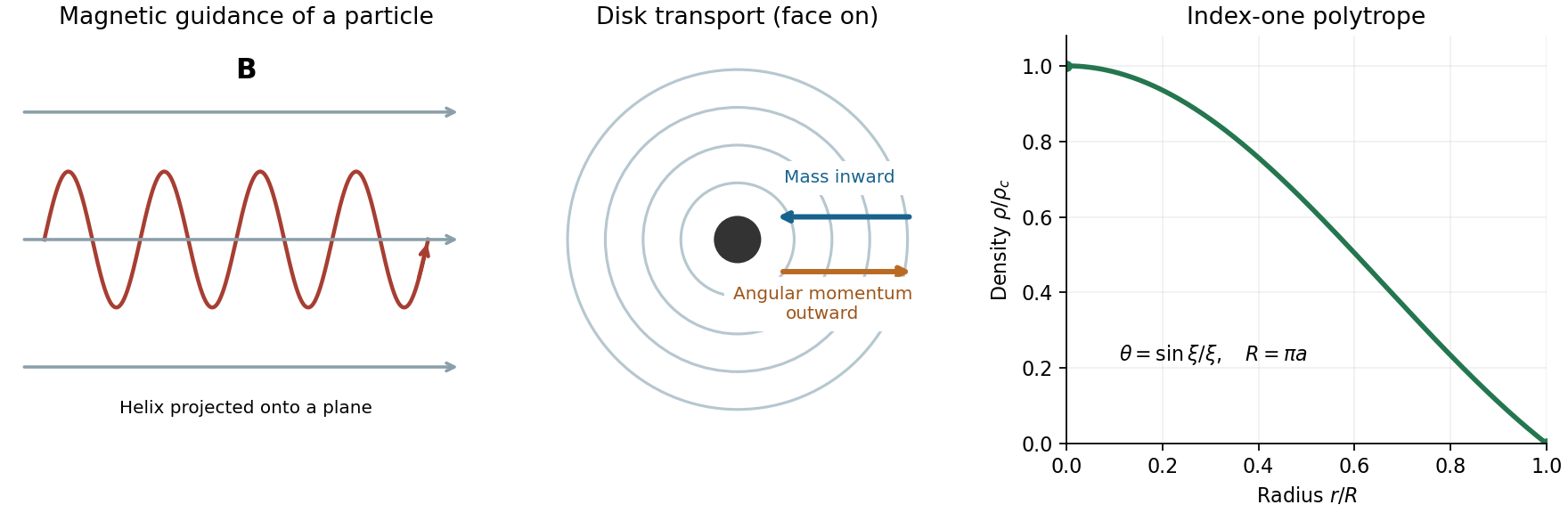
Magnetic guidance, disc transport, and an index-one stellar polytrope
. Details. A plasma contains mobile charged species whose collective electromagnetic response matters. On scales large compared with the Debye length, positive and negative charge densities nearly cancel: this is quasineutrality, not the absence of electric currents or electric fields. For electrons of temperature and number density , the characteristic plasma screening and oscillation scales areA collective plasma description requires many particles within a screening volume; long-wavelength, sufficiently slow behavior can often be described by magnetohydrodynamics with an appropriate fluid closure.
An individual particle feels the Lorentz force . In a uniform magnetic field, its transverse motion gyrates while its parallel motion remains free, giving a helical path when both components are present. The nonrelativistic cyclotron frequency and gyroradius areWhen the system scale is much larger than and the relevant time scale longer than , the field strongly organizes transport across it, provided collisions do not interrupt the gyromotion. A perpendicular electric field also gives the common guiding-centre drift .
For a conducting fluid, the macroscopic Lorentz force density has the useful decompositionThese terms are magnetic pressure and magnetic tension. Magnetic tension resists bending, while magnetic-pressure gradients resist nonuniform compression. The plasma beta compares thermal and magnetic stresses.
With uniform magnetic diffusivity , the resistive induction equation isIf the magnetic Reynolds number , ideal magnetohydrodynamics applies approximately and magnetic flux freezing links the field geometry to fluid motion. Finite diffusivity permits field slippage and magnetic reconnection. Field tension supports Alfvén waves with ; coupled magnetic and gas compression also supports magnetosonic waves. These effects allow a field to transmit forces and angular momentum between distant parts of an astrophysical plasma.
An accretion disk forms when infalling material has enough angular momentum to orbit before it can reach the central object. In a thin disc dominated by a central mass , the orbital motion is approximately Keplerian rotation:Vertical hydrostatic equilibrium gives the disk scale height ; a geometrically thin disc has . The surface density is , and a steady inward mass flow rate is .
Moving inward requires losing specific angular momentum. Internal stresses transport angular momentum outward; much of the mass can then accrete while an outer fraction spreads to larger radius. Molecular viscosity alone is generally inadequate for rapid astrophysical accretion. Turbulent and magnetic stresses, including those generated by the magnetorotational instability, provide effective transport. A common parametrization is for an effective kinematic viscosity, with a dimensionless stress parameter.
For a thin Keplerian accretion disk, the evolution equation isThis viscous evolution of an accretion disk occurs on the viscous timescale , much longer than an orbital period in a thin disc with moderate effective stress.
The orbital specific energy is , so inward motion releases binding energy. In a steady, optically thick, radiatively efficient disc with zero torque at its inner edge, the emergent flux from each face isThe Stefan–Boltzmann law identifies the local effective temperature. Far from the inner boundary, , so the emitted spectrum combines hotter inner and cooler outer annuli. Integrating both faces gives under these assumptions. This is not a universal spectrum or efficiency: optical depth, inner torque, energy advection and outflows can change the radiation. The essential connection is outward angular-momentum transport, inward accretion, and release of binding energy.
A stellar polytrope approximates a spherical self-gravitating star by the structural relationwhere is constant and is the polytropic index. Combining hydrostatic equilibrium with mass conservation givesThe Lane-Emden variables for a stellar polytrope separate the dimensional scales from the profile:For these substitutions give the Lane-Emden equationThe central conditions express finite central mass density and spherical symmetry. If is the first zero, a zero-pressure surface hasthe Lane-Emden mass formula. For this surface is at finite radius. For example, the polytrope of index one has and , giving the density profile shown in the overview figure.
An isentropic ideal monatomic gas has and hence , a useful approximation for a fully convective ideal-gas star. Nonrelativistic electron degeneracy pressure has the same density exponent. The exponent , giving , occurs for ultrarelativistic electron degeneracy and in appropriate radiation-dominated stellar models. The structural index should not be confused with the adiabatic index controlling a perturbation unless the model is actually isentropic.
Polytropes give useful mass-radius scalings and central concentration with very few parameters. They do not by themselves specify nuclear fusion, energy transport, or the star's thermal evolution. Nor does a structural profile alone establish dynamical stability; that requires the response of pressure to the perturbation.
Work in the rest frame of a thin planar shock wave, with normal upstream and downstream velocities . Assume a steady flow, negligible gravitational change across its thickness, no radiative energy loss, and negligible viscous stress and heat flux at the two remote faces of a control volume. Dissipation within the shock is permitted and is essential to the physical discontinuity.
Integrating mass conservation through that volume gives equal mass flux per unit area:The dimensions of are . The normal momentum entering minus that leaving must balance the pressure forces. Equivalently, the conserved normal momentum flux is , givingFor conservation of energy, matter advects kinetic and internal energy while pressure performs work at rate per unit area. Writing for specific internal energy, the energy flux is . With specific enthalpy , its conservation givesThe division by is valid for a genuine through-flow shock. Together these are the three Rankine-Hugoniot conditions. The conserved energy flux has units , and both momentum fluxes have units of pressure.
For a calorically perfect ideal gas, and . The three jump conditions can be combined explicitly. Put , so andSubstitute these into the enthalpy equation and use , with the upstream adiabatic sound speed. Besides the trivial no-shock root , the physical compression root isFor unchanged composition, . A compressive shock has and increases the specific entropy. Thus an adiabatic shock conserves total energy but is not an isentropic process.
Interpret as the normal upstream speed in the shock rest frame and as its upstream mass density. If the quoted jet speed is in another frame, the shock speed must first be supplied to obtain this relative velocity. Use a calorically perfect gas of mean particle mass .
In the strong-shock limit, . The Strong-shock Rankine-Hugoniot conditions giveThe pressure expression also follows from the supplied ratio by inserting . The ideal gas law then gives the immediate postshock temperatureThe upstream thermal contribution is negligible at this order. This is a temperature in kelvin, rather than a temperature change per unit time.
To turn the postshock thermal energy into a rate, the processed mass per unit time is . Its downstream specific internal energy isThus the thermal internal energy carried into the shocked gas per unit time isPer unit area, divide this expression by . Its dimensions are watts; the mean molecular weight cancels because the heat capacity per unit mass is inversely proportional to it, while is proportional to it.
There is a second common convention for shock heating power: the loss of directed bulk kinetic energy flux. The energy fluxes of a strong adiabatic shock giveThis equals the downstream enthalpy flux, and includes pressure work as well as the advected internal energy. For , the compression ratio is , , , and . Specifying the energy convention avoids conflating these rates. A rate for a fixed slab cannot be inferred without its participating mass and thermal evolution; the supplied data fix the postshock temperature and the processed energy fluxes.
Let be the constant isothermal sound speed squared. The stationary galactic gas obeys hydrostatic equilibrium in the specified gravitational potential:Integrating from the pressure-matching radius gives . Since and ,The exponent is dimensionless: the quantity in parentheses times is a difference of gravitational potential, of units . Density increases inward, as expected. The idealized potential is singular at the centre, so this formal profile should not be extrapolated into a region where the prescribed potential or the neglect of gas self-gravity fails.
The smaller galaxy is treated as a test particle released from rest at . Conservation of energy in the fixed gravitational potential givesThe galactic gas is stationary in its hydrostatic model, so this is the relative speed squared. Write on the inward path. The astrophysical ram pressure is the incident normal momentum flux , givingIt vanishes at release and increases during infall. This ram pressure convention is , not the sometimes called dynamic pressure. Gas drag and the object's response are neglected consistently with the prescribed ballistic motion.
Assume an inviscid barotropic fluid acted on by a conservative body force . Define its barotropic enthalpy function byThe Euler equations for an inviscid fluid are then . Using the vorticity and the vector identitygives , where .
For steady flow, dotting this equation with yields . Thus Bernoulli's equation isThe constant need not agree between different streamlines. If the flow is also irrotational, the vector equation gives , so one common constant applies throughout a connected flow region.
For an isentropic process with , up to an additive constant, equal to the thermodynamic specific enthalpy. For an externally maintained isothermal gas, ; this pressure potential is not the constant thermodynamic enthalpy of a fixed-temperature ideal gas.
If steady flow is not assumed, a useful additional case is unsteady potential flow . The same vector equation integrates spatially toGeneral unsteady barotropic flow does not possess the steady streamline constant without further conditions.
The surface must be a material surface , moving with the fluid; its boundary moves with it as well. The stated barotropic vorticity transport law, with , gives . Expanding its curl therefore yieldsA material tangent vector obeys . Apply the product rule to the cross product of two such tangents to obtain material surface element evolution:Here . The stretching and area-change terms cancel exactly in the transported flux element:Integrate over the fixed particle labels parameterizing the material surface. This proves the conservation of vorticity flux through a material surface:The conserved flux is also the circulation by the Stokes theorem, so this agrees with Kelvin's circulation theorem. The assumptions are smooth inviscid barotropic flow and conservative body forces. A fixed open surface generally exchanges vorticity flux with its surroundings and does not satisfy this conservation statement; compressibility by itself does not invalidate the material-surface result.
Assume a steady spherical outflow of fixed composition. Let be its mean particle mass, and define the constant isothermal sound speed by . Subsonic here refers to this isothermal closure, so . Mass conservation and radial momentum balance giveLogarithmically differentiating the first equation yields . Substitution eliminates the density gradient and gives the isothermal Parker wind equationAt a smooth speed maximum, , while the left prefactor is finite and negative. The right side must vanish, henceFor both the right side and the prefactor are negative, so ; for , . This is a true maximum on a subsonic isothermal breeze, not the accelerating transonic branch.
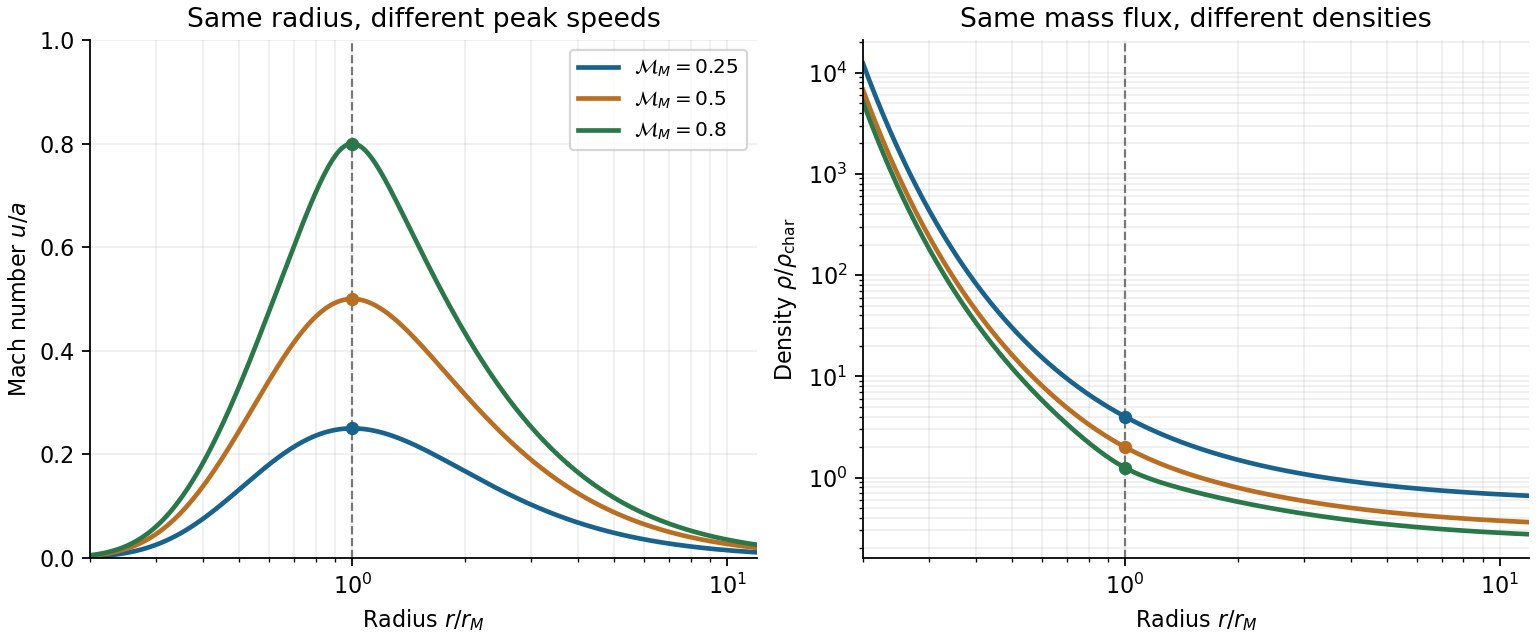
There is an underdetermination in the requested density estimate. Introduce the peak Mach number , where . The density at the maximum speed of an isothermal breeze is exactlyThe hypotheses do not fix . A boundary density or pressure, or an equivalent wind integration constant, is needed. The definite statement following from subsonicity is the lower boundIf a maximum speed of order is intended as an extra estimate, then . A very slow breeze can have a much larger density, so setting as an exact equality would contradict the stated always-subsonic assumption. The mean particle mass is another implicit fixed-composition input needed to express a temperature as a squared sound speed.
One can see the free parameter directly by integrating the wind equation:Different give different subsonic maxima at the same radius. The original plot illustrates this nonuniqueness. These breeze branches require nonzero ambient pressure at large radius; they are not the usual transonic escape into a low-pressure exterior.


Maintaining an isothermal expanding wind generally requires heat exchange; isothermal motion is not adiabatic motion.[ref]
https://nnp.ucsd.edu/the_mhd_muddle/PDF/Parker_1958_Dynamics_Gas_MagneticFields_HL.pdf. PDF p. 4, printed p. 667, section III: uniform temperature maintained by heating
For an unattenuated isotropic point source, the radiation flux is . The radiation pressure force per particle divided by its mass gives the outward accelerationThus the effective inward inverse-square coefficient is . Insert it into the preceding wind equation. The radiative shift of an isothermal breeze maximum isEquivalently, with opacity and an Eddington luminosity , this is . It is an exterior speed maximum only if the radius is positive and lies within the modeled wind region. For , the wind equation's right side is positive at every , so an always-subsonic outflow decreases in speed and has no such interior maximum.
Because is a cross section per particle, its conversion to acceleration requires ; that mass cannot be omitted dimensionally. The requested dependence on the four stated variables therefore assumes a fixed particle species. For the atomic hydrogen of part (e), set before molecule formation.
Retain the preceding isothermal assumption, so the gas temperature remains . When two neutral hydrogen atoms become one molecular hydrogen molecule, the mean particle mass doubles. At fixed mass density and temperature the ideal gas law would halve the pressure, but the flowing gas is free to compress and change speed. It cannot in general keep density, pressure, and velocity all unchanged.
To describe a thin steady transition, label the atomic and molecular sides by and and neglect the integrated external force and radiative recoil across its small thickness. Local mass conservation and momentum conservation requireThe isothermal sound speed changes from to . Dividing the momentum flux by gives , with . The subsonic continuation is thereforeThus the gas becomes denser and slower. In the well-subsonic limit, where ram stresses are small compared with thermal pressure, the useful leading description of isothermal flow through molecular hydrogen formation isThe exact momentum condition gives a small pressure increase at low Mach number, rather than an imposed discontinuous factor-of-two pressure drop. The full expressions above apply when the subsonic speed is not asymptotically small.
Radiation of the molecular binding energy prevents that released energy from automatically heating the gas. It does not, by itself, determine the temperature: the constant-temperature result uses the inherited isothermal closure. If that assumption is relaxed, an energy equation including cooling and molecular degrees of freedom is needed; the wording about emitted binding energy alone does not uniquely determine all four changes.
Articles by others on the same topic
There are currently no matching articles.