The central prediction of the ATP synthase ATP synthase rotary mechanism is relative motion of the central shaft and catalytic head, not simply a change in bulk ATP concentration. In the foundational single-molecule experiment, a visible marker coupled to the central gamma shaft reported its angular position relative to the immobilized catalytic head. Sustained directional rotations during ATP hydrolysis demonstrated rotary motion directly. The catalytic head contains three beta sites within an alpha-three beta-three assembly; their changing nucleotide affinities motivate the binding-change mechanism. [ref]
Direct observation of the rotation of F1-ATPase by Hiroyuki Noji and others. 1997 primary study, direct shaft-marker rotation
An angular trajectory gives more information than an average rotational speed. At low ATP, pauses before roughly 120-degree advances become longer as ATP falls, supporting an ATP-binding-limited wait. Reducing marker drag and improving temporal resolution reveals substeps and ATP-independent catalytic dwells. The early high-speed study resolved approximately 90-degree and 30-degree substeps, with more than one slow event during the catalytic dwell. Numerical angles vary with preparation and operational definition, so these observations should not be imposed as exact universal geometric increments.[ref]
The dwell-time model in b tests serial chemical kinetics; the angle histogram tests preferred positions. Comparing probe loads checks whether viscous drag limits the observed speed. Measuring torque and angular displacement estimates mechanical work, while a separate hydrolysis readout tests chemical coupling. With one ATP per 120-degree step, the chemical budget per revolution is three ATP, but rotation alone does not count every chemical event or establish unity efficiency.
A probe can perturb the very process it reports, and inhibited pauses or unresolved reversals can bias averages. Isolated F1 observed during hydrolysis also does not demonstrate proton-driven ATP synthesis by intact membrane F0F1. Testing reverse synthesis requires evidence for chemical gene expression under the corresponding driving conditions; a rotation movie by itself is insufficient. These distinctions connect the single-molecule motion to the free-energy balance without overinterpreting it.
Ion-channel deactivation and ion-channel inactivation are different. Ion-channel deactivation closes an activation gate when the voltage returns toward rest. Ion-channel inactivation makes a channel unavailable even while depolarization remains favorable for activation. A minimal kinetic picture is a closed state, an open state and an unavailable state, with recovery required before reopening. This helps terminate inward electric current and produces a neuronal refractory period.
In rapid voltage-gated potassium channel N-type inactivation, a cytoplasmic terminal segment, sometimes supplied by an auxiliary subunit, blocks the open inner pore. The classic ball-and-chain inactivation picture is supported by loss of rapid ion-channel inactivation after removing the relevant terminal segment and restoration by an appropriate soluble peptide. This links a mobile structural element to open-pore blockade; it does not imply that all potassium channels use that mechanism.[ref]
Restoration of inactivation in mutants of Shaker potassium channels by a peptide derived from ShB by William N. Zagotta and others. 1990 primary study, restoration of rapid inactivation
Slower C-type inactivation involves rearrangement near the selectivity filter and external pore. Dependence on pore structure, ion occupancy and extracellular ions distinguishes it from a simple cytoplasmic plugging particle. Different channels can combine several unavailable states, so a single recovery time constant need not describe every trace.
Fast ion-channel inactivation in canonical animal voltage-gated sodium channels involves the intracellular linker between domains III and IV, including its hydrophobic IFM motif, and is coupled to domain-IV voltage-sensor activation. The modern structural interpretation is an allosteric latch acting on the gate, rather than a universal literal particle sitting in the ion pathway. The older hinged-lid analogy is useful only with that qualification.[ref]
https://www.nature.com/articles/s41467-022-30400-w/. 2022 primary structural study, discussion distinguishes IFM-mediated allosteric inactivation from an observed alternative N-terminal pore block
Functionally, a voltage clamp trace shows electric current declining during a maintained step; a second test pulse measures recovery of availability. Holding-potential dependence separates an altered fraction of available channels from a mere change in maximal open electrical conductance. Persistent electric current after defective ion-channel inactivation, or delayed recovery that reduces subsequent responses, illustrates why both entry into and exit from unavailable states matter for excitability. A decaying macroscopic electric current alone does not uniquely identify the molecular mechanism.
Both motifs have a direct path and an indirect path . C1 coherent feed-forward loop uses three activating edges. I1 incoherent feed-forward loop activates and from , but lets repress . The AND condition means that the direct input must be active and the intermediate input must permit output: present for an activator, absent for a repressor. [ref]
Structure and function of the feed-forward loop network motif by Shmoolik Mangan and Uri Alon. 2003, AND-gated coherent and incoherent motifs
For a simple threshold model letThe coherent output obeys . Starting from under a sustained high input, . Provided , the gene expression delay isShorter input pulses do not turn on output gene expression. This is a persistence detector: it rejects brief positive inputs. Removing immediately removes the direct permission for gene expression, even if remains high. The concentration of subsequently decays with its own lifetime rather than vanishing instantly.
The incoherent output instead obeys . Gene expression begins immediately, then stops when accumulated repressor crosses threshold at . With zero initial output,A maintained stimulus therefore generates a pulse in this ideal Boolean model. Delayed inhibition can accelerate an early response and limit its duration. The ideal final zero output is conditional on crossing the repression threshold; graded response laws or basal gene expression can give a nonzero final level and need not adapt perfectly. If , the coherent circuit does not activate, while the incoherent circuit fails to terminate its gene expression. These boundary cases show why regulatory signs alone do not fix function.
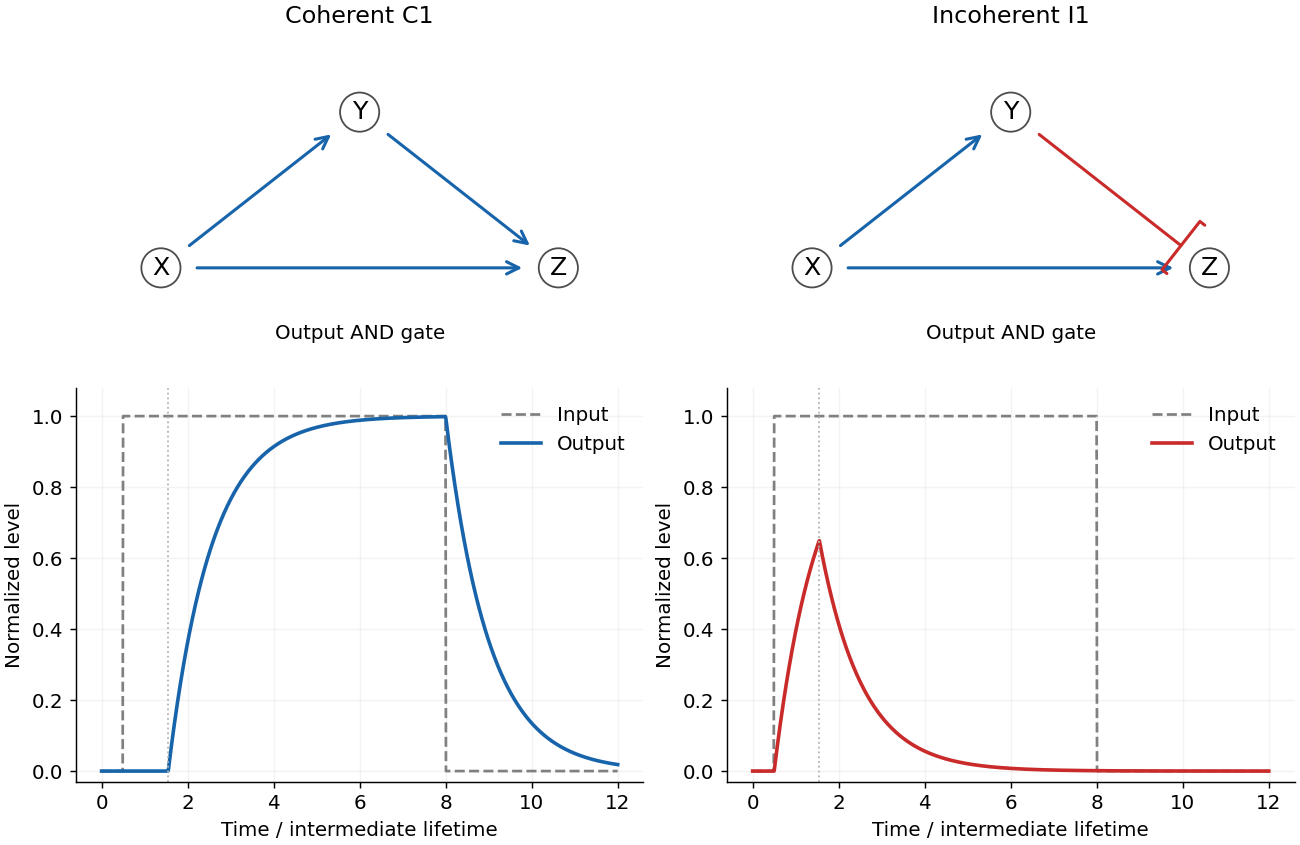
AND-gated coherent and incoherent type-1 feed-forward loops
. Original regulatory graphs and threshold-model responses. The coherent motif delays production until an activator accumulates; the incoherent motif produces a pulse before a repressor accumulates. Output concentrations retain their finite decay times. Details.
Articles by others on the same topic
There are currently no matching articles.