For a monocyclic, approximately planar, continuously conjugated pi system, Hückel's rule predicts aromatic closed-shell filling for pi electrons, with . Every atom on the circuit must have an appropriately oriented orbital; counting double bonds without checking pi conjugation is insufficient.
The two outer benzene rings are clearly aromatic; the central pyrone ring has a weaker, polarized six-pi aromatic contribution. Each outer ring has the familiar six-electron circuit. For the central ring, a useful charge-separated contributor moves the exocyclic carbonyl pi pair onto oxygen and donates one endocyclic oxygen lone pair into the ring. Its four fused carbon p centres contribute four electrons and the ring-oxygen lone pair supplies two: a six-pi, pyrylium-like circuit, with positive charge on the ring oxygen and negative charge on the carbonyl oxygen. This does not make three independent benzene rings of equal aromatic stabilization; localized carbonyl bonding and the fused benzene circuits remain important contributors.
The three oxygens play different roles. The endocyclic ether oxygen donates a p-type lone pair to pi conjugation. The carbonyl oxygen accepts pi density in the charge-separated contributor. The phenolic oxygen donates into the outer ring as a substituent. Its in-plane lone pair is not an extra pair to add to every ring's electron count. In particular, neither the external C=O pair nor both lone pairs on a ring oxygen should be counted as independent extra ring electrons. Structural studies of xanthone support a largely planar conjugated framework, while the division into strongly aromatic outer rings and a more polarized central ring is an electronic-structure interpretation.[ref]
Structure of xanthone by Shigeki Onuma and others. 1990, pp. 1725–1727, molecular geometry
B is 1,3-dibromo-2-hydroxyxanthone: both bromines are on the hydroxy-substituted outer ring, at its two available positions ortho to OH. Define C2 as the OH-bearing carbon; C1 lies between it and the carbonyl-side ring junction, and C3 lies on its other side. These labels specify the substitution independently of the orientation of the printed drawing.
Phenolic lone pair donation strongly activates its ortho and para positions towards electrophilic substitution. The para position is a fused junction and has no replaceable hydrogen, leaving C1 and C3 as the two directly activated sites. C1 also benefits from the conjugative influence of the ring ether oxygen. Although other positions receive some activation from that oxygen, they lack the stronger local phenolic activation of the selected pair. Excess bromine can therefore replace both ortho hydrogens. Replacing two hydrogens in gives , consistent with the stated composition. Addition across an outer-ring double bond would sacrifice aromaticity and would not account for the hydrogen loss.
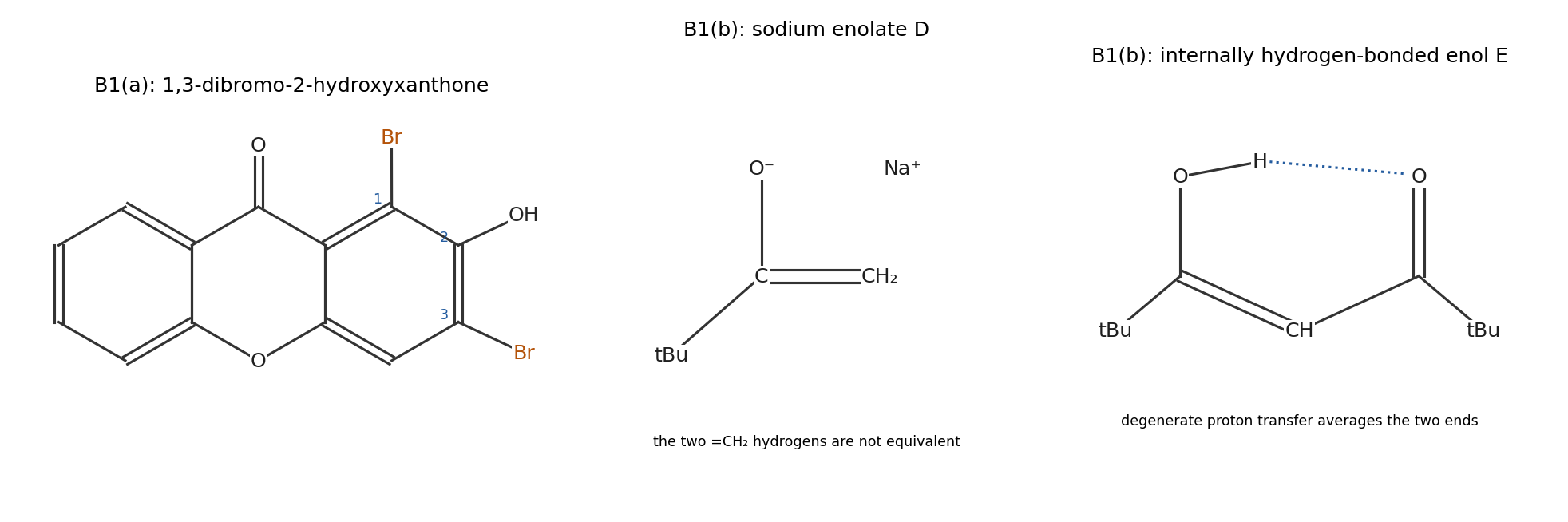
Original solution structures of the dibrominated xanthone, sodium enolate D and hydrogen-bonded enol E
. Details. 
The activated aromatic pi system polarizes bromine and attacks its electrophilic end while Br–Br cleaves. This makes a C–Br bond at C1 or C3 and gives a Wheland intermediate. Donation from phenolic oxygen stabilizes contributors with positive charge at its attached ring carbon. acetate or bromide then removes the proton from the attacked carbon; the C–H bond electrons restore the aromatic pi system. Repetition at the other activated ortho site gives the dibrominated product.
Each step replaces C–H by C–Br and restores aromaticity. No radical initiator or benzylic abstraction is needed, and no Lewis acid catalyst should be invented for this already activated phenolic substrate. The overall substitution balance is .
Write . D is the sodium enolate . Its two resonances in the alkene-proton region belong to the two hydrogens of the terminal methylene group. One is cis to oxygen and the other trans to oxygen, so they are not related by a symmetry operation even though both belong to the same carbon. Replacing one or the other gives different alkene geometries, so they are diastereotopic. Their weak or unresolved geminal coupling is consistent with the reported singlet descriptions. Without an additional spatial assignment, it is not justified to decide uniquely which numerical shift belongs to which of those two orientations. The nine-proton singlet is the tert-butyl group. The formula follows from removing one alpha hydrogen from pinacolone.
E is the enol-dominated 1,3-diketone , observed as . The very downfield broad signal belongs to the enol OH in a six-membered intramolecular O–H···O chelate. The one-proton signal in the vinyl region is its central enol CH; a predominantly diketo structure would instead require a two-proton central CH2 signal and no enol OH. The eighteen-proton singlet accounts for both tert-butyl groups. Rapid exchange between the two degenerate enol orientations can average their different local environments; accidental unresolved equality cannot be excluded by the supplied spectrum alone. Thus one should not infer a permanently symmetric single enol Lewis structure from that singlet. The total integration is , agreeing with .
amide ion removes a methyl-side alpha proton of pinacolone. The C–H electrons form the enolate C=C bond as the carbonyl pi pair moves onto oxygen; ammonia is formed. The tert-butyl-side alpha carbon has no hydrogen, fixing the ordinary enolate regiochemistry.
The carbon end of D attacks the acyl chloride carbonyl carbon. Move the C=O pi pair onto oxygen, then collapse the tetrahedral intermediate with chloride departure. This nucleophilic acyl substitution gives and constructs the bond between the original enolate methylene and the incoming carbonyl. The observed product requires carbon acylation, rather than an O-acyl enol ester. A further equivalent of D removes the much more acidic central proton of the new 1,3-diketone, generating its extensively delocalized enolate and returning that second D equivalent to pinacolone. Aqueous acid workup protonates the product enolate; keto–enol equilibration gives the conjugated, internally stabilized by a hydrogen bond enol observed by NMR. The acyl chloride contributes its entire pivaloyl group; neither tert-butyl group is lost.
One equivalent supplies carbon; the other acts as a base for the product. The newly formed 1,3-diketone is appreciably more acidic than the ketone from which D was prepared. proton transfer from its central CH2 to a second enolate equivalent is therefore favourable. Product-enolate stabilization also helps drive the acyl-substitution sequence towards completion.
The second enolate is consequently consumed as base, yielding pinacolone, rather than supplying a second carbon fragment to E. acid workup reverses the product deprotonation. Ignoring this acid–base step would predict that a single equivalent of D is sufficient to consume every equivalent of acyl chloride, despite the product immediately quenching part of the available reagent.
Articles by others on the same topic
There are currently no matching articles.