In step-growth polymerization, suitable reactive groups on molecules of different chain lengths can join. The linear count and its assumptions are given in polymerization.
A one-unit monomer, a two-unit chain, and a twenty-unit chain can all be joining partners if their functional groups are compatible and accessible. Schematically, : the subscripts count monomeric units, and end-group chemistry is suppressed. In chain-growth propagation, by contrast, requires a free monomer and a polymerization-active site. An arbitrary pair of existing chains is not a propagation pair in that mechanism. The practical consequence of step-growth polymerization is that most monomers can have joined something while the average chain is still short.
Whether a joining step releases a small molecule is a separate question. Polycondensation releases small products during the joining chemistry, as in the Nylon 6,10 demonstration in polymerization. Polyaddition joins suitable chains without that elimination: reacting a diol with a molecule bearing two isocyanate groups can build a polyurethane. Thus step-growth polymerization and polycondensation are not synonyms.[ref]
IUPAC Compendium of Chemical Terminology, fifth edition (Gold Book) by International Union of Pure and Applied Chemistry. polyaddition, P04720, definition and note 1; polycondensation, P04722, definition and growth-step equation; source recommendation p. 2307
Use an ideal feed in which every starting molecule has exactly two suitable functional groups: either one and one , or two groups mixed with two groups. Only an – pairing can form a joining chemical bond. Assume no loss of feed-derived material, no splitting of chains, no competing consumption of the counted functional groups, no branching, and no cyclization in step-growth polymerization. Linear here describes connectivity; a chain can bend in space. Small byproducts of polycondensation do not enter the chain-bearing molecule count.
Let count all initial feed molecules, the number of intermolecular joins, and all remaining chain-bearing molecules, including unreacted monomers. Each join turns two molecules into one, so exactly. If chain contains feed-derived monomeric units, conservation gives . Consequently the number-average degree of polymerization isThis is a count of both feed species' monomeric units, rather than a count of interior constitutional repeating units. For chemistry an interior repeat often contains two feed-derived units, as explained in monomer. Equal functional group reactivities are not needed for this bookkeeping at a specified ; predicting a time course or a chain-length probability distribution requires additional assumptions.
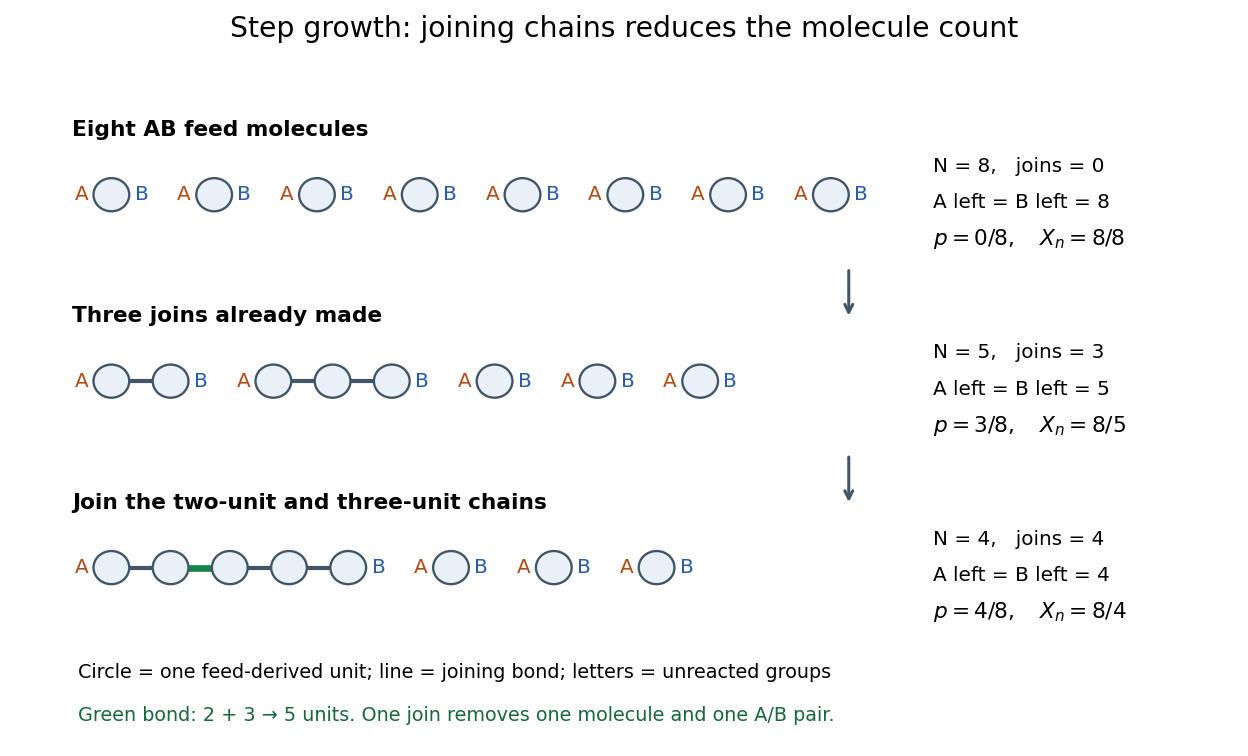
Exact step-growth polymerization count: joining a two-unit chain to a three-unit chain consumes one pair of functional groups
. Original stipulated eight--molecule example. Circles are feed-derived monomeric units, lines joining chemical bonds, and letters the surviving functional groups. Internal and groups have already reacted and are not drawn. The depicted layouts are schematic connectivity, not molecular geometry or sampled experimental chains. Details.
For the figure's eight feed molecules, three joins can give lengths , so and . Joining the first two chains gives : the incorporated total stays eight, becomes four, and . A graph makes the bookkeeping visible: each starting monomer molecule is a vertex of a graph, and each intermolecular joining chemical bond connects two previously distinct connected components of a graph. The connected pieces are the counted molecules.
In a balanced bifunctional feed there are initially groups and groups. Define the functional-group conversion in step growth by : the reacted fraction of either group type. Each join consumes one of each. Therefore . In the eight- example, three joins give and four give . In the latter state only three of eight starting monomer molecules remain isolated: their disappearance fraction is , different from . Neither this group-based nor disappearance of isolated monomers is the incorporated-feed fraction in the ideal living polymerization count.
With unequal initial counts , this article always uses , the conversion of the limiting groups. The reacted fraction of groups is , where . The fraction of all initial functional groups consumed is . At nonzero conversion these three fractions coincide only at . Naming the measured group type prevents an apparently correct equation from using the wrong conversion.
The balanced Carothers equation follows immediately from linear step-growth molecule count and functional-group conversion in step growth:The same Carothers equation extends to unequal group counts once the limiting-group convention is specified.[ref]
Generalization of the Carothers equation for linear step growth polymers by Emilio Meaurio. Introduction, equations (1)–(6): Carothers equation, end-group count and limiting- conversion
For an original balanced feed of monomer molecules, , , and intermolecular joins give , , and . The remaining counts are , , and , hence number-average degree of polymerization values , , and . The last thirty joins quadruple the average even though they consume only another of the initial groups of either type. These are exact synthetic counts, not experimental measurements.
The derivative explains the sensitivity: near , an absolute conversion uncertainty of changes the predicted degree of polymerization substantially. The exact balanced values at and are approximately and , instead of . An instrument reporting rounded “complete conversion” cannot distinguish those chain lengths. In a finite no-ring system, even one chain retains two ends; the maximum is and . The formal divergence at is a large-system limit, not an infinite chain in a finite flask.
For a strictly bifunctional feed, label the limiting functional groups , set , and define as in functional-group conversion in step growth. The initial molecule count is , and each intermolecular join consumes one and one . ThusThis version of the Carothers equation uses limiting-group conversion, not the fraction of all groups reacted.[ref]
As an original finite example, mix monomer molecules with monomer molecules. Then and . At , joins leave molecules, giving . At , joins leave five chains and ten unreacted groups; every chain has two ends, and . Continuing to wait cannot remove the missing- constraint within this model.
For , complete limiting-group conversion gives the ceiling . Reaching a target therefore requires , even before considering incomplete conversion. For , . Equality requires ; any lower conversion demands closer balance. The imbalance is measured relative to the initial number of groups, not relative to the total number of groups. A monofunctional impurity changes the initial groups-per-molecule count, so it cannot be inserted into this strictly bifunctional formula by retaining an unexamined .
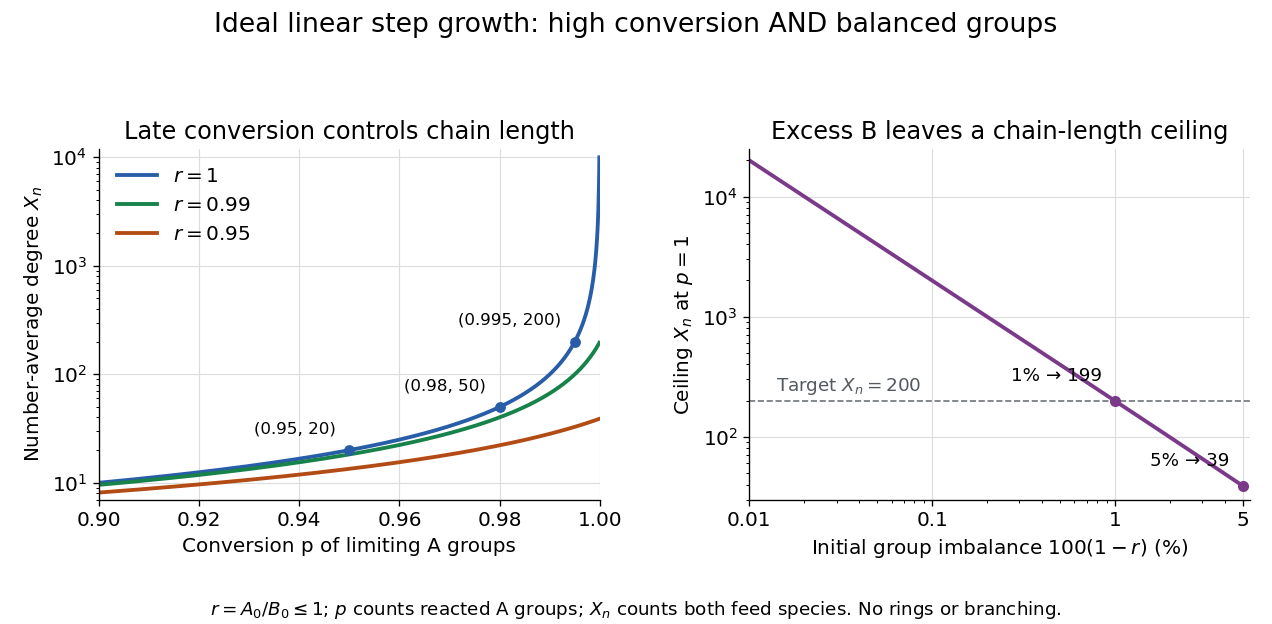
Carothers equation sensitivity to limiting-group conversion and initial stoichiometric imbalance in step growth
. Original analytic model curves with logarithmic vertical axes. Left: and the balanced example points. Right: versus , the initial excess- fraction relative to . These are ideal linear no-ring calculations, not fits to the polyurethane study. Details.
In cyclization in step-growth polymerization, compatible functional groups on the same chain react and close it into a ring. They consume groups without merging two molecules. If ring-closing events and intermolecular joins occur in an otherwise balanced bifunctional feed, the group conversion is , while . ThusFor example, an dimer can close its remaining and ends: two group pairings have occurred among two starting monomer molecules, giving , but the resulting single cyclic molecule has only two monomeric units. This counterexample shows exactly where the linear Carothers equation fails. Rings have no chain ends, so counting every chain-bearing molecule as two ends also fails.
Polyaddition is step-growth polymerization by joining reactions without elimination of small molecules. Compatible functional groups on different chain lengths remain eligible to join; the word addition alone does not imply chain-growth polymerization.[ref]
An experimental comparison joined a two-ended diol chain, HOPCLOH, with a bifunctional isocyanate, at reported isocyanate-to-diol ratio . The researchers used oven-dried round-bottom flasks and an IKA RET magnetic hotplate with a metal carrier. They varied solvent, concentration, reaction temperature ( or ), and duration ( or ).[ref]
Experimental Design (2⁴) to Improve the Reaction Conditions of Non-Segmented Poly(ester-urethanes) (PEUs) Derived from α,ω-Hydroxy Telechelic Poly(ε-caprolactone) (HOPCLOH) by Jaime Maldonado-Estudillo and others. sections 2.1 and 2.3: flask, heating apparatus and varied conditions
A Bruker NMR spectroscopy instrument measured residual hydroxy group-adjacent signal relative to an ester signal. Independently, size-exclusion chromatography used ResiPore columns at , a refractive-index detector, and polystyrene calibration. Figure 8 reports sharply increasing apparent number-average molar mass beyond the reported conversion . A deliberately water-exposed isocyanate comparison reproduced a infrared spectroscopy band assigned to urea-containing products. The authors warn that tiny residual NMR spectroscopy signals reduce integration precision.[ref]
Experimental Design (2⁴) to Improve the Reaction Conditions of Non-Segmented Poly(ester-urethanes) (PEUs) Derived from α,ω-Hydroxy Telechelic Poly(ε-caprolactone) (HOPCLOH) by Jaime Maldonado-Estudillo and others. sections 3.2–3.3; Figure 3 discussion of the water comparison; section 5.1 and Figure 8: independent conversion and GPC readouts and low-signal limitation
The inference is increasing chain size alongside depletion of reactive groups, consistent with step-growth polymerization. It is not an exact measurement of in the toy model. The feed contains already extended diol chains: counting their constituent repeat units differs from counting each feed molecule as one unit. Their varying molar masses, calibration against a different polymer, residual starting material, and competing chemical reactions further obstruct a direct conversion-to- substitution. Report which functional groups the conversion readout measures before comparing it with stoichiometric imbalance in step growth.
Useful proposed controls, distinct from the reported water comparison, are pre-reaction spectra and matched mixtures omitting each joining partner in turn. Keep solvent, heating, and signal normalization matched. Disappearance of an isocyanate signal in the omitted-diol control would reveal competing consumption rather than establish chain joining. Agreement between residual-group and independently calibrated chain-size readouts is stronger evidence than calculating both quantities from the same Carothers equation.
Polycondensation is step-growth polymerization in which joining reactions eliminate small molecules. Its chain-bearing molecule count excludes those byproducts; otherwise two chains joining while releasing one small product would misleadingly appear to conserve the counted population.[ref]
IUPAC Compendium of Chemical Terminology, fifth edition (Gold Book) by International Union of Pure and Applied Chemistry. polycondensation, P04722, definition and growth-step equation
Articles by others on the same topic
There are currently no matching articles.