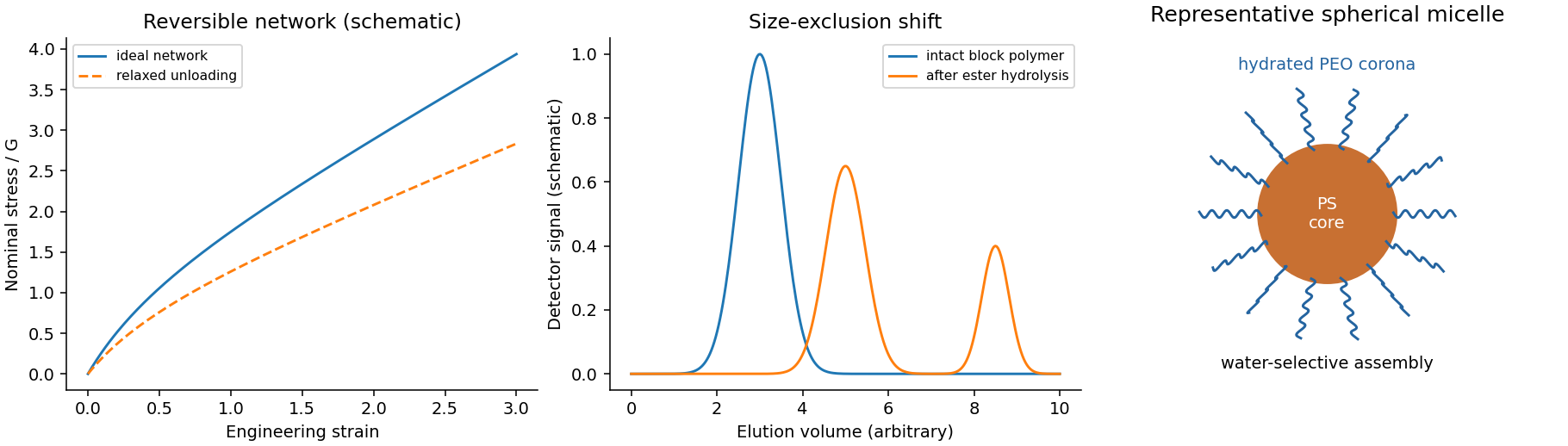
A is poly(norbornene); B is the corresponding sequential block copolymer with a methyl-ester-substituted second block. The process is ring-opening metathesis polymerization. Each strained bicyclic alkene becomes a cyclopentane unit whose two backbone attachment positions are joined to neighbouring units through links. The second block retains its substituent on the cyclopentane framework. Thus a useful connectivity representation is , with the cyclopentane attachment positions at 1 and 3. This representation specifies connectivity rather than a single backbone alkene geometry.
The ruthenium alkylidene reacts with a monomer alkene through a metallacyclobutane, then fragments with the other pair of bonds broken. A new ruthenium alkylidene remains at the growing end, allowing propagation and then addition of the second monomer. Relief of the bicyclic monomer's ring strain supplies the principal enthalpic driving force; the loss of monomer translational entropy opposes polymerization. Sequential addition yields blocks only if the first population of active ends survives until the second addition.
Figure 1.
Original polymer connectivity fragments and the reductive ozonolysis product
. Details.
With one growing chain per ruthenium initiator and negligible chain transfer, consumption of monomer gives
The conversion factor applies to incorporated monomer units, not the number of active chains. Slow initiation or inactive initiator would invalidate this ideal living polymerization estimate.
A sufficiently phase-separated block copolymer can show two glass transitions, associated approximately with its two microdomains. Simultaneous feeding instead tends to distribute the monomers along each chain, giving a statistical copolymer and usually one composition-dependent glass transition. Different monomer reactivities could produce a gradient rather than a perfectly random sequence.
For a homogeneous mixture an approximate interpolation is the Fox equation, , with temperatures in kelvin. Two transitions are not guaranteed merely by block architecture: short blocks, miscibility or insufficient experimental resolution can give one broad transition. The contrast is between domain-specific segmental environments and a more uniform mixed environment.
C has a saturated backbone and pendant groups in its second block. Hydrogenation converts every backbone to ; lithium aluminium hydride then reduces each to . The resulting connectivity is .
Hydrogenation removes local double-bond rigidity and commonly lowers the segmental barrier to motion, favouring a lower glass transition temperature. Ester reduction changes polarity and side-group volume, while the new hydroxyl groups introduce hydrogen bonding, which can raise the hydroxyl-rich block's glass transition temperature and strengthen segregation. These competing effects preclude a numerical transition shift or an unconditional direction for both transitions from structure alone.
The repeat-unit formulae after both operations are and . Taking standard atomic masses,
This is approximately 14.27 kg mol plus the net end-group mass. The termination chemistry is unspecified, so a more precise whole-chain mass is not determined; the methyl group lost during ester reduction must not remain in the second repeat's mass.
Pendant alcohols can form reversible borate bridges, schematically and , where P and P′ belong to different chains. Tetrahedral borate species are also possible depending on pH and water content. A bridge must connect different network strands to act as a cross-link; an intrachain loop does not contribute equivalently to elasticity.
Between cross-links, stretching reduces the number of accessible chain conformations. A simple incompressible rubber elasticity model gives the nominal tensile stress
where is the extension ratio and the density of elastically active strands. The initial response is soft; stronger extension gives increasing stress and ultimately finite-chain extensibility. Reversible borate exchange permits stress relaxation, rate dependence and a loading–unloading hysteresis loop, rather than permanent ideal elasticity at arbitrarily long times.
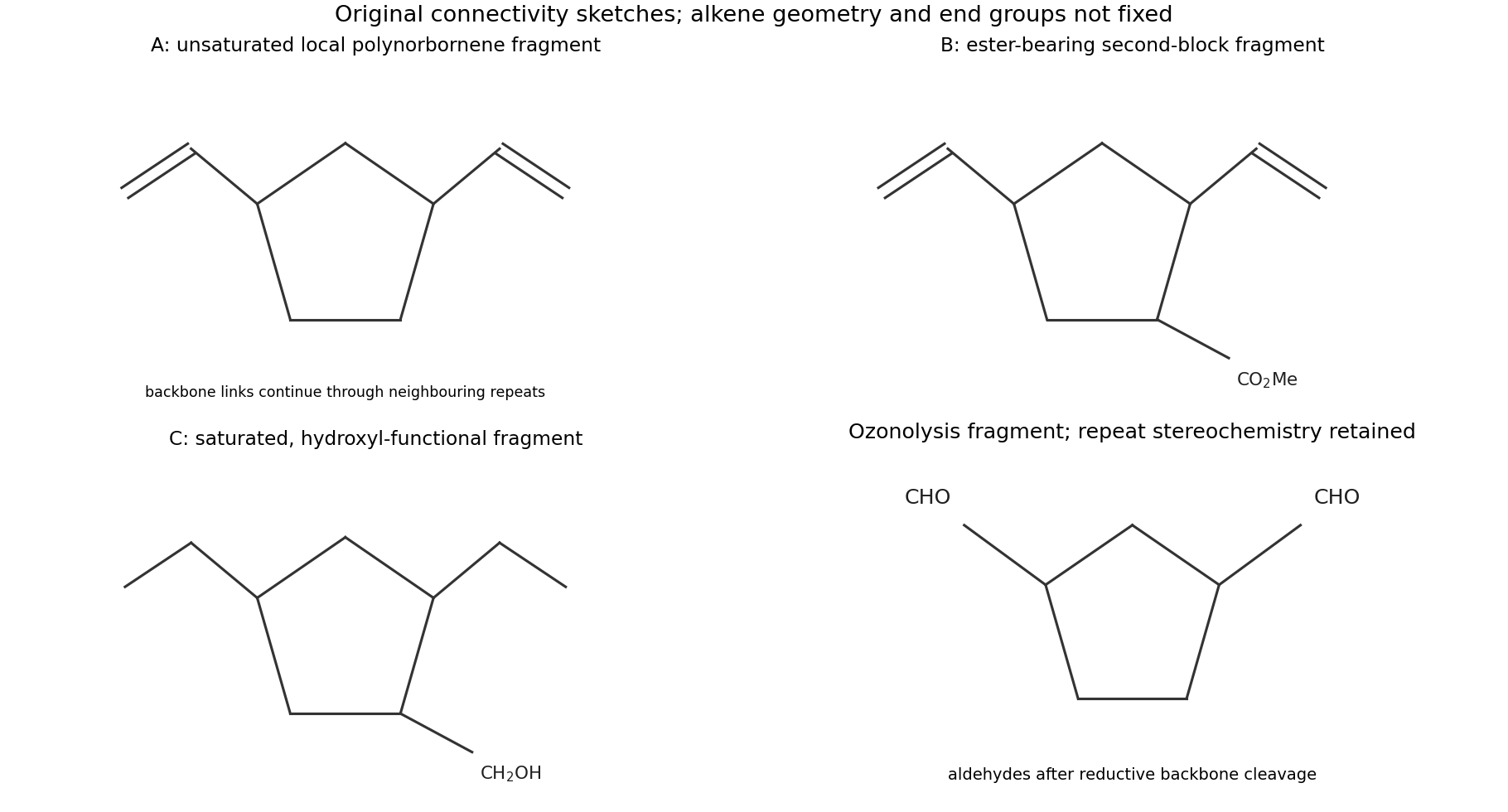
Figure 1.
Original schematic rubber stress, ester-block cleavage and amphiphilic assembly
. Details.
Reductive ozonolysis cuts the unsaturated backbone into cyclopentane-1,3-dicarbaldehyde units, apart from end fragments. Both alkene carbons carry a hydrogen, so the carbonyl products are aldehydes rather than ketones. Ring substituent stereochemistry is inherited from the polymer repeat; backbone E/Z geometry does not survive cleavage.
Ozone adds across a backbone alkene by cycloaddition, giving a primary ozonide. Its fragmentation produces a carbonyl group and a carbonyl oxide, which recombine to a secondary ozonide. Dimethyl sulfide reduces the peroxide-containing intermediate, forming dimethyl sulfoxide and the two carbonyl termini. Repetition at every backbone double bond liberates the dialdehyde. An oxidizing work-up would instead risk oxidation to carboxylic acids, so the specified reductive work-up is essential.

Articles by others on the same topic (0)

There are currently no matching articles.