For a homogeneous mixture an approximate interpolation is the Fox equation, Tg−1=w1/Tg1+w2/Tg2, with temperatures in kelvin. Two transitions are not guaranteed merely by block architecture: short blocks, miscibility or insufficient experimental resolution can give one broad transition. The contrast is between domain-specific segmental environments and a more uniform mixed environment.
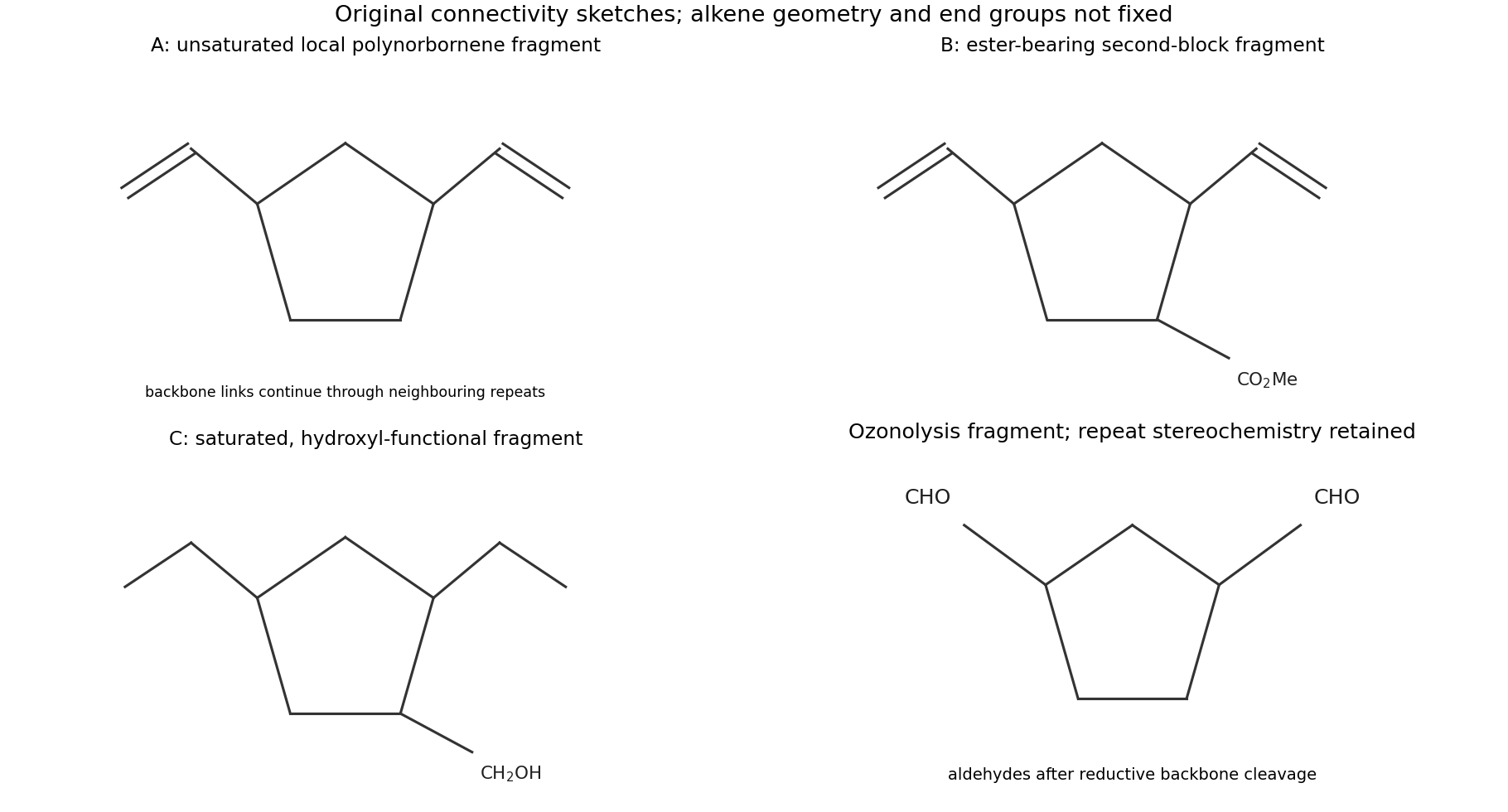
Chas a saturated backbone and pendant CH2OHgroups in its second block.Hydrogenation converts every backbone CH=CH to CH2CH2; lithium aluminium hydride then reduces each CO2Me to CH2OH. The resulting connectivity is [CH2CH2−C5H8]50−[CH2CH2−C5H7(CH2OH)]75.
This is approximately 14.27 kg mol−1 plus the net end-groupmass. The termination chemistry is unspecified, so a more precise whole-chain mass is not determined; the methyl group lost during ester reduction must not remain in the second repeat'smass.
Pendant alcohols can form reversible borate bridges, schematically P−O−B(OH)−O−P′ and B(O−P)3, where P and P′ belong to different chains. Tetrahedral boratespecies are also possible depending on pH and water content. A bridge must connect different network strands to act asa cross-link; an intrachain loop does not contribute equivalently to elasticity.
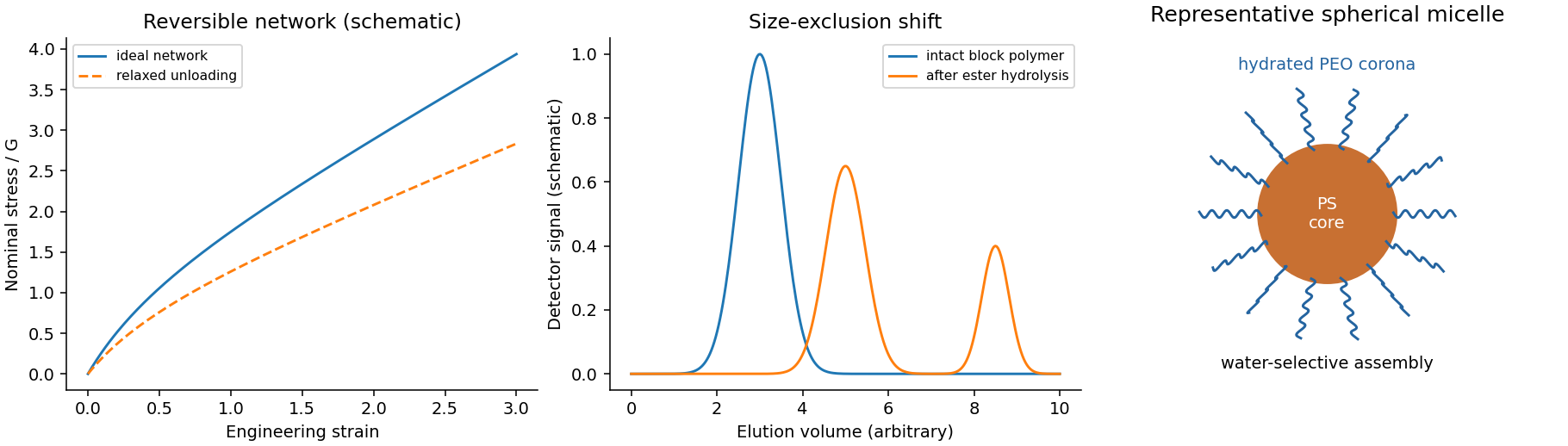
where λ is the extension ratio and νe the density of elastically active strands. The initial response is soft; stronger extension gives increasing stress and ultimately finite-chain extensibility. Reversible borate exchange permits stress relaxation, rate dependence and a loading–unloading hysteresis loop, rather than permanent ideal elasticity at arbitrarily long times.
Heating C under oxygen-free conditions homolytically cleaves its benzylic C–O bond to the nitroxide, releasing a benzylic radical and TEMPO. The radical adds styrene repeatedly; reversible trapping by TEMPO controls the active radical concentration. D is therefore a poly(lactide)–polystyreneblock copolymer with junction PLA−OCH2CH(Ph)−[CH2CH(Ph)]m−O−TEMPO and the hydroxyl end of PLA retained. This is nitroxide-mediated polymerization; atemperature around 120–130 °C is a representative condition for a TEMPO/styrene system, rather than an exact universal optimum.
Styrene, benzoyl peroxide and TEMPO provide the required radical addition–trapping sequence. Heating the peroxide breaks its O–O bond into benzoyloxy radicals. Before decarboxylation, PhCO2∙ can add to styrene's terminal carbon, generating the resonance-stabilized radical PhCO2CH2C˙HPh. Coupling with the oxygen-centred TEMPO radical then gives PhCO2CH2CH(Ph)−O−TEMPO, the benzoate-protected alkoxyamine A.
The connectivity distinguishes this route from initiators that leave acarbon-based radical fragment at the chain end. Competition with benzoyloxy-radical decarboxylation affects yield, so this is a plausible preparation rather than a claim of exclusive product formation. Subsequent benzoate cleavage reveals B's hydroxyl group without requiring rupture of its alkoxyamine linkage.
B has formula C17H27NO2. Lactide's entire cyclic diester mass is incorporated; multiplying its molar mass by two again would double-count its two lactyl units. The estimate assumes quantitative initiation, conversion, nitroxide recapping and no chain transfer or loss of chain-end fragments.
The principal surviving polymer is a polystyrene chain bearing the junction HOCH2CH(Ph)− end and its nitroxide-derived distal end. In gel permeation chromatography, the intact block copolymer normally elutes earlier than this smaller surviving polystyrene coil. Lactate and short hydrolysis fragments elute later still, provided the column and detector resolve such small solutes. The polymer peak therefore shifts to larger elution volume; its height need not remain constant under amass-sensitive detector. Elution reflects hydrodynamic volume, so calibration against polystyrene standards does not supply an exact absolute mass for the original mixed block.