The chemical potential is the change in Helmholtz free energy when particles are added at fixed temperature and volume:Equivalently, identifies it as the derivative of internal energy at fixed entropy and volume. In equilibrium, systems that exchange particles have equal chemical potentials.
The Fermi energy is the zero-temperature chemical potential, or, for independent electrons, the highest occupied single-particle energy in the zero-temperature limit. Its numerical value depends on the chosen energy reference; the Fermi energy need not be measured from the bottom of a band unless that convention is specified.
Expand a single-electron wavefunction as . Project the Schrödinger equation onto to obtainTranslation symmetry suggests the Bloch state on a periodic chain of sites. Substitution givesTake the conventional positive hopping . The first Brillouin zone is ; the band has minimum at and maximum at the zone edges. Its width is . A negative hopping interchanges the extrema but does not change the density of states after replacing by .
There are allowed wavevectors and two spin states per wavevector. For the total spin-summed density of states , each interior band energy has two roots, . Using the spacing givesThus the density of states per atom isIt is symmetric about and has integrable inverse-square-root Van Hove singularities at both band edges. Its integral over the band is two states per atom. The plot labels the dispersion extrema and both singular edges.
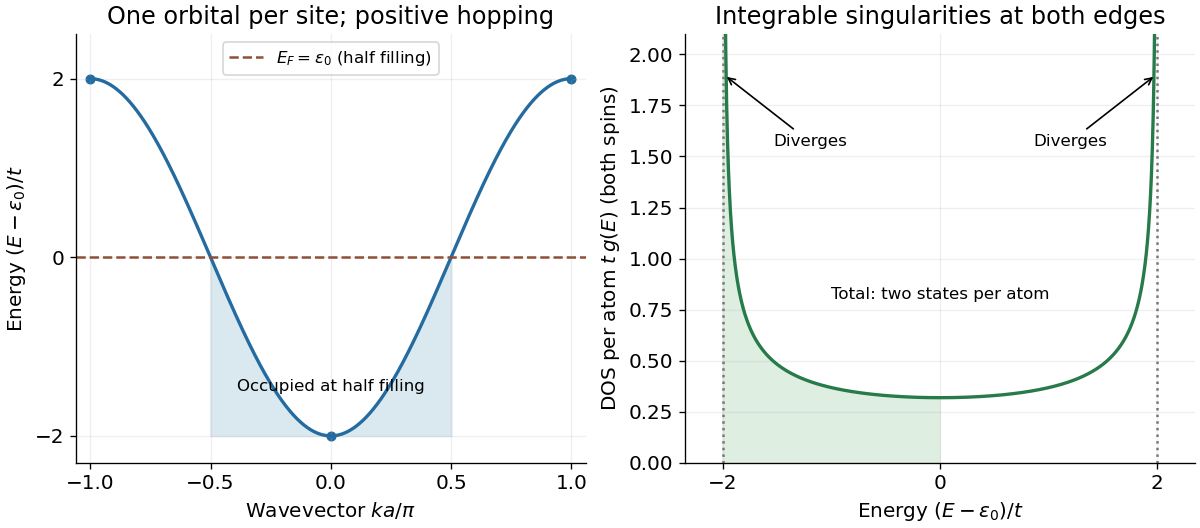
Monovalency gives one electron per atom, so the two-spin-state band is half filled. At zero temperature, occupying gives . HenceRelative to the band minimum, the Fermi energy is .
The density of states obeys . At , the Fermi-Dirac distribution satisfiesPairing the energies above and below the band centre therefore leaves exactly half of the two available states per atom occupied, at every positive temperature. Increasing strictly increases the mean particle number, so this solution at fixed half filling is unique. ConsequentlyThis particle-hole symmetry of a half-filled bipartite band argument uses the symmetric tight binding band and fixed half filling; it is not a general temperature-independence property of chemical potential in metals with additional bands or an asymmetric density of states.
The first Brillouin zone is the squareAt half filling, translation of the wavevector by exchanges the two band energies:Thus the same energy-pair argument as in part c givesAt zero temperature, the Fermi surface satisfies . Within the square Brillouin zone this is the diamondwhose vertices are and . The occupied region is the diamond's interior, containing the band minimum at the zone centre. It has half the Brillouin zone area, consistent with one electron per atom and two spin states per wavevector.
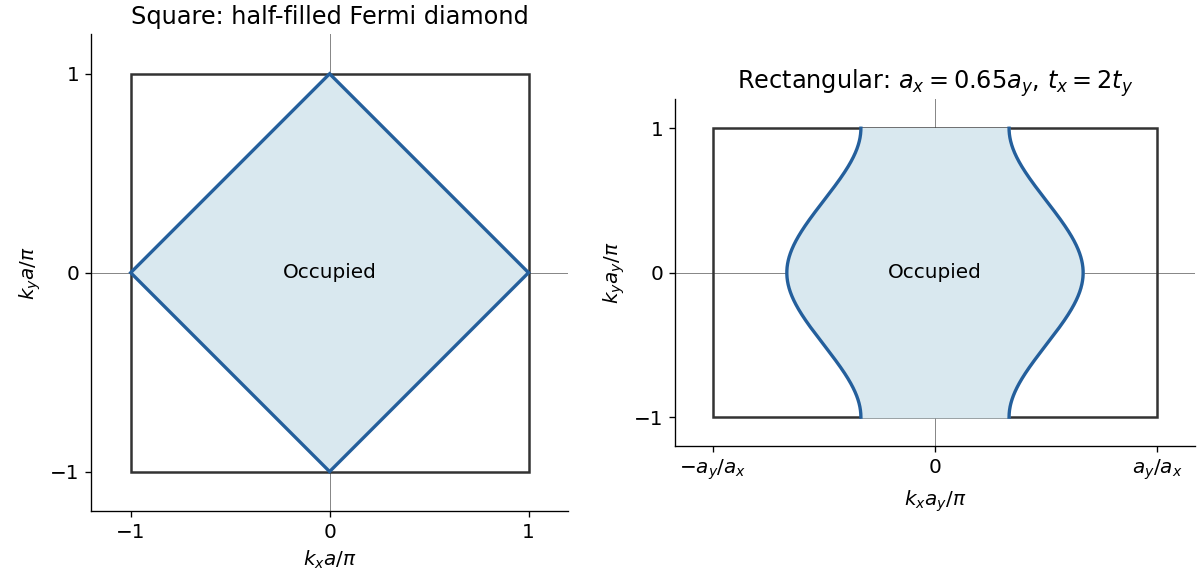


The reciprocal primitive vectors are and , so the first Brillouin zone isIt is wider in the direction because .
The geometry alone does not fix the hopping amplitudes or a unique Fermi surface. One consistent tight-binding model isrepresenting larger hopping between the closer atoms. It remains a nearest-neighbour bipartite band at half filling, so its chemical potential is . Its Fermi surface consists of the two sheetsThese meet the top and bottom zone edges and continue periodically into the neighbouring zones. The right panel of the figure gives an explicit example with and . The central region between the sheets is occupied and has half the zone area. If the hopping amplitudes instead remained equal, a geometrically stretched diamond would also satisfy the stated information. The metric inequality alone does not determine which of these shapes occurs.
Articles by others on the same topic
There are currently no matching articles.