Seek the travelling forced component of the surface elevation in the form , where and is a signed coefficient. The forcing has wavenumber one. Separation of variables in the Laplace equation, followed by the bed no-penetration boundary condition, givesSince , the surface kinematic boundary condition requires , soAt , . The dynamic member of the linearized free-surface boundary conditions therefore becomesConsequently the signed response and the nonnegative amplitude areThe travelling-pressure response of finite-depth surface gravity waves is opposite in phase to the imposed pressure below the resonant speed and in phase above it. These expressions describe the travelling forced component; freely propagating surface gravity waves can be superposed to meet additional initial conditions.
The denominator of the travelling response vanishes atFor the positive speeds in the paper, a finite travelling response exists whenever . At , the dynamic condition would reduce to , which is impossible. The finite-depth dispersion relation of a surface gravity wave with wavenumber is . At , its phase speed equals : the moving pressure pattern drives a natural surface gravity wave at its own speed, producing resonance.
The restriction concerns a bounded travelling response. To distinguish this from existence of a solution of an initial value problem, set , , and . Ifthe linearized free-surface boundary conditions reduce to the forced harmonic oscillatorFor example, if the forcing is switched on at from a flat surface with zero initial velocity, then, for ,This satisfies and contains both free oscillations and the forced component. At a solution of the initial value problem still exists, but its particular solution containswhich grows linearly with time. Thus the ideal inviscid flow model predicts resonant growth rather than a finite constant amplitude. Additional free oscillations can set the initial conditions but cannot remove that secular growth.
For , the nonnegative amplitude isIts first two derivatives are positive in this interval:The graph is increasing and convex, starts with a horizontal tangent at the limiting value , and has a vertical asymptote at . Therefore the hydrostatic lower bound for a travelling-pressure response isBecause the paper assumes , this is an infimum, approached as , rather than an attained minimum. If the stationary limit is admitted, equality holds: the hydrostatic equilibrium condition is . Near resonance,The divergence describes the linear model; sufficiently close to the small-disturbance assumptions fail. The lower bound and sketch refer to the travelling forced component, since adding free oscillations can change the instantaneous surface elevation.
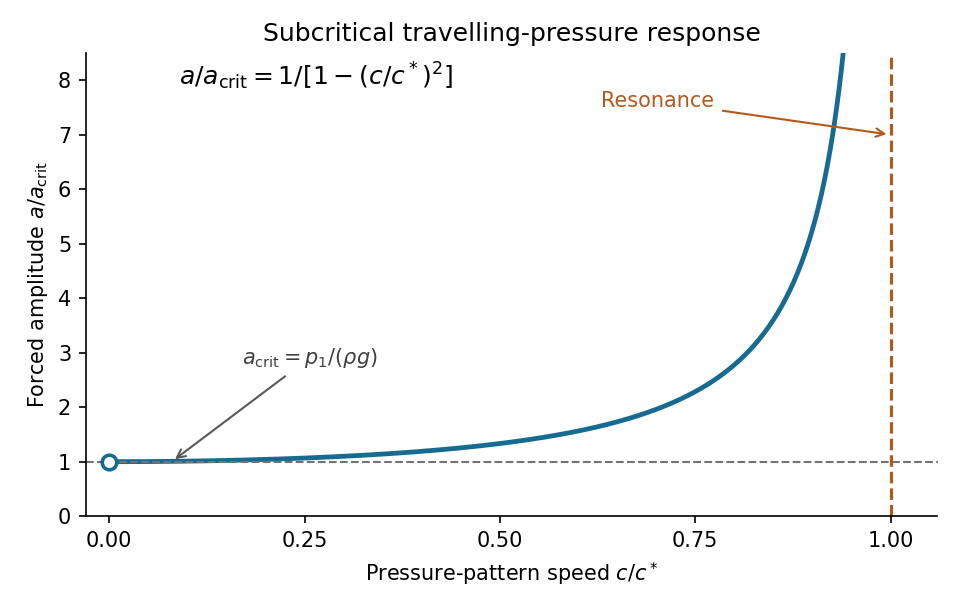
Subcritical travelling-wave amplitude rises from its hydrostatic lower bound and diverges at resonance
. Details. 
Articles by others on the same topic
There are currently no matching articles.