In the central classically forbidden region, define the positive decay momentum and the dimensionless action integral . The general leading WKB approximation isBoth coefficients are allowed: this interval has finite length, so the exponential that grows towards the barrier centre cannot be discarded by a condition at infinity. The WKB validity condition holds away from the classical turning point ; a local Airy function solution supplies its continuation there.
In the right-hand classically allowed region, put and . A convenient form of the general WKB approximation isThe phase origin is a choice of basis for the two oscillatory solutions, anticipating the Airy turning-point connection formula. Equivalently, one may use independent and branches. The coefficients have not yet been related to those in either forbidden region.
Beyond the outer classical turning point, let and . The bound state condition removes the growing branch at positive infinity, leavingHere is an arbitrary common amplitude pending the matching and wavefunction normalization. For the confining potential energy in the native diagram, the decaying branch gives the required exterior square-integrable function.
The WKB approximation fails at a simple classical turning point , because makes its amplitude singular and violates the WKB validity condition. Locally replace by . For a forbidden region on the right, and the rescaled coordinate changes the time-independent Schrödinger equation into the Airy ordinary differential equation . Reversing the coordinate handles a forbidden region on the left.
The two independent Airy functions have asymptotic forms, for ,Match these to the WKB approximation in an overlap region where the linearization of the potential energy and the large-argument asymptotic expansions both apply. If on the forbidden side and on the allowed side, the Airy turning-point connection formula isThus a decaying exponential acquires a factor two in its allowed-side amplitude, whereas a growing exponential does not. The phase convention uses positive integrals measured away from the classical turning point, so it applies at both ends of the well without an extra orientation sign. These are leading semiclassical matching rules for simple, separated classical turning points.
Use the amplitudes and positive action integrals of part (a), and define the right-well phaseMatching at the inner classical turning point gives , . Matching the exterior decaying wavefunction at the outer classical turning point givesThe trigonometric identitytherefore yieldsAll three pieces on are now fixed up to and :The Airy function descriptions replace the apparent singularities at the classical turning points. For the permitted energy eigenvalues, part (d) extends this right-hand wavefunction to the left by even or odd parity; is then determined by wavefunction normalization. At arbitrary , the decaying right-hand solution instead has a unique continuation by the Schrödinger equation, which need not decay at negative infinity.
For , the parity operator commutes with the Hamiltonian operator. Also , so its eigenvalues are and the energy eigenspaces admit a basis of definite parity. More strongly, nondegeneracy of one-dimensional bound states says that each bound state energy here is nondegenerate: the Wronskian of two solutions at the same energy is constant by the Schrödinger equation, and decay at infinity makes it zero, forcing linear dependence. Thus each bound state itself is even or odd.
An even function obeys the Neumann boundary condition ; an odd function obeys the Dirichlet boundary condition . WriteSmooth reflection symmetry gives , while . Hence, for the central WKB approximation from part (c),The two boundary conditions consequently give the WKB quantization condition for a symmetric double well:The full wavefunction is in the even case and in the odd case, with the value at zero fixed continuously. The relevant boundary condition makes these extensions differentiable at zero. Both action integrals depend on through the integrands and the classical turning points.
A tall, broad central potential barrier has . Let denote even parity and odd parity, and write , where . Since , the condition in part (d) givesThus the leading correction to the isolated-well Bohr-Sommerfeld quantization condition isThis is an implicit condition, with all action integrals evaluated at the corrected energy. To convert it into an explicit leading energy correction, let solve and define the full classical oscillation period in one well by . Differentiation of the action integral has no endpoint terms because , and givesConsequently, to leading exponentially small order within the WKB approximation,The even member lies below its odd partner. For an approximately harmonic oscillator well, , giving the familiar double-well tunneling splitting . The explicit energy formula retains only its leading exponential correction; varying and with the shifted energy also contributes at higher orders.
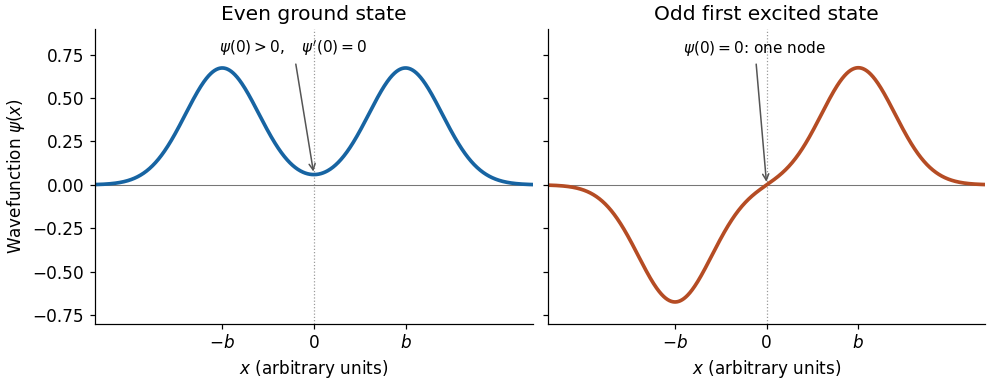
The ground state has an even, everywhere same-sign wavefunction with a peak in each well and a small nonzero value beneath the central potential barrier. Its derivative vanishes at zero. The first excited state is odd, has opposite-sign lobes in the two wells, and has exactly one interior node of a wavefunction, at zero. Both wavefunctions decay outside the wells. In terms of localized normalized wavefunctions , with overlap , their qualitative shapes are the lowest parity states of a symmetric double well:The overall sign of the odd wavefunction is arbitrary. The sketch uses localized Gaussian profiles to show the parity and the central node of a wavefunction, rather than claiming exact energy eigenfunctions for an unspecified potential energy.

Articles by others on the same topic
There are currently no matching articles.