Solutions to all three questions of the Further quantum theory course of the University of Oxford Part B examination, held on 29 May 2023. Source: original released PDF, bundle pages 268–271; paper pages 1–4. In question 2 the paper defines , a momentum; the corresponding wavenumber is . Keeping these distinct retains the paper's convention without setting the reduced Planck constant to one.
An irreducible spin representation is a nonzero Hilbert space with no proper nonzero closed invariant subspace under all three angular momentum operators. Equivalently, the associated unitary representation of SU(2) cannot be decomposed into two nonzero orthogonal invariant pieces. The irreducible possibilities are labelled by a spin and have dimension .
Choose an orthonormal basis , with . The angular momentum commutation relations imply , , , and . The complete action isIn particular, the spin raising operator annihilates and the spin lowering operator annihilates . The coefficient follows by taking the squared norm and using . Thus the ladder operators connect every member of the basis, while terminating at its two endpoints.
On the tensor product of spins and , the combined angular momentum operator is . The Clebsch-Gordan decomposition iswhere increases by one and each irreducible spin representation occurs once. The dimensions agree: .
The uncoupled orthonormal basis diagonalizes ; the coupled orthonormal basis diagonalizes . The Clebsch-Gordan coefficients are their change-of-basis entries, with conventionThey vanish unless . Since both bases are orthonormal, this change-of-basis matrix obeys unitarity. Overall phases of the coupled basis vectors are fixed by a convention and do not change the energy eigenvalues.
Write for the two eigenstates, of eigenvalues . The spin-spin interaction can be evaluated usingFor , take and . The unperturbed energy eigenvalues are on , respectively. For an isolated normalized energy eigenstate , first-order nondegenerate perturbation theory gives . The two antiparallel spins have expectation , soFor the zero-energy degenerate eigenspace, degenerate perturbation theory requires diagonalizing the restriction of . On the ordered basis it is : the ladder operators cannot take one parallel state to the other. Indeed neither parallel state couples to anything else under , so the remaining two levels are exactly , retaining their twofold quantum degeneracy.
For , take and , where . The spin-one-half triplet state basis and spin-one-half singlet state areThe identity gives unperturbed energy eigenvalues and . Direct action givesConsequently the restriction of to the entire triplet degenerate eigenspace is zero, so no first-order splitting is missed. The singlet expectation is also zero. In second-order nondegenerate perturbation theory, . Within the triplet, the corresponding second-order effective matrix is , already diagonal in this basis. Thus, through second order,The last two expressions have higher corrections beginning at , as the exact calculation in part (d) also verifies. For positive , coupling to the lower singlet raises the triplet's level and lowers the singlet; the signs are precisely the energy denominators above.
In the ordered product basis , the Hamiltonian operator has matrixThe middle block has characteristic polynomial . Hence the exact energy eigenvalues areThis is the Two-spin Heisenberg Hamiltonian in an opposing longitudinal field, with its interaction and field parameters rescaled to the paper's units. For positive and , the Taylor expansion giveswhich agrees with the first-order result of part (c). For positive and ,These agree with the second-order triplet and singlet results. If , their association with the signs reverses; if , the two antiparallel product-state labels reverse. The unordered exact spectrum and the perturbative expressions with their signed denominators remain valid.
Let exchange the two equal-spin factors, so . For the unperturbed Hamiltonian operator, addition of angular momentum givesFor nonzero , different have distinct energy eigenvalues, while each eigenspace has the values of . The stated symmetry of the Clebsch-Gordan coefficients gives the exchange parity of two coupled identical spins:However, changes sign: . For any two basis vectors in the same eigenspace, insertion of therefore givesThus the entire projected perturbation is zero, including its off-diagonal matrix elements. Degenerate perturbation theory now proves that every first-order-in- energy correction vanishes. This is first-order cancellation for an exchange-odd perturbation; checking only the individual diagonal expectations would not by itself settle a degenerate problem.
For , put and . Outside the support of the potential energy, a generalized eigenfunction of the Hamiltonian operator has the plane wave formHere denotes the support radius, to distinguish it from the quantum reflection probability . The momenta are and the velocities are . Thus describe incoming scattering channels from the left and right, and describe outgoing scattering channels towards the left and right. These energy eigenfunctions are not square-integrable functions; normalizable incoming wave packets are formed by superposition over energy, and their passage through the interaction region gives the physical quantum scattering experiment.
For incidence from the left, normalize and write . The quantum reflection amplitude is and the transmission amplitude is . The ratios of outgoing to incident probability currents defineNo extra velocity ratio occurs because both exterior regions have the same potential energy and mass. The scattering matrix, with a fixed choice of channel order, isIts first and second columns are the responses to unit incidence from the left and right, respectively. For a reflection-symmetric potential energy, these conventions give and .
For a real potential energy and a stationary state, the probability current isThe time-independent Schrödinger equation gives , so . In an exterior plane wave superposition, interference terms contribute no current andConsequently for every choice of incoming amplitudes. If , this says for every complex vector . Since is Hermitian, vanishing of its quadratic form implies that the matrix itself vanishes. ThereforeThe second identity follows by choosing . Since is a square matrix, the first also implies , proving unitarity. A real delta potential preserves this proof: continuity of and the real derivative jump make the current continuous across the interaction point.
Assume and put , , and . At a delta potential located at , integration of the Schrödinger equation gives the matching conditionsWriting the adjacent plane wave coefficients as and givesSolving these two linear equations yields the transfer matrix of a delta potential:For the symmetric double-delta potential, use separate plane wave pairs in , , and . Successive matching gives between the two exterior pairs. For real , multiplication givesThe determinant identity reads . Left incidence means , whenceHere the first relation also follows from . Therefore the requested transmission probability and quantum reflection probability, as functions of the printed momentum , areThey obey . As checks, gives , and the coincident limit gives , the answer for a single delta potential of strength .
Continue the transmission amplitude to complex wavenumber with , equivalently complex momentum . Then . In the left exterior region the term grows at negative infinity and the term decays; in the right exterior region the term grows and the term decays. A bound state thus requires , with nonzero . The transfer matrix relation gives . Equivalently, a zero of the incoming coefficient is a bound-state pole of , whose numerator is nonzero at .
The denominator found in part (c) givesFactorization produces two branches. To identify their parity, use an even interior wavefunction or an odd interior wavefunction for , joined to a decaying exterior wavefunction at . Continuity and the derivative jump give, respectively,Rearrangement gives the implicit energy eigenvalue equationsOnly strictly positive equation roots are retained. With , the even equation root lies above and the odd equation root, when it exists, lies below , so the even bound state has lower energy. The formal zero equation root in the odd equation does not itself establish a normalizable wavefunction.
For , the Hamiltonian operator is nonnegative: its quadratic form is . Thus it has no negative-energy bound states. A nonnegative-energy exterior wavefunction cannot be square integrable unless it vanishes identically, so there are no other bound states either.
For , set . The even equation is the zero of . Since , and , the intermediate value theorem and strict monotonicity give exactly one positive equation root.
The odd equation is the zero of . Here , , , and . If , strict concavity makes for every . If , initially increases, has exactly one maximum, and then decreases through zero exactly once. This proves the bound-state count of an attractive symmetric double-delta potential:At the threshold , the odd zero-energy solution is proportional to inside and to outside. It is bounded but not a square-integrable function, so it is a zero-energy scattering resonance rather than a second bound state. Each negative-energy bound state is either even or odd by nondegeneracy of one-dimensional bound states; the two branches above exhaust the count.
In the central classically forbidden region, define the positive decay momentum and the dimensionless action integral . The general leading WKB approximation isBoth coefficients are allowed: this interval has finite length, so the exponential that grows towards the barrier centre cannot be discarded by a condition at infinity. The WKB validity condition holds away from the classical turning point ; a local Airy function solution supplies its continuation there.
In the right-hand classically allowed region, put and . A convenient form of the general WKB approximation isThe phase origin is a choice of basis for the two oscillatory solutions, anticipating the Airy turning-point connection formula. Equivalently, one may use independent and branches. The coefficients have not yet been related to those in either forbidden region.
Beyond the outer classical turning point, let and . The bound state condition removes the growing branch at positive infinity, leavingHere is an arbitrary common amplitude pending the matching and wavefunction normalization. For the confining potential energy in the native diagram, the decaying branch gives the required exterior square-integrable function.
The WKB approximation fails at a simple classical turning point , because makes its amplitude singular and violates the WKB validity condition. Locally replace by . For a forbidden region on the right, and the rescaled coordinate changes the time-independent Schrödinger equation into the Airy ordinary differential equation . Reversing the coordinate handles a forbidden region on the left.
The two independent Airy functions have asymptotic forms, for ,Match these to the WKB approximation in an overlap region where the linearization of the potential energy and the large-argument asymptotic expansions both apply. If on the forbidden side and on the allowed side, the Airy turning-point connection formula isThus a decaying exponential acquires a factor two in its allowed-side amplitude, whereas a growing exponential does not. The phase convention uses positive integrals measured away from the classical turning point, so it applies at both ends of the well without an extra orientation sign. These are leading semiclassical matching rules for simple, separated classical turning points.
Use the amplitudes and positive action integrals of part (a), and define the right-well phaseMatching at the inner classical turning point gives , . Matching the exterior decaying wavefunction at the outer classical turning point givesThe trigonometric identitytherefore yieldsAll three pieces on are now fixed up to and :The Airy function descriptions replace the apparent singularities at the classical turning points. For the permitted energy eigenvalues, part (d) extends this right-hand wavefunction to the left by even or odd parity; is then determined by wavefunction normalization. At arbitrary , the decaying right-hand solution instead has a unique continuation by the Schrödinger equation, which need not decay at negative infinity.
For , the parity operator commutes with the Hamiltonian operator. Also , so its eigenvalues are and the energy eigenspaces admit a basis of definite parity. More strongly, nondegeneracy of one-dimensional bound states says that each bound state energy here is nondegenerate: the Wronskian of two solutions at the same energy is constant by the Schrödinger equation, and decay at infinity makes it zero, forcing linear dependence. Thus each bound state itself is even or odd.
An even function obeys the Neumann boundary condition ; an odd function obeys the Dirichlet boundary condition . WriteSmooth reflection symmetry gives , while . Hence, for the central WKB approximation from part (c),The two boundary conditions consequently give the WKB quantization condition for a symmetric double well:The full wavefunction is in the even case and in the odd case, with the value at zero fixed continuously. The relevant boundary condition makes these extensions differentiable at zero. Both action integrals depend on through the integrands and the classical turning points.
A tall, broad central potential barrier has . Let denote even parity and odd parity, and write , where . Since , the condition in part (d) givesThus the leading correction to the isolated-well Bohr-Sommerfeld quantization condition isThis is an implicit condition, with all action integrals evaluated at the corrected energy. To convert it into an explicit leading energy correction, let solve and define the full classical oscillation period in one well by . Differentiation of the action integral has no endpoint terms because , and givesConsequently, to leading exponentially small order within the WKB approximation,The even member lies below its odd partner. For an approximately harmonic oscillator well, , giving the familiar double-well tunneling splitting . The explicit energy formula retains only its leading exponential correction; varying and with the shifted energy also contributes at higher orders.
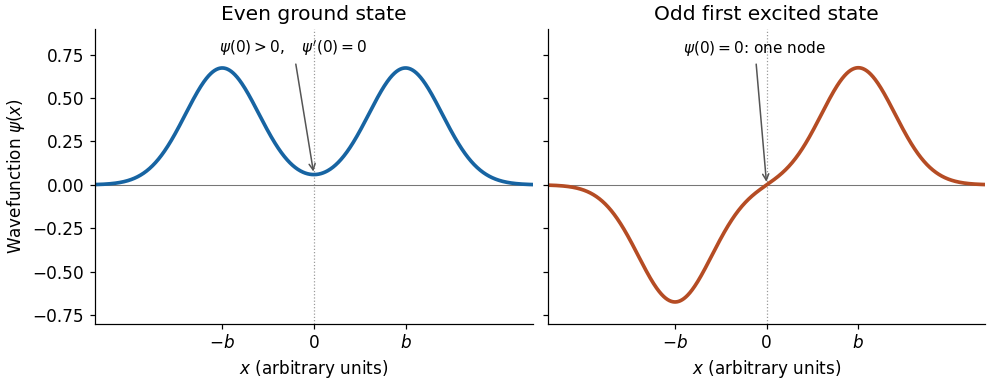
The ground state has an even, everywhere same-sign wavefunction with a peak in each well and a small nonzero value beneath the central potential barrier. Its derivative vanishes at zero. The first excited state is odd, has opposite-sign lobes in the two wells, and has exactly one interior node of a wavefunction, at zero. Both wavefunctions decay outside the wells. In terms of localized normalized wavefunctions , with overlap , their qualitative shapes are the lowest parity states of a symmetric double well:The overall sign of the odd wavefunction is arbitrary. The sketch uses localized Gaussian profiles to show the parity and the central node of a wavefunction, rather than claiming exact energy eigenfunctions for an unspecified potential energy.

Articles by others on the same topic
There are currently no matching articles.