A regular hypersurface , with , is a null hypersurface if its normal covector has zero squared norm:Its normal vector is then also tangent to the hypersurface; the induced metric tensor is degenerate.
For the Kerr metric the normal to a constant- surface has squared normFor the two roots are positive and distinct. To verify that they are genuine regular null hypersurfaces, rather than trusting singular Boyer-Lindquist coordinates, introduce ingoing Kerr coordinatesSubstitution givesThere are no terms. At either root , and the determinant is away from the angular coordinate poles. Thus the metric tensor extends smoothly across each root. The raised normal on either surface isThis is a nonzero null Killing vector field normal to the surface. Both surfaces are Killing horizons, with horizon angular velocities .
The event-horizon terminology in the paper needs qualification. In the usual asymptotically flat Kerr black hole extension, relative to a chosen exterior's future null infinity, the future branch of is the event horizon, the boundary . In the intervening black-hole region , the coordinate has timelike gradient and future-directed curves move toward smaller ; they cannot return across the outer boundary to that exterior. The inner surface is a Cauchy horizon, not a second event horizon for the same asymptotic end. Nullness is a local property; identifying an event horizon additionally requires this global causal structure.[ref]
General Relativity by David Tong. Sections 6.3.2 and 6.2.4: regular extension across the two Kerr roots, global diagram and the inner Cauchy horizon
The allowed endpoint provides an especially concrete counterexample to the unrestricted description of both roots. The Kerr metric then becomes Schwarzschild spacetime, is its regular event horizon, but is a curvature singularity:It is not a regular inner null hypersurface. Thus the two-horizon calculation above assumes .
The metric tensor is independent of and , soare commuting Killing vector fields. For they span the continuous Killing vector field algebra; every constant linear combination is also a Killing vector field. They express stationary spacetime and axial symmetry, respectively. At the allowed endpoint the spherical symmetry of Schwarzschild spacetime enlarges the algebra: in addition to , a basis of rotational Killing vector fields isTheir polar-coordinate expressions are singular at the axis, but the rotational fields are smooth there.
Let be the tangent to any affinely parametrized geodesic. For a Killing vector field ,This is the geodesic conserved quantity from a Killing vector. With , choose the energy and axial angular momentum conventionsFor a massive particle with proper time parameter these are per unit rest mass; for a null geodesic their common scale depends on the affine parameter normalization. Expanding in the supplied Boyer-Lindquist coordinates givesThe factor of two between and the coefficient of is essential for these signs and coefficients.
Reflection across is an isometry; a geodesic initially tangent to its fixed equatorial plane remains in that plane by uniqueness of the geodesic equation. Thus take , , and . Define the algebraic abbreviationsThe conserved quantities of part (b) becomeFor , inversion givesThe null condition can be written without expanding a quadratic square:Substituting the preceding expressions yields the equatorial Kerr null geodesic radial equationAn equivalent useful polynomial form isThese expressions use an affine parameter ; a common rescaling of and accompanies its rescaling. The inversion was performed in the exterior , where Boyer-Lindquist coordinates are regular. The polynomial radial identity has a smooth continuation to a horizon, but the formulas for and there must be replaced by regular-coordinate expressions. In the limit , the result reduces to the Schwarzschild spacetime equation .
The assertion about every exterior radius is false for geodesics. A circular orbit here means an equatorial null geodesic at constant , rather than a genuinely radial trajectory. A zero of the radial effective potential alone gives a turning point, not necessarily a circular orbit. The radial geodesic equation must hold as well.
Write andFor an exterior circular null geodesic, the two conditions are , equivalently with fixed. One way to justify the derivative condition without dividing by is to use the radial Euler-Lagrange equation. At constant it givesTogether with , and the fixed conserved , this is precisely the double-root condition for .
NowSetting this to zero and using givesA nontrivial exterior null geodesic cannot have here: the second equation would force , and then every tangent component would vanish. ThereforeBoth equations, with the same constants , are required. They give the requested radius relations in terms of the conserved quantities, while showing why an arbitrary exterior radius is not permitted.
For a more explicit classification let be the impact parameter. The second relation gives with . Substituting into the first relation yieldsFor , gives the prograde equatorial circular Kerr photon orbit and the retrograde one. The two allowed exterior radii areBoth are strictly greater than in the subextremal range. Squaring the signed radius equation gives , but introduces an additional inner root and loses the sign distinguishing the two senses of rotation. At the two exterior radii coincide at the photon sphere , with .
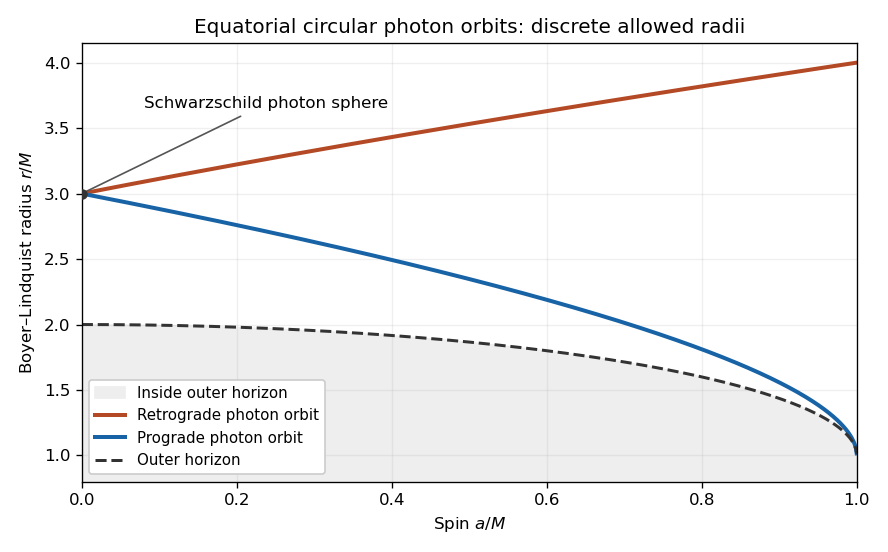

For a direct counterexample to the all-radii claim take and . Choose and so that . The radial geodesic equation nevertheless givesIt is a turning point, not a circular orbit. Alternatively, constant- null directions exist throughout the exterior because the two angular-velocity roots of are real; almost all of their integral curves require acceleration and fail the radial geodesic equation. This distinction explains how an all-radii assertion can arise.
Finally, itself has the null geodesic generators of its Killing horizon, proportional to . They are a separate horizon case. On the horizon is normal to every tangent, so its contractions with and both vanish: for a generator tangent. Its affine parameter can be chosen by rescaling that tangent. The exterior calculation dividing by does not include it. The presence of these generators does not supply circular null geodesics at the intervening arbitrary exterior radii.
Articles by others on the same topic
There are currently no matching articles.