Sequence divergence alone does not identify its cause. A difference can arise through mutation and spread through genetic drift, natural selection, or both. The useful comparison is with an explicit neutral expectation that accounts for shared ancestry, mutation rate and demographic history, rather than treating every conspicuous genomic difference as an adaptation.
First establish orthology, align homologous sequence accurately, and sample several individuals from each species. An apparent fixed difference in one pair of genomes may actually be segregating variation, an assembly error or comparison of paralogues. An outgroup can help polarize changes, although ancestral polymorphism and introgression can make different genomic regions have different histories. Estimate population size changes, migration and relatedness from many suitably chosen loci before interpreting an exceptional region.
For coding sequence, compare nonsynonymous and synonymous substitution rates per eligible site through the nonsynonymous-to-synonymous substitution rate ratio. A ratio greater than one in an appropriate branch or site model supports adaptive amino-acid substitution; a low average ratio indicates pervasive constraint but can hide positive selection at a few sites. A rise toward one can reflect relaxed purifying selection rather than adaptation. Synonymous sites are useful controls, not guaranteed neutral standards: codon usage, splicing regulation and mutation-context effects can matter.
Within-species polymorphism adds an independent timescale. In the McDonald-Kreitman test, let be nonsynonymous and synonymous fixed differences and their polymorphic counterparts. A simple neutral model predicts matching ratios. An excess is consistent with adaptive fixation, and the idealized estimatorestimates the adaptive fraction of nonsynonymous divergence. John H. McDonald and Martin Kreitman introduced this logic with the Drosophila Adh locus. Slightly deleterious variants inflate , demographic changes affect which variants persist, and low counts make the ratio unstable; the model and uncertainty must therefore be examined rather than interpreting every positive estimate literally.[ref]
Adaptive protein evolution at the Adh locus in Drosophila by John H. McDonald and Martin Kreitman. Polymorphism-divergence comparison and the Adh example
Other signatures are complementary. A recent selective sweep can reduce linked diversity and distort the site frequency spectrum and linkage disequilibrium. Excess differentiation measured by FST can suggest geographically divergent selection, but can also result from reduced within-population diversity or population history. Background selection can mimic some diversity reductions. Comparisons with matched recombination and mutation environments, demographic simulations and several independent populations help discriminate these explanations. Long-maintained variation can instead leave signatures of balancing selection.
Noncoding differences require their own functional tests. A conserved regulatory element with an accelerated lineage-specific substitution rate is a candidate for altered function, but altered mutation bias or GC-biased gene conversion can also produce rapid sequence change. Reporter assays, allele replacement and measurements of expression, phenotype and fitness connect a candidate to a mechanism. Demonstrating an effect on expression does not by itself establish an advantage in the historical environment.
The strongest inference combines an appropriate population-genetic null, agreement among independent signatures, and a functional explanation connected to reproductive success. Conversely, failure to reject neutrality means that the evidence does not discriminate the models at the available resolution; it does not prove that a difference has no effect.
Take selection for darker coats as the premise of the hypothetical example, rather than an established prediction about polar bears. The course of an adaptive walk depends on the available variation, its inheritance, fitness effects and ecological context. Warming alone does not specify a pigmentation mechanism, the strength of selection or whether dark coloration would improve total reproductive success.
The initial response can use standing genetic variation. If darker phenotypes already segregate and have an additive heritable component, a response can begin without waiting for a new mutation. The breeder's equation describes a short-term one-trait expectation under its assumptions. Here is the difference between the mean phenotype of successful parents and the population mean, while is narrow-sense heritability in the relevant environment. Environmental darkening without inherited differences does not supply the same response.
If useful variants are absent, arrival can limit adaptation. In a diploid population with census size and per-haploid-genome beneficial mutation rate , the approximate number of new beneficial copies is per generation. Most rare variants are lost initially. In a suitable large-population, weak-selection model, an allele whose heterozygote has advantage has establishment probability of approximately ; this is not a general formula for every dominance relation or bottleneck. The mutation supply depends on actual reproductive numbers, while effective population size controls much of the drift and inheritance history. Long generation times can make a short walk in generations slow in calendar years.
The genetic architecture matters. A change in pigment production, hair structure or the spatial regulation of a developmental pathway can have different pleiotropic consequences. A large-effect allele may be hidden when recessive, constrained by costs in another trait, or beneficial only after a change at another locus. Under sign epistasis, the sign of a step depends on the starting genotype; under diminishing returns, later favourable steps tend to have smaller benefits on an already adapted background. One-step-at-a-time fixation is only an approximation for a sexual, potentially polygenic population.
Recombination can assemble favourable variants inherited from different parents, but can also break favourable combinations. Gene flow can introduce useful alleles or oppose local adaptation if migrants come from a differently selected population. Population bottlenecks can remove rare variants and strengthen drift. Spatial differences in substrate, prey, mate choice or thermal conditions can maintain more than one coat phenotype instead of producing uniform dark fixation.
Finally, the fitness landscape can move while the population responds. Selection on survival, reproduction, energetic balance and correlated traits must be considered jointly. If demographic decline is faster than adaptive change, the existence of an accessible darker phenotype does not guarantee evolutionary rescue. No particular number of substitutions, waiting time or final shade follows from the premise alone. One would need measurements of inherited variation, population structure, generation time and the fitness of alternative phenotypes in the changing environment.
The target is genetic variation in a reaction norm: how pigmentation produced by a genotype changes with developmental temperature. A gene affecting pigmentation at every temperature is not necessarily a gene affecting plasticity. The design must estimate inherited differences in responsiveness separately from differences in baseline colour.
Raise replicated genotypes or families across several controlled developmental temperatures, distributing members of the same genetic background among environments. Standardize sex, age, nutrition, density and the body region scored; female posterior abdominal pigmentation is a useful defined trait. Randomize position and scoring order and quantify colour from calibrated images. Record viability and development time, since selective mortality can change the composition of survivors and imitate a plastic response. A parental common-garden generation and reciprocal crosses can help separate inherited nuclear effects from maternal or carry-over effects.
A simple mixed-effects model iswhere genotype and environment effects describe baseline differences and the shared temperature response, their interaction describes genotype-specific responses, and represents an appropriate block effect. Treating temperature as a continuous predictor gives genotype-specific slopes, but a curved response should not be forced into one line. Fit reaction norms with uncertainty and test whether their shapes differ.
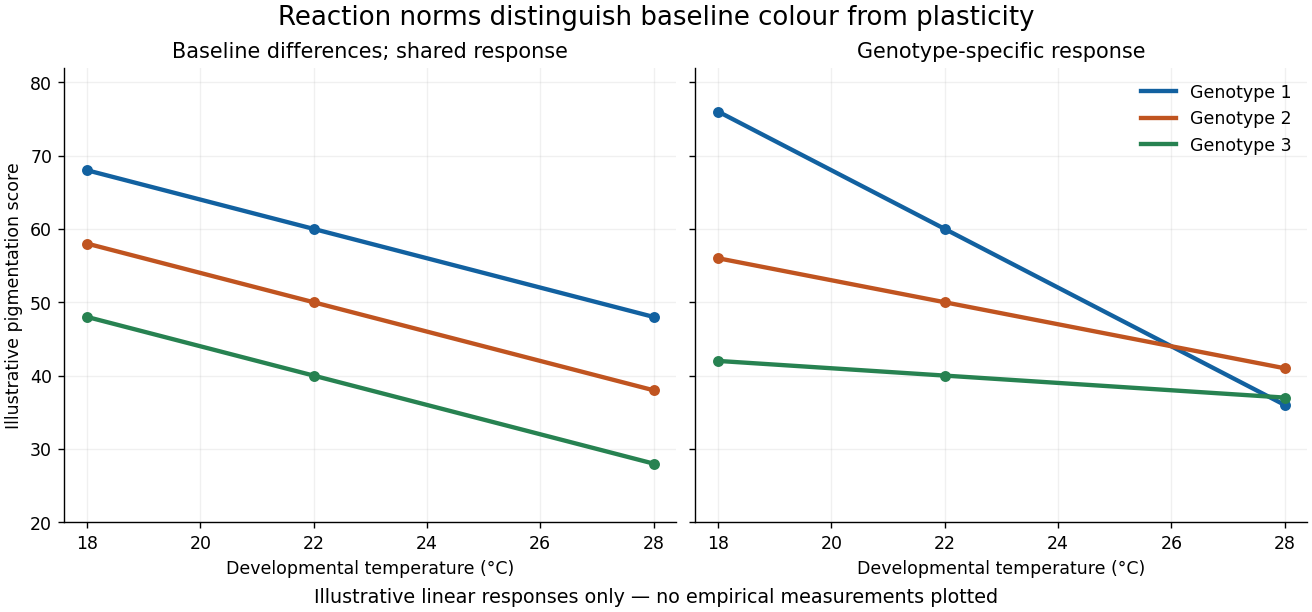
Illustrative pigmentation reaction norms separating baseline genetic differences from genotype-by-temperature interaction
. Details. 
Quantitative trait locus mapping in segregating crosses can locate loci affecting the temperature interaction. A genome-wide association study in a diverse panel can complement it, with controls for relatedness and population structure. Analyse the joint phenotype across temperatures, rather than comparing a significant association at one temperature with a nonsignificant association at another and calling the difference an interaction. Mapping resolution, power and multiple-testing correction determine how many candidate regions can be distinguished.
Follow candidates with staged expression measurements, chromatin assays and functional perturbations. A coding change might alter enzyme temperature sensitivity; a cis-regulatory change might alter where or when the enzyme is produced; a trans-acting chromatin or hormonal regulator could affect several pathways. Allele-specific expression in a shared trans environment can help distinguish cis from trans effects. Replacing an allele or rescuing a perturbation and then measuring the entire reaction norm tests causality more strongly than expression correlation alone.
The expectation is a context-dependent genetic network, potentially including pigmentation enzymes, developmental regulators and chromatin regulation. Jean-Michel Gibert and colleagues found temperature-sensitive regulation involving Abdominal-B, bric-à-brac and chromatin regulators in female abdominal pigmentation. That supports a distributed mechanism rather than a universal dedicated plasticity gene. It does not imply that the same causal variants explain every natural population or all body regions.[ref]
Phenotypic Plasticity in Drosophila Pigmentation Caused by Temperature Sensitivity of a Chromatin Regulator Network by Jean-Michel Gibert and others. Temperature, regional developmental regulation and pigmentation-enzyme expression
Thus one may find variants affecting baseline colour, slope or curvature, as well as environment-dependent dominance and epistasis. Some apparent interactions may disappear after controlling development stage or survival. Demonstrating heritable plasticity does not establish that it is adaptive: that further claim requires fitness comparisons in the relevant environments.
Evolutionary developmental biology has connected differences in form to changes in the developmental processes that construct it. Its central advance is a mechanistic bridge: homologous developmental systems can generate diverse morphology through changes in deployment, interaction and timing, rather than each lineage requiring an entirely new toolkit.
Conservation is itself informative. Homologous patterning genes and signalling pathways occur in animals with very different anatomies, so the presence of a familiar gene cannot alone explain a new structure. Differences can arise through altered expression domains, developmental timing, dosage, protein function or the interactions among tissues. Heterotopy, heterochrony and heterometry describe spatial, temporal and quantitative changes; they are descriptions to be linked to a molecular cause, not explanations by themselves.
Modular cis-regulation supplies a concrete route to change. An enhancer active in one developing structure can evolve while other enhancers preserve expression elsewhere. In sticklebacks, recurrent deletions of a pelvic enhancer of Pitx1 are associated with pelvic reduction. This distinguishes loss of a particular expression domain from complete loss of the multifunctional transcription factor. The study combined population variation and functional evidence rather than inferring mechanism from a sequence difference alone.[ref]
Adaptive evolution of pelvic reduction in sticklebacks by recurrent deletion of a Pitx1 enhancer by Yingguang Frank Chan and others. Tissue-specific regulation, recurrent deletion and pelvic morphology
Cross-species enhancer tests can establish stronger causality. Work on the ZRS enhancer of Sonic hedgehog showed altered limb-enhancer function in snake lineages; replacing the corresponding mouse enhancer with snake sequence produced a limb phenotype. Such experiments connect regulatory sequence to developmental output. Their interpretation remains context dependent: a sequence is being tested with the transcription factors, chromatin and tissues of the recipient animal, rather than reconstructing the complete ancestral organism.[ref]
Progressive Loss of Function in a Limb Enhancer during Snake Evolution by Evgeny Z. Kvon and others. Cross-species enhancer function and genomic replacement
The field also explains why the production of variation is structured. Developmental modularity can permit a local change with limited effects elsewhere, while pleiotropy and tissue interactions constrain accessible outcomes. Co-option recruits an existing regulatory programme into a new context. Gene duplication can allow functional divergence, although duplication by itself does not show which copy later caused a morphological change. Mechanical forces, cell behaviour and environmental sensitivity connect molecular changes to the resulting tissue geometry.
There are important limits. A developmental perturbation producing a resemblance is not necessarily the mutation that evolved historically. Expression correlations can be consequences of altered morphology, and viable laboratory effects do not establish a fitness advantage in nature. The fossil record and phylogeny are needed to order changes, population genetics to distinguish selection from drift, and ecology to explain which outcomes spread. Coding changes, regulatory changes, altered cell numbers and interactions among many small effects all contribute; there is no universal rule that morphology evolves only through enhancers.
The field has therefore advanced understanding substantially by replacing some pattern-based explanations with experimentally testable causal chains. It complements rather than replaces population-genetic and ecological accounts: development explains how variation is produced, and those accounts help explain its sorting and historical persistence.
Rapid artificial selection is often measured over a short interval during which breeders impose a consistent objective on a population containing useful inherited variation. Evolution in nature is not intrinsically incapable of comparable speed. The contrast arises from the strength and consistency of selection, accessible variation, competing fitness demands and the timescale on which change is measured.
In the one-trait breeder's equation, . Breeders can choose an extreme fraction of parents each generation, giving a large and consistently signed selection differential. They may also supply favourable food and protection that reduce viability costs of the selected trait. In nature, reproductive success integrates survival, mating and fecundity, so an improvement in the measured trait can be offset by a cost elsewhere.
For multiple traits, the short-term response is summarized by Lande's equationThe additive genetic covariance matrix can deflect the response away from the direction of the selection gradient . There may be little inherited variation along the direction that selection currently favours, even when each individual trait is heritable. Correlated responses and antagonistic pleiotropy can therefore slow change in one focal character without eliminating evolution altogether.
Natural selection also fluctuates through time and space. A drought can favour one phenotype and a later environment another; repeated changes partly cancel in the long-term net displacement. Peter R. Grant and B. Rosemary Grant documented changing directions and outcomes in a long-term study of Darwin's finches. Such observations show that a small endpoint difference can conceal substantial intervening evolution, rather than demonstrating persistent evolutionary inactivity.[ref]
Unpredictable evolution in a 30-year study of Darwin's finches by Peter R. Grant and B. Rosemary Grant. Long-term changes in body and beak traits
Gene flow can oppose local selection, and density or frequency dependence can move the optimum as a trait becomes common. An organism may already be near an ecological optimum, so stabilizing selection removes deviations that a breeder might deliberately amplify. Plasticity can buffer a new environment and reduce immediate selection on the underlying genetic trait. Alternatively, plasticity can expose new variation; its effect is not invariably to slow evolution.
Initial experimental responses can exploit standing variation and linkage disequilibrium that later disappear. Sustained change may then depend on mutation, recombination or a new environment. Artificially selected lines can reach plateaus, suffer inbreeding or show costs outside the selected environment. Comparing their first few generations with a natural lineage averaged over thousands of generations consequently exaggerates the general difference. Calendar time also matters: a species with a long generation interval has fewer opportunities for inherited change per year.
Finally, measured phenotypic change is not necessarily genetic evolution. Environmental trends can make wild populations change quickly without an inherited response, or conceal a genetic response by changing development in the opposite direction. Common-garden, pedigree or genomic evidence is needed to separate these effects. Strong short-term response under controlled selection and modest long-term net change in nature are compatible with the same inheritance and selection principles.
The selfish-invasion hypothesis concerns the origin and spread of introns, whereas current function concerns the consequences of their presence today. A sequence can begin by improving its own transmission, later become dependent on host machinery, and subsequently acquire a host-beneficial function. Conversely, present-day persistence need not mean that every intron was retained because it helps the organism.
Group II introns provide a mechanistic model for mobile, self-splicing ancestors of spliceosomal introns. Their structural and catalytic similarities to the spliceosome support a historical relationship, although the detailed route and timing of eukaryotic intron origins remain reconstructed hypotheses. In ordinary spliceosomal introns, many activities needed for RNA processing are supplied in trans by a shared cellular machinery rather than by a complete mobile apparatus encoded in each intron. This dependence limits autonomy but does not demonstrate that all selfish proliferation has ended.
Purifying selection constrains the burden. Insertions that disrupt coding information, essential regulation or reliable splicing can reduce host fitness. Intron loss can remove transcriptional, processing and mutational costs, and selection preserves splice signals needed to produce functional RNA. The balance depends on effective population size, mutation and loss rates, gene expression and the effect of a particular insertion. Weakly deleterious introns can persist when drift overwhelms selection; a large genome-wide intron count is therefore insufficient evidence for either universal adaptation or unrestricted selfish spread.
The host has also harnessed intronic sequence and the processing step. Alternative splicing can connect one gene to several regulated transcripts, while exon shuffling can rearrange protein modules. Introns can contain enhancers, microRNAs and small nucleolar RNAs; splicing can be coupled to RNA export and surveillance. Some alternative events regulate transcript abundance through nonsense-mediated decay rather than producing a stable alternative protein. These examples establish possible functions, not that every alternative isoform or every intronic base has been selected for such a function.
Specific experiments demonstrate functions that an origin story alone cannot predict. Julie Parenteau and colleagues found that deleting introns from budding-yeast genes often impaired performance during nutrient depletion and connected intron presence with control of growth-related expression. Jeffrey T. Morgan and colleagues identified excised introns that become stable linear RNAs under particular growth-inhibitory conditions and contribute to growth regulation. These are evidence for regulated intron-derived activity in defined conditions, not a license to regard all excised introns as functional.[ref]
Introns are mediators of cell response to starvation by Julie Parenteau and others. Intron-deletion phenotypes during nutrient depletion
[ref]Excised linear introns regulate growth in yeast by Jeffrey T. Morgan and others. Stabilized excised introns and growth control
To distinguish function from a correlated consequence, an intron deletion must be assessed for effects on expression, local DNA regulation and splicing, with rescue or appropriate sequence controls. Comparative conservation, turnover and experimentally measured fitness costs help determine whether host-level selection maintains a given feature. The extent of containment is thus substantial but incomplete and lineage dependent: shared processing and host selection constrain the elements, while retained introns span functional, tolerated and potentially deleterious cases.
There is no unconditional prediction that a difficult environment must increase both rates. Mutation produces new alleles, whereas recombination rearranges existing alleles; each can improve future variation while imposing an immediate cost. Predictions must distinguish a reversible physiological response from evolution of an inherited rate modifier, and predictable environmental cues from genuinely uninformative fluctuations.
In a well-adapted population, most new mutations are neutral or deleterious, so increased mutation can raise mutation load. During adaptation, a mutator can nevertheless become associated with a beneficial mutation that it generated and spread by genetic hitchhiking. This association is strongest in clonal populations and can be weakened by recombination. After adaptation, deleterious effects can favour lower rates again, although changing rate requires available modifiers and depends on drift and selection. A mechanism that raises mutation only in a particular stressed state can have a different long-term cost from a permanently high genomic rate.
Empirical support is conditional. Paul D. Sniegowski and colleagues observed spontaneous mutator evolution during long-term adaptation of laboratory bacteria. This demonstrates that rate evolution can occur; it does not establish that mutators always win in stressful conditions or that each mutation is directed toward the needed phenotype.[ref]
Evolution of high mutation rates in experimental populations of E. coli by Paul D. Sniegowski and others. Emergence of mutator lineages during adaptation
Increased recovery of selected variants is not itself a measured mutation-rate increase: differential growth, survival and pre-existing variants can change their frequency. Mutation-accumulation measurements, neutral reporters and appropriately interpreted fluctuation analyses address different parts of that problem.Recombination can assemble favourable alleles from different backgrounds and reduce Hill-Robertson interference. Under changing selection it can generate combinations not already common, but it can also break well-adapted combinations. In a simple two-locus model, recombination changes the frequency of the haplotype by , where . If favourable alleles are concentrated in competing and backgrounds, then and recombination produces more ; if , the immediate effect reverses. Thus an argument about recombination must specify the associations that selection and environment generate.
The Red Queen hypothesis gives a specific changing environment: coevolving parasites can repeatedly shift which host genotypes perform well. Levi T. Morran and colleagues found increased outcrossing under experimental host-parasite coevolution in nematodes. That supports a benefit of biparental reproduction in that system, but outcrossing is not identical to crossover frequency within meiosis, and the result is not a universal prediction for every abiotic challenge.[ref]
Running with the Red Queen: host-parasite coevolution selects for biparental sex by Levi T. Morran and others. Experimental changes in outcrossing under coevolution
Environmental predictability determines whether a cue-sensitive response is useful. A cue that forecasts a sustained new condition can favour one regulatory strategy; rapid, uncorrelated fluctuations can favour robustness, plasticity or diversified offspring instead. Long-term growth depends on compounded reproductive success, often represented by expected log fitness, rather than the arithmetic benefit in one favourable episode. Tests should therefore compare replicated populations and time courses, measure rate modifiers directly, and distinguish sexual reproduction, outcrossing, gene conversion and crossing over. The evidence supports several mechanisms for conditional increases, not a general law that adversity increases evolvability.
Articles by others on the same topic
There are currently no matching articles.