Define the salinity contrast , positive when the warm box is saltier. The linear equation of state gives the cold-minus-warm density contrast and signed volume fluxHere represents warm upper water travelling poleward and cold deep water returning equatorward. The in this question is the haline density coefficient, unrelated to the planetary vorticity gradient in Question 1. The imposed heating and cooling are taken to maintain .
For the positive circulation shown in the source diagram, the exact stationary salt budget of the cold box isThe precipitation adds no salt. Replacing the salinity multiplying the small compensating volume flux by a reference gives . When circulation reverses, the upstream box for the exchange reverses too: the homogenizing exchange is , not . In the same reference-salinity approximation the two stationary salt budgets reduce toFor example, when and , the exact cold-box balance is , giving and the same leading approximation.
Substitute into the density-driven volume flux and multiply by :Both and have the units of volume flux, so every term has units of squared volume flux. The absolute value expresses the fact that transport in either direction reduces the salinity contrast, while the density contrast sets its direction.
The requested equation is thus the reference-salinity, or virtual salt flux, version of the two-box overturning model. If the finite compensating flow is retained exactly with unequal , one has the appropriate upstream salinity on the right-hand side instead of exactly . The approximation assumes and . Also, for , cannot be a steady solution: the imposed freshwater transport would build an uncompensated salinity contrast.
Using the constants as printed, with volume flux measured in Sverdrups, givesIn particular the two small expansion coefficients should not be silently replaced by different oceanographic values.
For a positive steady volume flux, the equation in 2(a) is . For a negative steady volume flux, it is , with only its negative root admissible. Therefore for the branches areThe upper positive branch is stable, the lower positive branch is unstable, and the reversed branch is stable under the usual salt budget dynamics with fixed . Thus there is bistability below the positive-branch fold. At the fold the two positive equilibria merge with a zero restoring rate; the point is not an ordinary asymptotically stable interior point of either branch. The negative algebraic root of the positive- quadratic, or positive root of the negative- quadratic, must never be added as extra solutions.
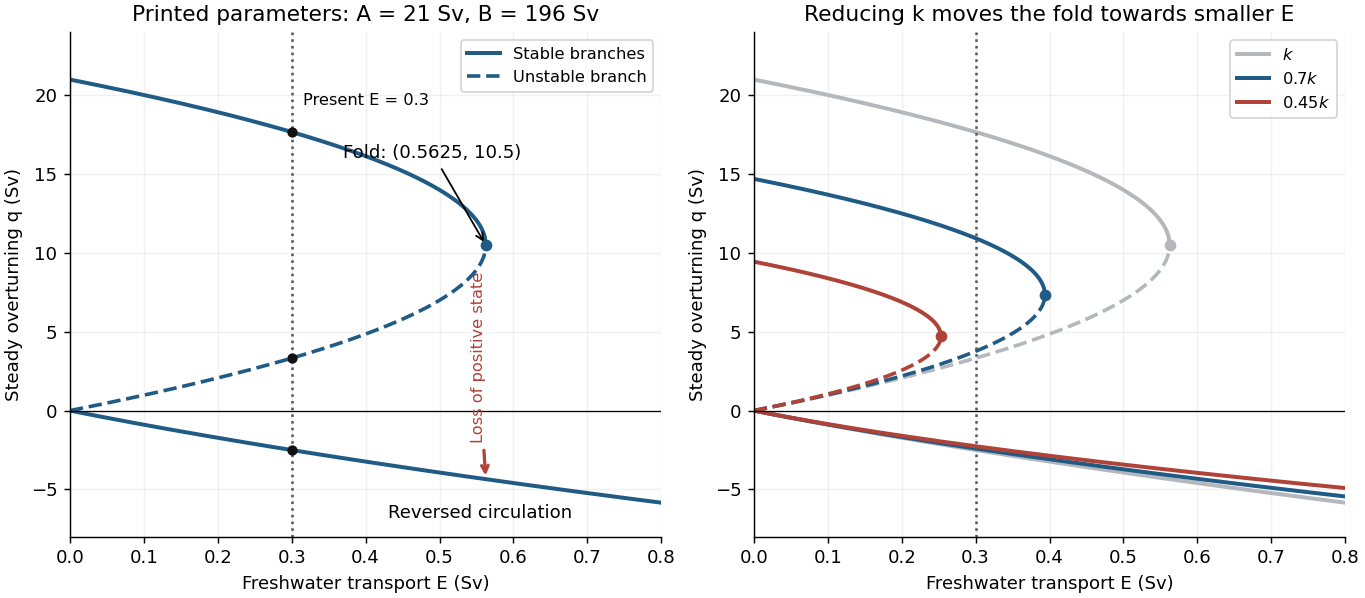
Steady overturning branches, their stability, and the effect of reducing the density-to-transport coefficient
. Details. 
At , the three steady volume fluxes areThe present thermally dominated, northward-upper-flow Atlantic meridional overturning circulation corresponds to . These algebraic data alone also allow a stable reversed state, so selecting the present branch uses the stated circulation direction. On the large positive branch, the predicted salinity contrast is , consistent with the reference-salinity approximation. The weaker branches give larger contrasts, approximately and , so the approximation is less accurate there.
The saddle-node bifurcation occurs atFor , only the reversed steady volume flux remains. At there are still two distinct values, the double positive root and the negative root; “single-valued” holds strictly above this threshold.
Slowly increasing from the present value causes the stable positive volume flux to weaken. Its salinity contrast then increases because salt exchange is weaker, reducing the cold-box density advantage further: this is the salt-advection feedback. At the fold the positive steady state disappears, producing an abrupt transition to the reversed branch in the quasistatic limit. At the same that branch hasFor a finite slow ramp there can be a small dynamical delay near the fold. In this model subsequently reducing while keeping it positive follows the stable reversed branch instead of automatically restoring the positive branch, an example of hysteresis. The two small branches approach as . At this is an equal-density, no-exchange equilibrium with , whereas the positive branch tends to with . One must use the original density relation at this endpoint, rather than divide by .
The reversal is thermally opposed but salinity driven: freshwater makes the cold box sufficiently fresh that the warm, salty box becomes denser. A real weakening would reduce the northward ocean heat flux and alter regional climate and ocean ventilation. The fold and full reversal here describe the ideal two-box overturning model; its numerical threshold is not a forecast for the real ocean, whose other controls appear in 2(c).
Northern high-latitude cooling removes heat from surface water and raises its density. If the surface water becomes denser than the water below, convection mixes it downward and forms dense water that can be exported in the deep southward branch of the Atlantic meridional overturning circulation. This water-mass transformation helps maintain the contrast represented by in 2(a). Freshening can oppose it by reducing density and increasing stable stratification. Local convection and the basin-integrated sinking volume flux are related but are not the same process: export and the return path also depend on the large-scale dynamics.
Dense water formed in marginal seas spills over sills and descends the continental slope as a marginal-sea overflow. Strong shear flow generates turbulent mixing and entrainment of surrounding, lighter water. The descending current's volume flux grows while its density anomaly is diluted, modifying the depth at which it joins the deep circulation and the temperature and salinity of the exported water. Thus the deep volume flux can substantially exceed the source overflow volume flux; it cannot be inferred from northern surface cooling alone.[ref]
https://www2.whoi.edu/staff/lpratt/wp-content/uploads/sites/120/2019/07/PrattSec2.11_11823.pdf. Anatomy of an overflow, section 2.11: observed downstream entrainment and dilution of the Faroe Bank Channel overflow
Southern Ocean westerly wind stress drives northward surface Ekman transport in the Southern Hemisphere. Its divergence and the circumpolar geometry allow deep water to rise towards the surface along tilted isopycnals, providing an important return route for the deep branch of the Atlantic meridional overturning circulation. Surface heat fluxes and freshwater fluxes then transform the upwelled water before it enters shallower return pathways. The winds supply mechanical energy; the overturning cannot be represented entirely by a local northern density difference. Eddy-induced overturning opposes part of the wind-driven contribution, so the net water-mass transformation and transport need not increase in direct proportion to the wind stress.[ref]
https://www.awi.de/en/science/climate-sciences/physical-oceanography/main-research-focus/southern-ocean-overturning-circulation.html. Alfred Wegener Institute, Southern Ocean overturning circulation: wind-driven upwelling and its opposition by mesoscale eddies
Deep currents and tides moving across rough topography, including the Mid-Atlantic Ridge, generate internal waves. Their breaking produces turbulent mixing across isopycnals, called diapycnal mixing. This transfers buoyancy between deep and overlying waters, transforms dense water into lighter water, and contributes to the upward return needed to close the overturning. The required mechanical energy ultimately comes from winds and tides; roughness is a mechanism for converting this input into mixing, rather than an independent source of energy. Mixing is spatially concentrated, and local vertical motion depends on the divergence of the turbulent buoyancy flux, so enhanced mixing does not imply uniform local upwelling everywhere over a ridge.[ref]
https://www.whoi.edu/cms/files/vmix_38943.pdf. The Impact of Abyssal Mixing Parameterizations in an Ocean General Circulation Model, abstract and introduction: tidal internal-wave generation over rough topography and its role in overturning
With the same prescribed , , and , replacing by changes both transport coefficients:Hence the positive steady volume fluxes becomeand the negative steady volume flux isThe bifurcation diagram undergoes a particularly simple rescaling:Thus it contracts horizontally and vertically by the same factor. Its branch stability and saddle-node bifurcation structure persist, but the range of freshwater forcing that admits the stable positive circulation shrinks. At a fixed subcritical , the upper stable positive branch weakens, the lower unstable positive branch moves upward, and the reversed branch decreases in magnitude. These changes reduce the separation of the positive equilibria and the margin against an overturning transition. The right panel of the figure in 2(b) shows this for and .
For the present , a positive steady state exists only ifAt equality the positive branches merge at ; below it only the reversed steady state remains. If a discovery merely revises our estimate of , it revises the inferred branch strengths and threshold, rather than itself causing an instantaneous physical transition. If the real effective were to decrease slowly through the critical value while stayed fixed, this model predicts loss of the positive steady circulation and transition to the reversed branch. Uncertainty in therefore translates directly into uncertainty in the model's freshwater threshold and its inferred proximity to a transition.
Articles by others on the same topic
There are currently no matching articles.