For a curve in the special orthogonal group, differentiate at the identity. This gives . Conversely, the matrix exponential of any real skew-symmetric matrix is orthogonal and has determinant . HenceA basis is for , where is a matrix unit. If and , their Lie brackets areThere are independent off-diagonal entries. A maximal torus rotates independently in mutually orthogonal two-planes, generated by . ThusThe maximality follows by simultaneously decomposing commuting real skew-symmetric matrices into rotation two-planes, with at most one remaining fixed axis.
The unbroken group is the stabilizer subgroup of the vacuum expectation value. For a nonzero vector vacuum expectation value, an orthogonal transformation puts . A special orthogonal transformation fixing it has the block form with . ConsequentlyThe zero vacuum expectation value leaves the entire special orthogonal group unbroken.
For a real symmetric tensor write its vacuum expectation value as a real symmetric matrix . The transformation is . The spectral theorem for real symmetric matrices gives an orthonormal basis in whichBecause is equivalent to , an unbroken transformation preserves each eigenspace. The complete unbroken group is thereforeIts identity component is . This symmetric tensor vacuum stabilizer shows why the representation alone does not determine a unique breaking pattern:
- If , all of survives, even when .
- If all eigenvalues are distinct, , consisting of diagonal sign changes with total sign ; no continuous symmetry survives.
- If the two eigenvalue multiplicities are and , then , with identity component .
For example a rank-one tensor preserves embedded by . Its continuous unbroken group is , but it also allows reversal of the distinguished axis. Restricting to a traceless symmetric tensor imposes and otherwise leaves the same classification.
The complexification of a Lie algebra gives of type Dn root system and of type Bn root system. For , the simple roots for and give a chain with two terminal nodes joined to . All edges are single. For , use for and . The Bn Dynkin diagram is a chain with a double final edge and an arrow pointing to the short node .
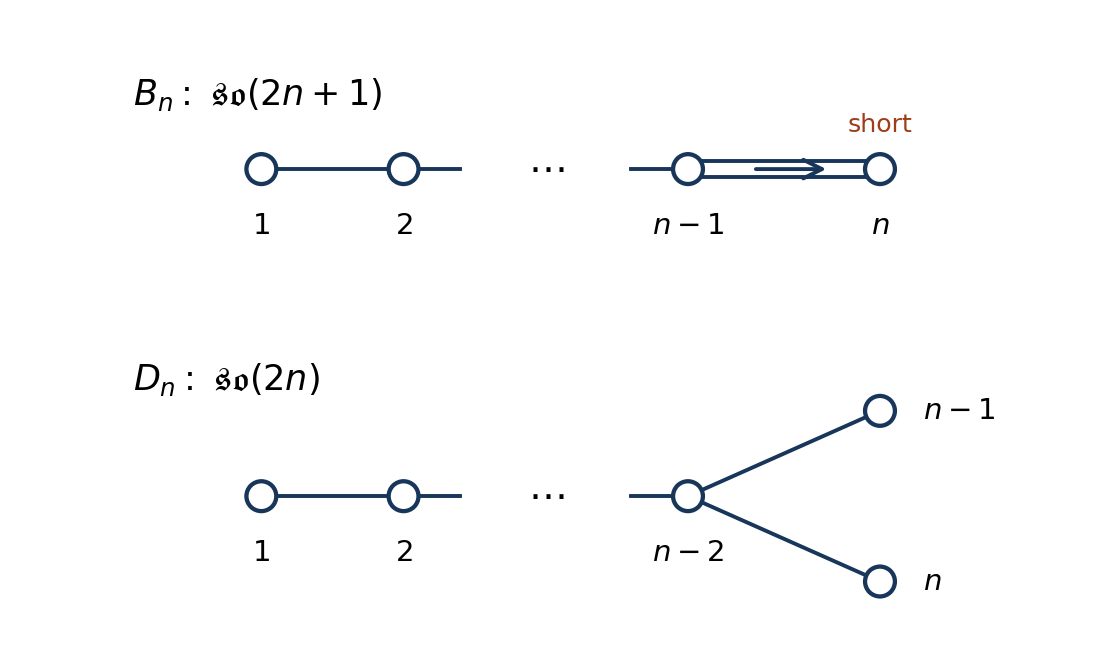
Dynkin diagrams of the odd and even orthogonal Lie algebras, with the final arrow pointing toward the short root
. Details. 
The usual family diagrams apply to for and for . The small cases are , , ; is one-dimensional and Abelian.
To fix Casimir normalization for orthogonal vector representations, use Hermitian Lie algebra generators , so the defining representation has Dynkin index . With long roots of squared length two, the quadratic Casimir operator has Casimir eigenvaluewhere is the Weyl vector and in the final expression is the column of Dynkin labels. The defining fundamental representation has highest weight in the stated family conventions.
For , the row supplied in the source has sum and first entry one, soFor , the supplied row has sum , givingTaking the trace of gives the relation between the Dynkin index and Casimir eigenvalue, . ThereforeThere is also a direct check: each coordinate appears in planes and , so .
If the Casimir operator is instead defined by , every Lie algebra generator is larger by and the corresponding answers are and . These are the same Lie algebra in a different normalization. At the exceptional small ranks the family Dynkin labels of the vector change, but the direct matrix computation remains valid.
In the normalization of c, the Adjoint representation of has highest weight , the highest root. The supplied Gram matrix has second row , whose sum is five. HenceThe Adjoint representation has the same dimension as the Lie algebra, so its Dynkin index is also . The Weyl fermions form a direct sum of vector representations; additivity of the trace gives .
Substitution into the given one-loop renormalization-group beta function yieldsFor positive , asymptotic freedom at this order requires a negative beta function, equivalentlyIndeed, if , integrating givesso the gauge coupling decreases towards zero as the energy scale increases. At the one-loop coefficient vanishes and the given equation cannot decide asymptotic freedom; has the opposite one-loop running.
With the alternative convention described in c, , , and the same source formula reads . Rescaling the gauge coupling together with the Lie algebra generators relates the conventions; the bound is identical.
Articles by others on the same topic
There are currently no matching articles.