On the space of endomorphisms of , left and right multiplication by commute, and is their difference. The binomial theorem therefore givesFor , every term has either or , so every term vanishes when . Restriction to the invariant Lie subalgebra provesThe argument works over every field; no division by a binomial coefficient is used.
We prove the common-zero-vector form of Engel's theorem by strong induction on the dimension of the acting Lie algebra of operators, allowing its action on a nonzero finite-dimensional space to have a kernel. The zero-dimensional case is immediate.
First, every proper Lie subalgebra has a strictly larger normalizer of a Lie subalgebra. The action of on by consists of nilpotent operators by part (a). Its image has dimension at most . By induction it has a nonzero common-zero vector , giving with . Hence .
Choose a maximal proper Lie subalgebra . The preceding paragraph forces , so is an ideal of a Lie algebra. Moreover has dimension one: otherwise any nonzero one-dimensional subspace of , which is a Lie subalgebra, would lift to an intermediate proper subalgebra. By induction the common kernelis nonzero. It is -invariant, since for , , . Take . Its restriction to is nilpotent and so has a nonzero vector in its kernel. As , this vector is killed by every element of :This completes the induction. The underlying space is understood to be nonzero, as required for the asserted vector to exist.
Start with the given basis of , and follow it by arbitrary lifts of the given basis of . Since is an invariant linear subspace, every acting endomorphism has block formwhere and are its matrices on and . Both are strictly upper triangular in the chosen bases. Therefore the whole matrix has zero entries on and below its diagonal. The same lifted basis works simultaneously for all elements of .
Use induction on . By part (b), there is a one-dimensional invariant linear subspace on which acts as zero. The induced operators on remain nilpotent, so induction gives a simultaneous strictly upper triangular basis there. Part (c) lifts it together with to such a basis of .
Thus all elements strictly lower one common complete flag. A nested Lie bracket of sufficiently many flag-lowering operators lowers it past zero. Consequently the lower central series of terminates, proving that the Lie algebra is nilpotent. In fact its nilpotency class is at most for ; the zero algebra covers the one-dimensional case.
A Cartan subalgebra is a nilpotent Lie subalgebra equal to its normalizer of a Lie subalgebra. Write for a choice attaining the minimum dimension, and let . For , the subalgebra is invariant under because . On , the operator induced by is invertible: is its full generalized zero eigenspace, and the finite-dimensional Fitting decomposition separates that from the invertible part.
The determinant of the operator induced by on is a polynomial in , nonzero at zero. Thus it is nonzero for all but finitely many . For these values, the generalized zero eigenspace lies in . Minimality of among elements from forces equality. Hence is nilpotent for all but finitely many .
Each nonleading coefficient of its characteristic polynomial is a polynomial in . Since is infinite, a polynomial vanishing at all but finitely many elements is identically zero. The coefficient of degree in the matrix entries is homogeneous of degree ; its highest possible coefficient is the corresponding characteristic coefficient of . All these vanish, so that operator has characteristic polynomial and is nilpotent by the Cayley-Hamilton theorem. ThusFor existence, choose an of smallest dimension among all . Since , it also minimizes the same set with restricted to . Applying the proved statement makes every nilpotent. Engel's theorem makes nilpotent, and the allowed self-idealizer property makes it self-normalizing. Therefore it is a Cartan subalgebra, illustrating Cartan subalgebra existence from a minimal Engel subalgebra.
For the three-dimensional example, direct use of the brackets gives for every nonzero : the equations are the vanishing of all two-by-two minors of the two coordinate vectors, so they are proportional. Every nonzero nilpotent Lie algebra has a nonzero center, as seen from its last nonzero lower-central term. A nilpotent subalgebra with a central nonzero element must therefore satisfy , and has dimension one. The zero subalgebra is not self-normalizing. Thus all Cartan subalgebras have dimension one. For example is nilpotent and its normalizer is , so such subalgebras do occur.
Use the standard split weight-space decomposition in characteristic zero, in particular the usual complex setting: , with generalized weights for the nilpotent algebra . The characteristic-zero condition prevents nonzero weight shifts from wrapping around; the unrestricted positive-characteristic version would need additional hypotheses.
For fixed , let . On a bracket of vectors from , the derivation identity givesIterating it gives the binomial expansion of these two commuting actions. At power , each term kills at least one factor, because generalized weight vectors are killed by the th power of the corresponding shifted operator. Therefore the bracket lies in the generalized eigenspace for for every . Stabilization of kernels by dimension giveswhere when is not a weight.
Nilpotence of gives . If is a Cartan subalgebra and , the action of on this quotient consists of nilpotent operators. Engel's theorem supplies a nonzero coset killed by , giving with , a contradiction to self-normalization. Conversely, if and normalizes , then for each . Applying further powers of kills this vector because its restriction to is nilpotent. Hence . This proves the equivalence.
The operator sends into . Repetition follows a consecutive -string; after steps it must leave the weight set, because is the largest number of weights in any such string. Thus on every weight space and hence on .
Finally put and . Expand as the sum of all words of length , without commuting and . Acting on , each word follows weights with increasing by one at each step. Linear independence of in characteristic zero makes the successive weights distinct. A nonzero length- path would require different weight spaces, but . Every word therefore vanishes, giving
A reduced crystallographic root system in a real Euclidean space is a finite spanning subset not containing zero, with , closed under , and satisfying for all roots. A base of a root system is a vector-space basis such that every root has integer coefficients of one sign in that basis.
Choose not orthogonal to any root and call roots with positive. Let be the positive roots that cannot be written as a sum of two positive roots. Repeated decomposition terminates because each summand has strictly smaller positive -value in a finite set. Thus every positive root is a nonnegative integer combination of .
For distinct , : otherwise the allowed difference-root lemma would make either or positive, decomposing one of them. In a real linear relation among , move negative coefficients to the other side, obtaining as positive combinations with disjoint supports. Then , so . But a nonempty positive combination has , a contradiction. Thus the elements are linearly independent. They span every root and hence , proving existence of a base of a root system. The difference-root lemma is used only for distinct roots; that qualification excludes the zero difference.
For the displayed set, there are eight coordinate roots, twenty-four roots with two nonzero unit entries, and sixteen half-coordinate roots: forty-eight in total. It spans , is reduced, and has squared root lengths one and two. Signed coordinate permutations preserve it. Reflections in coordinate roots are sign changes, and reflections in roots are signed coordinate permutations. Every half-coordinate root is obtained by a signed permutation from , so it remains to check its reflectionIt sends to , a half-coordinate root; it fixes and sends to the negative sum of the other two coordinate vectors. For a half-coordinate root, the sum of its four signs is or ; the formula sends it, respectively, to itself, a coordinate root, or its negative when parallel to . Thus reflection closure holds. For a long root, the required Cartan integer is an integer dot product; for a coordinate root it is twice a half-integer; for it is . Symmetry gives the remaining cases. Therefore this is the F4 root system.
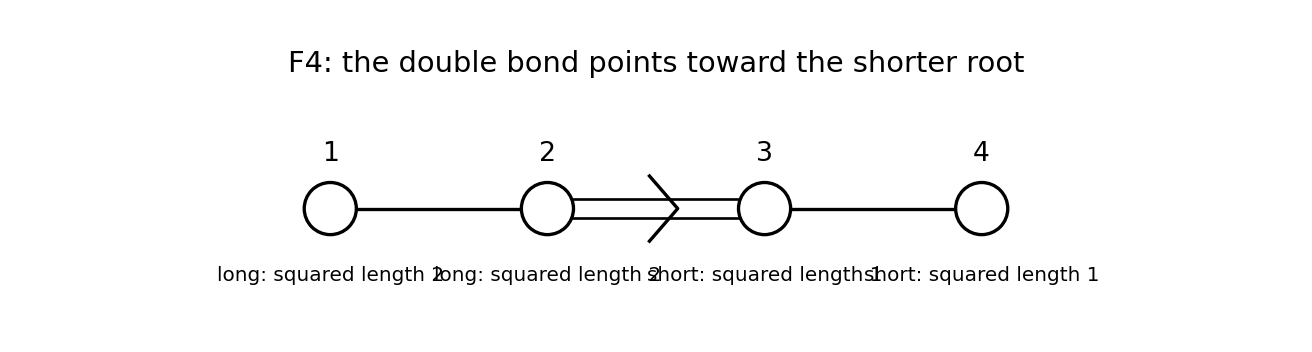
In the printed base order, the Gram matrix isUsing the convention , the Cartan matrix isThe row-coroot convention transposes this matrix. The Dynkin diagram is the chain , with the double bond pointing toward the shorter third root:

Articles by others on the same topic
There are currently no matching articles.