Source: Oxford mathematics examination release, private bundle
Part C 2007 11.pdf, pages 10–14. The printed Part C cover identifies mathematics, mathematics and philosophy, and mathematics and statistics. The complete editable transcription is retained in the private examination archive.On the space of endomorphisms of , left and right multiplication by commute, and is their difference. The binomial theorem therefore givesFor , every term has either or , so every term vanishes when . Restriction to the invariant Lie subalgebra provesThe argument works over every field; no division by a binomial coefficient is used.
We prove the common-zero-vector form of Engel's theorem by strong induction on the dimension of the acting Lie algebra of operators, allowing its action on a nonzero finite-dimensional space to have a kernel. The zero-dimensional case is immediate.
First, every proper Lie subalgebra has a strictly larger normalizer of a Lie subalgebra. The action of on by consists of nilpotent operators by part (a). Its image has dimension at most . By induction it has a nonzero common-zero vector , giving with . Hence .
Choose a maximal proper Lie subalgebra . The preceding paragraph forces , so is an ideal of a Lie algebra. Moreover has dimension one: otherwise any nonzero one-dimensional subspace of , which is a Lie subalgebra, would lift to an intermediate proper subalgebra. By induction the common kernelis nonzero. It is -invariant, since for , , . Take . Its restriction to is nilpotent and so has a nonzero vector in its kernel. As , this vector is killed by every element of :This completes the induction. The underlying space is understood to be nonzero, as required for the asserted vector to exist.
Start with the given basis of , and follow it by arbitrary lifts of the given basis of . Since is an invariant linear subspace, every acting endomorphism has block formwhere and are its matrices on and . Both are strictly upper triangular in the chosen bases. Therefore the whole matrix has zero entries on and below its diagonal. The same lifted basis works simultaneously for all elements of .
Use induction on . By part (b), there is a one-dimensional invariant linear subspace on which acts as zero. The induced operators on remain nilpotent, so induction gives a simultaneous strictly upper triangular basis there. Part (c) lifts it together with to such a basis of .
Thus all elements strictly lower one common complete flag. A nested Lie bracket of sufficiently many flag-lowering operators lowers it past zero. Consequently the lower central series of terminates, proving that the Lie algebra is nilpotent. In fact its nilpotency class is at most for ; the zero algebra covers the one-dimensional case.
A Cartan subalgebra is a nilpotent Lie subalgebra equal to its normalizer of a Lie subalgebra. Write for a choice attaining the minimum dimension, and let . For , the subalgebra is invariant under because . On , the operator induced by is invertible: is its full generalized zero eigenspace, and the finite-dimensional Fitting decomposition separates that from the invertible part.
The determinant of the operator induced by on is a polynomial in , nonzero at zero. Thus it is nonzero for all but finitely many . For these values, the generalized zero eigenspace lies in . Minimality of among elements from forces equality. Hence is nilpotent for all but finitely many .
Each nonleading coefficient of its characteristic polynomial is a polynomial in . Since is infinite, a polynomial vanishing at all but finitely many elements is identically zero. The coefficient of degree in the matrix entries is homogeneous of degree ; its highest possible coefficient is the corresponding characteristic coefficient of . All these vanish, so that operator has characteristic polynomial and is nilpotent by the Cayley-Hamilton theorem. ThusFor existence, choose an of smallest dimension among all . Since , it also minimizes the same set with restricted to . Applying the proved statement makes every nilpotent. Engel's theorem makes nilpotent, and the allowed self-idealizer property makes it self-normalizing. Therefore it is a Cartan subalgebra, illustrating Cartan subalgebra existence from a minimal Engel subalgebra.
For the three-dimensional example, direct use of the brackets gives for every nonzero : the equations are the vanishing of all two-by-two minors of the two coordinate vectors, so they are proportional. Every nonzero nilpotent Lie algebra has a nonzero center, as seen from its last nonzero lower-central term. A nilpotent subalgebra with a central nonzero element must therefore satisfy , and has dimension one. The zero subalgebra is not self-normalizing. Thus all Cartan subalgebras have dimension one. For example is nilpotent and its normalizer is , so such subalgebras do occur.
Use the standard split weight-space decomposition in characteristic zero, in particular the usual complex setting: , with generalized weights for the nilpotent algebra . The characteristic-zero condition prevents nonzero weight shifts from wrapping around; the unrestricted positive-characteristic version would need additional hypotheses.
For fixed , let . On a bracket of vectors from , the derivation identity givesIterating it gives the binomial expansion of these two commuting actions. At power , each term kills at least one factor, because generalized weight vectors are killed by the th power of the corresponding shifted operator. Therefore the bracket lies in the generalized eigenspace for for every . Stabilization of kernels by dimension giveswhere when is not a weight.
Nilpotence of gives . If is a Cartan subalgebra and , the action of on this quotient consists of nilpotent operators. Engel's theorem supplies a nonzero coset killed by , giving with , a contradiction to self-normalization. Conversely, if and normalizes , then for each . Applying further powers of kills this vector because its restriction to is nilpotent. Hence . This proves the equivalence.
The operator sends into . Repetition follows a consecutive -string; after steps it must leave the weight set, because is the largest number of weights in any such string. Thus on every weight space and hence on .
Finally put and . Expand as the sum of all words of length , without commuting and . Acting on , each word follows weights with increasing by one at each step. Linear independence of in characteristic zero makes the successive weights distinct. A nonzero length- path would require different weight spaces, but . Every word therefore vanishes, giving
A reduced crystallographic root system in a real Euclidean space is a finite spanning subset not containing zero, with , closed under , and satisfying for all roots. A base of a root system is a vector-space basis such that every root has integer coefficients of one sign in that basis.
Choose not orthogonal to any root and call roots with positive. Let be the positive roots that cannot be written as a sum of two positive roots. Repeated decomposition terminates because each summand has strictly smaller positive -value in a finite set. Thus every positive root is a nonnegative integer combination of .
For distinct , : otherwise the allowed difference-root lemma would make either or positive, decomposing one of them. In a real linear relation among , move negative coefficients to the other side, obtaining as positive combinations with disjoint supports. Then , so . But a nonempty positive combination has , a contradiction. Thus the elements are linearly independent. They span every root and hence , proving existence of a base of a root system. The difference-root lemma is used only for distinct roots; that qualification excludes the zero difference.
For the displayed set, there are eight coordinate roots, twenty-four roots with two nonzero unit entries, and sixteen half-coordinate roots: forty-eight in total. It spans , is reduced, and has squared root lengths one and two. Signed coordinate permutations preserve it. Reflections in coordinate roots are sign changes, and reflections in roots are signed coordinate permutations. Every half-coordinate root is obtained by a signed permutation from , so it remains to check its reflectionIt sends to , a half-coordinate root; it fixes and sends to the negative sum of the other two coordinate vectors. For a half-coordinate root, the sum of its four signs is or ; the formula sends it, respectively, to itself, a coordinate root, or its negative when parallel to . Thus reflection closure holds. For a long root, the required Cartan integer is an integer dot product; for a coordinate root it is twice a half-integer; for it is . Symmetry gives the remaining cases. Therefore this is the F4 root system.
In the printed base order, the Gram matrix isUsing the convention , the Cartan matrix isThe row-coroot convention transposes this matrix. The Dynkin diagram is the chain , with the double bond pointing toward the shorter third root:
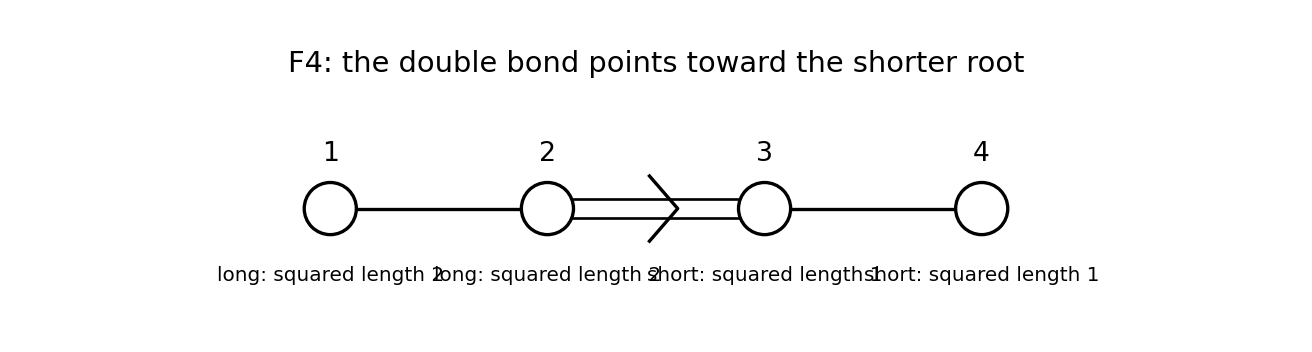

The associated symmetric positive definite form, normalized as a squared length, isIndeed it equalswhich is strictly positive for nonzero . The alternative Gram normalization is the same positive definite form up to a positive scalar.
A tabloid records the sets of entries in each row of a tableau. Let be the subgroup permuting entries independently within each column. The polytabloid isand the Specht module is spanned by these vectors. A standard polytabloid is one whose tableau increases along rows and down columns.
Order tabloids by first sorting each row increasingly, then comparing the resulting row-reading words lexicographically. For a standard tableau , every nonidentity column permutation produces a strictly larger word. In the first row affected by that permutation, each replacement comes from farther down the same column and is larger than the entry it replaces; all earlier rows remain unchanged. Sorting the affected row therefore increases its word. Also no nontrivial column permutation fixes its row sets, since a cell is the unique intersection of its row and column. Hence the least tabloid in is with coefficient one.
Distinct standard tableaux have distinct row tabloids. In a nonzero linear relation among their polytabloids, choose the least leading tabloid with a nonzero coefficient. None of the vectors with larger leading tabloids can contribute to it, so its coefficient cannot cancel. This contradiction proves linear independence of the standard polytabloids.
The hook length of a cell is one plus the number of cells to its right in the same row and below it in the same column. The hook-length formula isFor , with , the second-row hook product is . In the first row, the hooks are for and for , so their product is . ConsequentlyAt , interpret the second binomial coefficient as zero.
For a cycle type , the Murnaghan–Nakayama rule isThe sum is over partitions whose diagrams remain after removing the specified border strip; is the remaining cycle type, and the recursion ends with the empty character equal to one. At the identity, . Incompatible total sizes contribute zero.
For shape and a transposition, a horizontal strip in the bottom row leaves with positive sign; a vertical strip in the right column leaves with negative sign. Both remaining dimensions are one. Thus
For shape with , there are exactly two removable rim hooks of size two: the bottom row, leaving , and the final two cells of the first row, leaving . Both have height zero. A vertical pair cannot be removed while leaving a Young diagram because the first row is longer than the second by at least two.
For an integer partition , its Young diagram has left-justified cells in row . A Young tableau of shape is a filling of its cells. Under the usual standard numbering convention, a standard Young tableau uses each integer once and increases strictly along every row and down every column. For a different fixed ordered set of distinct labels, the same inequalities define the corresponding ordered-label version, which becomes standard after replacing its labels by their ranks.
First convert the printed cycle to one-line notation:Apply row insertion to these values, recording the insertion time in each new cell. The successive insertion-tableau row lists areTherefore the Robinson-Schensted-Knuth correspondence givesBoth have shape .
First prove preservation of the row and column inequalities for distinct ordered labels. If , row insertion appends it to the first row, and the inequalities remain valid. Otherwise let be the first position with . Replace by and insert the bumped in the second row. Its first larger entry is some with , because . Replace by and put the bumped in the new third-row cell.
The first-larger-entry choices preserve strict row order. At column , if the first-row entry is , while if it is the new . At column when , the unchanged lower entry satisfies . Every other old column keeps its previous inequalities. The new third-row entry is larger than the second-row first entry: for this is , while for it follows from . Thus the new shape is a Young diagram with strictly increasing rows and columns. This proves the insertion assertion for the ordered-label convention.
There is a numbering qualification in the literal standard convention of part (a). If uses exactly , an arbitrary missing natural number need not be . For example, inserting six into rows produces , which has the order inequalities but not the labels . Thus standardness with consecutive labels requires , or increasing relabelling afterward. The printed wording is retained in the private transcription; row insertion itself preserves the needed order structure.
The Robinson-Schensted-Knuth correspondence is a bijection between permutations and ordered pairs of standard Young tableaux of the same shape. Hence the class with shape has size . For , the hook lengths arewith product . The hook-length formula gives . Therefore
The symmetric group acts on tabloids by permuting their entries; extending linearly gives the permutation module . Its dimension isA tableau of type contains exactly copies of the label . Fix a numbering of the -diagram's cells by . For a filling , let the th row set of an associated -tabloid be the set of cell numbers whose labels in equal . This is a bijection from type- fillings to -tabloids.
Define by moving labels along the numbered positions: its label at cell is the old label at cell . The associated row set is then the image under of the old row set. Thus the bijection is equivariant, and its linear extension makes and isomorphic representations. Extend from group elements to the group algebra by linearity.
Young's rule states that in characteristic zero,where the Kostka number counts Semistandard Young tableaux of shape and type : rows are weakly increasing, columns strictly increasing, and label occurs times. The summands are irreducible Specht modules, and the coefficients are nonnegative integer multiplicities.
For type , all labels are distinct, so a semistandard tableau is precisely a standard Young tableau. Thus , and Young's rule givesThis is also the decomposition of the regular representation, since tabloids with one entry per row are naturally indexed by all permutations.
For shape and type both , column strictness makes every entry in row at least . All entries equal to one must therefore be in the first row, which has exactly that length; it is filled with ones. Remove that row and repeat after subtracting one from the remaining labels. Induction gives the unique filling whose th row consists of 's. Thus , and Young's rule proves that occurs exactly once.
More generally, if a semistandard filling of shape and type exists, its entries at most must lie in the first rows. Counting them givesThese are the inequalities defining the dominance order on partitions. Hence implies , and the asserted restriction on summands follows from Young's rule.
We calculate the exact multiplicity without using Young's rule, via a two-subset incidence realization of a two-row Specht module. Let be the permutation representation on unordered pairs from a six-element set, and the natural permutation representation on its singletons. The equivariant incidence mapis surjective: the transpose map sends to the pair coefficients , and all such sums can be zero only when every in characteristic zero. Thus .
Identify the tabloids of shape with their two-element bottom rows. A polytabloid is a signed four-edge vector , whose incidence at every vertex is zero. Hence . The standard polytabloid basis theorem and the hook-length formula give , so equality holds. By Maschke's theorem,Take , preserving blocks of sizes three, two and one. It has three orbits on singletons and five on pairs: pairs inside the first block, inside the second, and between each of the three distinct pairs of blocks. Thus and . Averaging over makes taking fixed vectors exact in characteristic zero, so .
Finally . Frobenius reciprocity, and equality of invariant and coinvariant dimensions in characteristic zero, identify the required multiplicity with this two-dimensional fixed space. Thereforewhich in particular satisfies the requested lower and upper bounds.
The simple modules are indexed by the p-regular partitions of , meaning no part is repeated or more times. Equip the tabloid permutation module with the bilinear form invariant under the symmetric group making its tabloid basis orthonormal. The construction isThe standard modular Specht theorem says this quotient is nonzero precisely for p-regular , is then simple, and these quotients give all simple modules.
To verify distinctness of labels, use the standard dominance triangularity theorem: if occurs as a composition factor of , then ; for a p-regular label the diagonal multiplicity is one. If , then occurs in , so , and the symmetric argument gives . Antisymmetry of the dominance order on partitions yields . These are the general representation-theoretic results allowed in this part.
Realize as the augmentation submoduleof the natural permutation module: its polytabloids are the differences , which span exactly . Let be a submodule. If it contains a vector with two unequal coordinates , thenThe coefficient is nonzero, so ; its symmetric-group orbit spans , forcing . Therefore every proper nonzero submodule consists only of constant-coordinate vectors. Those form at most a one-dimensional trivial submodule. If such a trivial submodule is absent, no proper nonzero submodule exists, so the Specht module is simple.
On a one-dimensional representation, acts by a nonzero scalar . Its square is one. The braid relation becomes , and hence . Thus all adjacent transpositions act by one common scalar with .
In characteristic different from two, or . Since adjacent transpositions generate the group, these choices give exactly the trivial representation and sign representation. For they coincide, leaving only the trivial representation.
In characteristic three with , a constant vector belongs to the augmentation submodule only if , which forces . Thus has no trivial submodule. Part (b) proves that it is simple, of dimension four, and therefore equals .
The standard polytabloid basis is defined over the integers and remains a basis after reduction modulo three. Thus . The given submodule has dimension four by part (d), so the quotient is one-dimensional and part (c) leaves only the trivial or sign action.
A transposition has ordinary trace one on : the Murnaghan–Nakayama rule has only the horizontal bottom-row two-strip, leaving shape with dimension one. Reduction of its integral action matrix preserves this trace in . Its trace on is , since the natural five-point permutation representation has three fixed coordinates and contains the trivial line. Therefore its trace on the one-dimensional quotient is , distinct from one in characteristic three. This gives the characteristic-three sign quotient of the Specht module of shape three two. The quotient is the sign representation:
Articles by others on the same topic
There are currently no matching articles.