For general coordinates expressed as functions of , the chain rule gives , whereThe Jacobian determinant is the oriented volume scaling of this linearized map. Thus the unsigned volume element transforms as . Where the coordinate change is invertible, the inverse Jacobian determinant is , by the Jacobian chain rule.
For cylindrical coordinates, use , , and unchanged height . Direct differentiation giveswhose determinant is . ThereforeBoth directions are displayed because “from Cartesian to cylindrical” can refer either to the derivative of the new coordinates or to the factor used in transforming a Cartesian volume integral. They are reciprocals; the cylindrical axis is a coordinate degeneracy.
Take spherical polar coordinates with polar angle measured from positive and azimuthal angle :The derivative matrix isExpanding its determinant gives . ThusThe inverse formula holds where and ; it excludes the origin and polar axis. These formulas use the general chain rule and determinant construction in solution.
Assume a positive common density scale and use the unit-radius coordinates of the source. The cylinder's density depends on distance from its axis. Its mass isThe radial factor in the cylindrical volume element cancels the apparent density singularity.
For the sphere, the spherical volume element givesThe condition is necessary for finite mass; the integral diverges for . Equating the two finite masses yields , and henceThis satisfies . A divergent pointwise density can therefore have finite total mass: the integrable power-law density at an axis or center must be tested together with its volume factor. Dimensionally, the density laws can be understood as and with unit radius in the chosen length units.
A scalar line integral is : it weights arc length by a scalar field and is unchanged by reversing orientation. A vector-work line integral is : it measures the tangent component of a vector field and changes sign under reversal. Both are invariant under a regular orientation-preserving reparametrization.
For the prescribed counterclockwise curve, traverse the upper semicircle from to , then the lower parabola from back to .
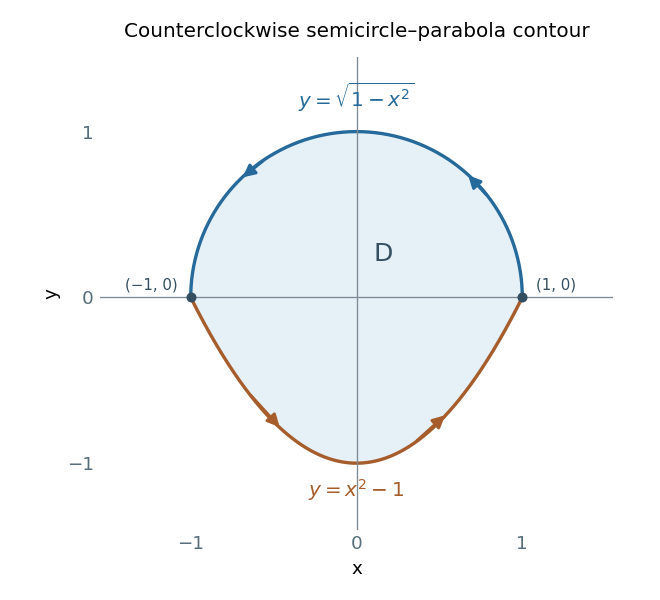
Counterclockwise contour formed by the upper unit semicircle and the lower parabolic arc.
The upper arc runs from right to left; the lower arc runs from left to right. The enclosed area is the sum of a semicircle and a parabolic segment. Details.
On the upper arc, use , , . Thenso its integral is : the last two terms integrate to zero by symmetry or direct integration. On the parabolic arc, use , for . Here andThereforeAs an independent check, Green's theorem gives the integrand . The region is symmetric in , so its odd part vanishes. Its area is , giving , exactly the same value.
Articles by others on the same topic
There are currently no matching articles.