Write , and . Since both moves have positive physical probability, the binomial options pricing model is free of arbitrage exactly whenIf , borrowing the share price and buying one share gives terminal gain or , both nonnegative and at least one positive. If , shorting one share and investing its proceeds gives the opposite comparison, with gain or . Equality at either endpoint still permits arbitrage because the other outcome has positive probability.
Conversely, strict inequalities give a risk-neutral probability , for which the discounted share is a martingale. Any zero-cost self-financing portfolio with nonnegative terminal value has zero discounted expectation under this equivalent positive-probability law and hence cannot have a strictly positive payoff in either state. Applying this argument conditionally at each node proves no-arbitrage over the tree.
A replicating strategy holds shares and a current cash amount in the bank account. Matching the two next values givesSolving this linear system,By no-arbitrage, the claim costs . Collecting the coefficients of its two future values yieldsThe physical probability does not appear: replication fixes the price of this contingent claim from traded prices.
Using the risk-neutral probability from part c, the stock tree has values initially, after one step, and after two. The American put option has terminal financial payoffs . Work backwards, comparing the immediate exercise payoff with its discounted continuation value.
At , continuation is , exceeding the zero exercise payoff. At , continuation is , while exercise pays three. Therefore exercise at the down node and continue at . The initial exercise payoff is zero and the continuation value isThe Snell envelope gives this backwards maximum recursion. For comparison, restricting exercise to expiry would give , so early exercise genuinely adds value.
For the forward-start call option, the strike is fixed by the intermediate stock price. The four path payoffs areThe same final price eight has different payoffs on the two middle paths, so one must retain the history at expiry. At time one, risk-neutral pricing gives and . ThusEquivalently, its value at the strike-fixing date is by homogeneity, so the martingale property of discounted stock prices gives the initial value .
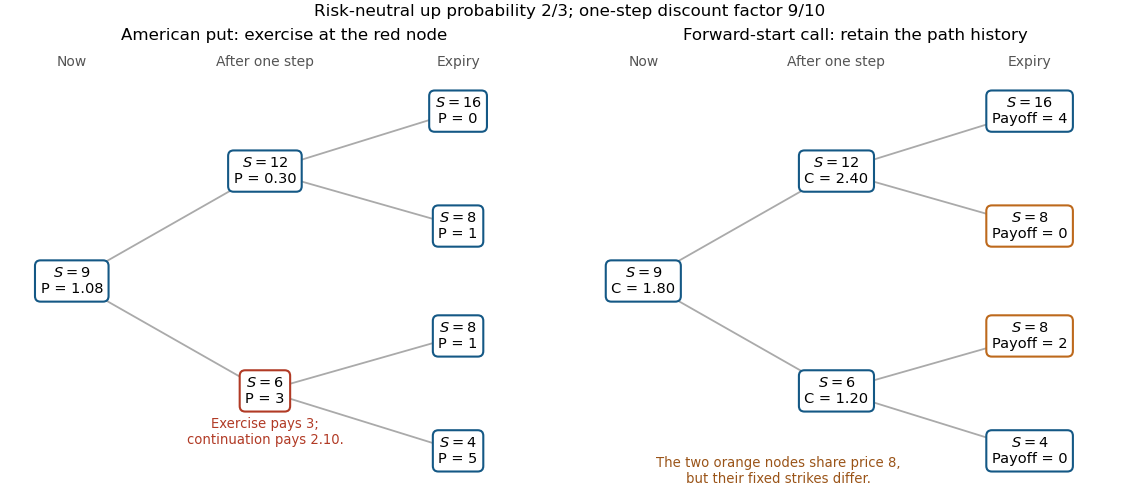
Two-step American-put exercise and forward-start call payoffs
. The American put is exercised at the down node after one step. The forward-start call has different payoffs on the two paths ending at stock price eight, because their strikes were fixed at different intermediate prices. Details.
Articles by others on the same topic
There are currently no matching articles.